

STUDIES ON THY: INSECT FAUNA ON SCOTCH BROOM
93
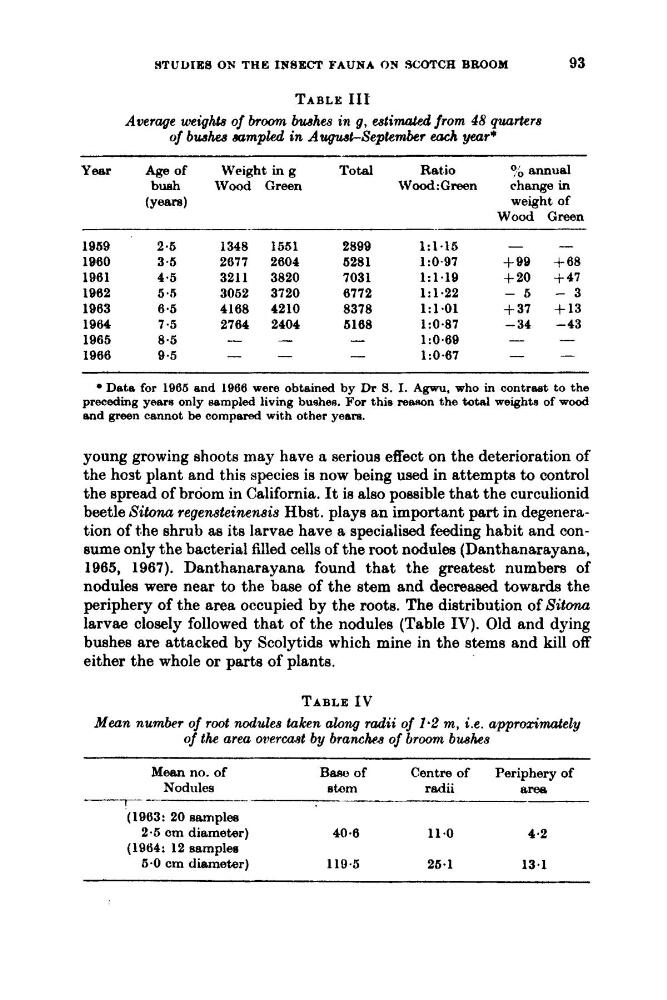
TABLE 111
Average weigh& of broom bushes an g , estimated from 48 quartere
of buahea sampled i n AugzlatSeptember each year*
~
~~~
~
~~
~~~
Year
Age of
Weight i n g
Total
Ratio
00 annual
bush
Wood Green
Wood:Green
change in
(Y-4
weight of
Wood Green
1969
1960
1961
1962
1963
1964
1965
1966
2 -6
1348
3.5
2677
4.5
321 1
5 *5
3062
6.6
4168
7.5
2764
8.5
-
9-5
-
1561
2604
3820
3720
4210
2404
2899
5281
7031
6772
8378
6168
1:1-15
1 :O-97
1:1.19
1:1*22
1:1*01
1:0*87
1:0*69
1:0*67
-
-
+99
+68
+20
+47
- 6
- 3
+37
+13
-34
-43
-
-
Data for 1966 and 1966 were obtained by Dc S. I. Agwu, who in contraat to the
preceding yeam only sampled living bushes. For this reason the total weights of wood
and green cannot be compared with other years.
young growing shoots may have a serious effect on the deterioration of
the host plant and this species is now being used in attempts to control
the spread of broom in California. It is also possible that the curculionid
beetle Sitonu regensteineneis Hbat. playa an important part in degeneration of Che shrub as its larvae have a specialised feeding habit and consume only the bacterial filled cells of the root nodules (Danthanarayana,
1965, 1967). Danthanarayana found that the greatest numbers of
nodules were near to the base of the stern and decmawd towarrds the
periphery of the area occupied by the roots. The distribution of B i t m
larvae closely followed that of the nodules (Table IV). Old and dying
bushes are attacked by Scolytids which mine in the stems and kill off
either the whole or parts of plants.
TABLE IV
Mean n u d e r of root nodules taken along radii of 1.2 m, i.e. approximately
of the area overcast by brancka of broom bushes
M a n no. of
Baa0 of
Centre of
Periphery of
Nodules
stom
radii
area
-
- -
7- --(1963: 20 samples
(1964: 12 samples
2-5 om diameter)
40.6
11.0
4.2
6.0 cm diameter)
110.5
26.1
13.1
93
TABLE 111
Average weigh& of broom bushes an g , estimated from 48 quartere
of buahea sampled i n AugzlatSeptember each year*
~
~~~
~
~~
~~~
Year
Age of
Weight i n g
Total
Ratio
00 annual
bush
Wood Green
Wood:Green
change in
(Y-4
weight of
Wood Green
1969
1960
1961
1962
1963
1964
1965
1966
2 -6
1348
3.5
2677
4.5
321 1
5 *5
3062
6.6
4168
7.5
2764
8.5
-
9-5
-
1561
2604
3820
3720
4210
2404
2899
5281
7031
6772
8378
6168
1:1-15
1 :O-97
1:1.19
1:1*22
1:1*01
1:0*87
1:0*69
1:0*67
-
-
+99
+68
+20
+47
- 6
- 3
+37
+13
-34
-43
-
-
Data for 1966 and 1966 were obtained by Dc S. I. Agwu, who in contraat to the
preceding yeam only sampled living bushes. For this reason the total weights of wood
and green cannot be compared with other years.
young growing shoots may have a serious effect on the deterioration of
the host plant and this species is now being used in attempts to control
the spread of broom in California. It is also possible that the curculionid
beetle Sitonu regensteineneis Hbat. playa an important part in degeneration of Che shrub as its larvae have a specialised feeding habit and consume only the bacterial filled cells of the root nodules (Danthanarayana,
1965, 1967). Danthanarayana found that the greatest numbers of
nodules were near to the base of the stern and decmawd towarrds the
periphery of the area occupied by the roots. The distribution of B i t m
larvae closely followed that of the nodules (Table IV). Old and dying
bushes are attacked by Scolytids which mine in the stems and kill off
either the whole or parts of plants.
TABLE IV
Mean n u d e r of root nodules taken along radii of 1.2 m, i.e. approximately
of the area overcast by brancka of broom bushes
M a n no. of
Baa0 of
Centre of
Periphery of
Nodules
stom
radii
area
-
- -
7- --(1963: 20 samples
(1964: 12 samples
2-5 om diameter)
40.6
11.0
4.2
6.0 cm diameter)
110.5
26.1
13.1