

PATTERN AND PROCESS IN COMPETITION
53
from two areas of typical forest habitat and introduced approximately
equal numbers of E. minimus and, likewise, introduced E. amoenus into
areas previously occupied by E . minimus. Introduced populations of
10 E. amoenus in each of two areas either failed to survive or dispersed
away from the alpine habitats where E . minimus had lived before. On
the other hand, of 15 E. minimus transplanted into E . amoenus habitat,
3 were recovered 1 year later, 1 was still present after 2 years, and an
immature E . minimus captured 2 years after the original introduction
was presumably the offspring of a pair of the introduced adults. Although the survival rate for the introduced E . minimus was not
particularly high, this experiment did show that they are capable of
living and probably reproducing in habitats from which they appear to
be excluded.
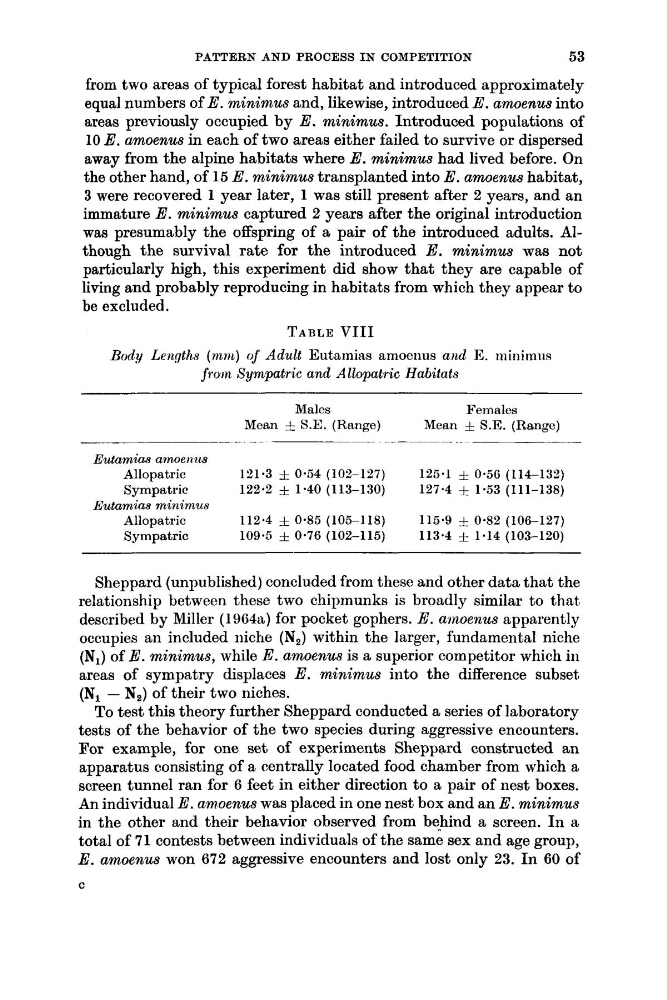
TABLE VIII
Body Lengths ( m n ~ )
of Adult Eutarniits amoenus and E. minimus
from Symputric and Allopatric Habitats
Malcs
Females
Mean & S.E. (Range)
Mean & S.E. (Range)
-.
._
. .
Eutarnias amoenus
Allopatric
121.3 f 0.54 (102-127)
125.1
0.5G (114-132)
Sympatric
122.2
1.40 (113-130)
127.4 f 1.53 (111-138)
Eutarnias mininaus
Allopatric
112.4 f 0.85 (105-118)
115.9 & 0.82 (106-127)
S ympatric
109.5 + 0.76 (102-115)
113.4 & 1.14 (103-120)
Sheppard (unpublished) concluded from these and other data that the
relationship between these two chipmunks is broadly similar to that
described by Miller (1 9G4a) for pocket gophers. E. amoenus apparently
occupies an included niche (N,) within the larger, fundamental niche
(N,) of E . minimus, while E. amoenus is a superior competitor which in
areas of sympatry displaces E. .minimus into the difference subset
(N, - N,) of their two niches.
To test this theory further Sheppard conducted a series of laboratory
tests of the behavior of the two species during aggressive encounters.
For example, for one set of experiments Sheppard constructed an
apparatus consisting of a centrally located food chamber from which a
screen tunnel ran for 6 feet in either direction to a pair of nest boxes.
An individual E . amoenus was placed in one nest box and an E . minimus
in the other and their behavior observed from be-hind a screen. In a
total of 71 contests between individuals of the same sex and age group,
E . amoenus won 672 aggressive encounters and lost only 23. In 60 of
C
53
from two areas of typical forest habitat and introduced approximately
equal numbers of E. minimus and, likewise, introduced E. amoenus into
areas previously occupied by E . minimus. Introduced populations of
10 E. amoenus in each of two areas either failed to survive or dispersed
away from the alpine habitats where E . minimus had lived before. On
the other hand, of 15 E. minimus transplanted into E . amoenus habitat,
3 were recovered 1 year later, 1 was still present after 2 years, and an
immature E . minimus captured 2 years after the original introduction
was presumably the offspring of a pair of the introduced adults. Although the survival rate for the introduced E . minimus was not
particularly high, this experiment did show that they are capable of
living and probably reproducing in habitats from which they appear to
be excluded.
TABLE VIII
Body Lengths ( m n ~ )
of Adult Eutarniits amoenus and E. minimus
from Symputric and Allopatric Habitats
Malcs
Females
Mean & S.E. (Range)
Mean & S.E. (Range)
-.
._
. .
Eutarnias amoenus
Allopatric
121.3 f 0.54 (102-127)
125.1
0.5G (114-132)
Sympatric
122.2
1.40 (113-130)
127.4 f 1.53 (111-138)
Eutarnias mininaus
Allopatric
112.4 f 0.85 (105-118)
115.9 & 0.82 (106-127)
S ympatric
109.5 + 0.76 (102-115)
113.4 & 1.14 (103-120)
Sheppard (unpublished) concluded from these and other data that the
relationship between these two chipmunks is broadly similar to that
described by Miller (1 9G4a) for pocket gophers. E. amoenus apparently
occupies an included niche (N,) within the larger, fundamental niche
(N,) of E . minimus, while E. amoenus is a superior competitor which in
areas of sympatry displaces E. .minimus into the difference subset
(N, - N,) of their two niches.
To test this theory further Sheppard conducted a series of laboratory
tests of the behavior of the two species during aggressive encounters.
For example, for one set of experiments Sheppard constructed an
apparatus consisting of a centrally located food chamber from which a
screen tunnel ran for 6 feet in either direction to a pair of nest boxes.
An individual E . amoenus was placed in one nest box and an E . minimus
in the other and their behavior observed from be-hind a screen. In a
total of 71 contests between individuals of the same sex and age group,
E . amoenus won 672 aggressive encounters and lost only 23. In 60 of
C