

52
RICHARD S. MILLER
greater distances in the open and making greater use of alternate forms
of cover such as fell boulders and logs. Other ecological differences such
as food habits were not great, and could be explained by the frequency
occurrence of particular food species within the different .habitats,
rather than an expressed preference. There is, however, a difference in
the body sizes of the two species and corresponding differences in
aggressive behavior.
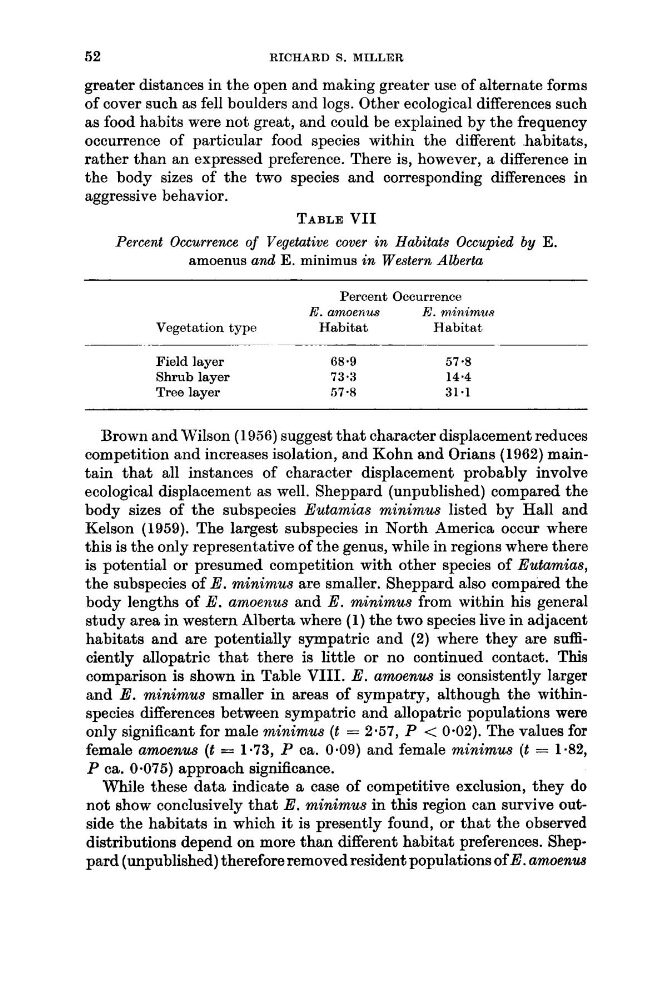
TABLE VII
Percent Occurrence of Vegetative cover in Habitats Occupied by E.
amoenus and E. minimus in Western Alberta
Percent Occurrence
E. amoenus
E. minimus
Vegetation type
Habitat
Habitat
-
. ~~
Field layer
68.9
57 *8
Shrub layer
73.3
14.4
Tree layer
87.8
31-1
Brown and Wilson (1956) suggest that character displacement reduces
competition and increases isolation, and Kohn and Orians (1962) maintain that all instances of character displacement probably involve
ecological displacement as well. Sheppard (unpublished) compared the
body sizes of the subspecies Eutamias minimus listed by Hall and
Kelson (1959). The largest subspecies in North America occur where
this is the only representative of the genus, while in regions where there
is potential or presumed competition with other species of Eutamias,
the subspecies of E. minimus are smaller. Sheppard also compared the
body lengths of E. amoenus and E. minimus from within his general
study area in western Alberta where (1) the two species live in adjacent
habitats and are potentially sympatric and (2) where they are sufficiently allopatric that there is little or no continued contact. This
comparison is shown in Table VIII. E. amoenus is consistently larger
and E. minimus smaller in areas of sympatry, although the withinspecies differences between sympatric and allopatric populations were
only significant for male minimus (t = 2-57, P < 0.02). The values for
female amenus (t = 1-73, P ca. 0.09) and female minimus (t = 1.82,
P ca. 0.075) approach significance.
While these data indicate a case of competitive exclusion, they do
not show conclusively that E. minimus in this region can survive outside the habitats in which it is presently found, or that the observed
distributions depend on more than different habitat preferences. Sheppard (unpublished) therefore removed resident populations of E . amoenus
RICHARD S. MILLER
greater distances in the open and making greater use of alternate forms
of cover such as fell boulders and logs. Other ecological differences such
as food habits were not great, and could be explained by the frequency
occurrence of particular food species within the different .habitats,
rather than an expressed preference. There is, however, a difference in
the body sizes of the two species and corresponding differences in
aggressive behavior.
TABLE VII
Percent Occurrence of Vegetative cover in Habitats Occupied by E.
amoenus and E. minimus in Western Alberta
Percent Occurrence
E. amoenus
E. minimus
Vegetation type
Habitat
Habitat
-
. ~~
Field layer
68.9
57 *8
Shrub layer
73.3
14.4
Tree layer
87.8
31-1
Brown and Wilson (1956) suggest that character displacement reduces
competition and increases isolation, and Kohn and Orians (1962) maintain that all instances of character displacement probably involve
ecological displacement as well. Sheppard (unpublished) compared the
body sizes of the subspecies Eutamias minimus listed by Hall and
Kelson (1959). The largest subspecies in North America occur where
this is the only representative of the genus, while in regions where there
is potential or presumed competition with other species of Eutamias,
the subspecies of E. minimus are smaller. Sheppard also compared the
body lengths of E. amoenus and E. minimus from within his general
study area in western Alberta where (1) the two species live in adjacent
habitats and are potentially sympatric and (2) where they are sufficiently allopatric that there is little or no continued contact. This
comparison is shown in Table VIII. E. amoenus is consistently larger
and E. minimus smaller in areas of sympatry, although the withinspecies differences between sympatric and allopatric populations were
only significant for male minimus (t = 2-57, P < 0.02). The values for
female amenus (t = 1-73, P ca. 0.09) and female minimus (t = 1.82,
P ca. 0.075) approach significance.
While these data indicate a case of competitive exclusion, they do
not show conclusively that E. minimus in this region can survive outside the habitats in which it is presently found, or that the observed
distributions depend on more than different habitat preferences. Sheppard (unpublished) therefore removed resident populations of E . amoenus