

288
J . A. KITCHING A N D F. J. EBLINQ
by Naylor (1958), and in the starfish Luidia sarsi by Fenchel (1965).
These rhythms, in Lough Ine, appear to separate predator and prey,
and may serve to prevent over-predation, and thus to stabilize the
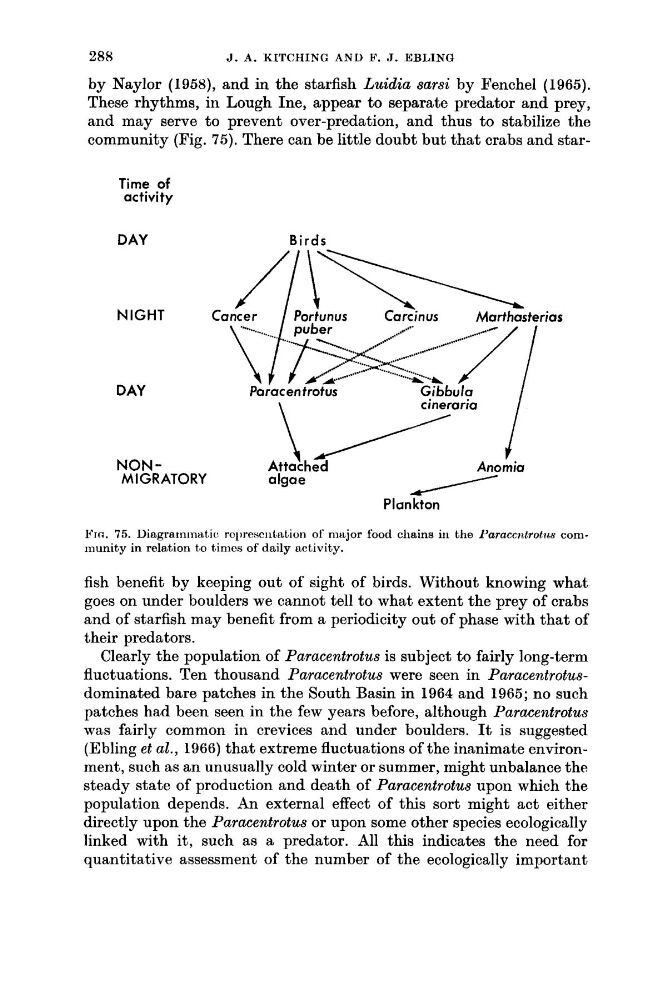
community (Fig. 75). There can be little doubt but that crabs and starTime of
activity
DAY
NIGHT
DAY
\
cineraria
NONAttached \ /
Anornia J
/
MIGRATORY
algae
Plankton
FIG. 75. Uiagrarnmat,ic rol)rrscnLatiun of major food chains iii tho Paraccntrotrm cominunity in relation to tinios of daily activity.
fish benefit by keeping out of sight of birds. Without knowing what
goes on under boulders we cannot tell to what extent the prey of crabs
and of starfish may benefit from a periodicity out of phase with that of
their predators.
Clearly the population of Paracentrotus is subject to fairly long-term
fluctuations. Ten thousand Paracentrotus were seen in Paracentrotusdominated bare patches in the South Basin in 1964 and 1965; no such
patches had been seen in the few years before, although Paracentrotus
was fairly common in crevices and under boulders. It is suggested
(Ebling et al., 1966) that extreme fluctuations of the inanimate environment, such as an unusually cold winter or summer, might unbalance the
steady state of production and death of Paracentrotus upon which the
population depends. An external effect of this sort might act either
directly upon the Paracentrotus or upon some other species ecologically
linked with it, such as a predator. All this indicates the need for
quantitative assessment of the number of the ecologically important
J . A. KITCHING A N D F. J. EBLINQ
by Naylor (1958), and in the starfish Luidia sarsi by Fenchel (1965).
These rhythms, in Lough Ine, appear to separate predator and prey,
and may serve to prevent over-predation, and thus to stabilize the
community (Fig. 75). There can be little doubt but that crabs and starTime of
activity
DAY
NIGHT
DAY
\
cineraria
NONAttached \ /
Anornia J
/
MIGRATORY
algae
Plankton
FIG. 75. Uiagrarnmat,ic rol)rrscnLatiun of major food chains iii tho Paraccntrotrm cominunity in relation to tinios of daily activity.
fish benefit by keeping out of sight of birds. Without knowing what
goes on under boulders we cannot tell to what extent the prey of crabs
and of starfish may benefit from a periodicity out of phase with that of
their predators.
Clearly the population of Paracentrotus is subject to fairly long-term
fluctuations. Ten thousand Paracentrotus were seen in Paracentrotusdominated bare patches in the South Basin in 1964 and 1965; no such
patches had been seen in the few years before, although Paracentrotus
was fairly common in crevices and under boulders. It is suggested
(Ebling et al., 1966) that extreme fluctuations of the inanimate environment, such as an unusually cold winter or summer, might unbalance the
steady state of production and death of Paracentrotus upon which the
population depends. An external effect of this sort might act either
directly upon the Paracentrotus or upon some other species ecologically
linked with it, such as a predator. All this indicates the need for
quantitative assessment of the number of the ecologically important