

286
J. A. KITCHING AND F. J . EBLINO
growth. Paracentrotus is omnivorous, and its effect must be to eliminate
a number of species from the community. In so far as Paracentrotus is
itself controlled by crabs and other predators, these predators must encourage the growth of algae and their associated fauna. It is interesting
that another carnivore, the Pacific Starfish Pisaster ochraceus, is believed
to encourage diversity of species within its community. According to
Paine (1966), Pisaster reduces the competition for space, so that species
survive which would otherwise be crowded out.
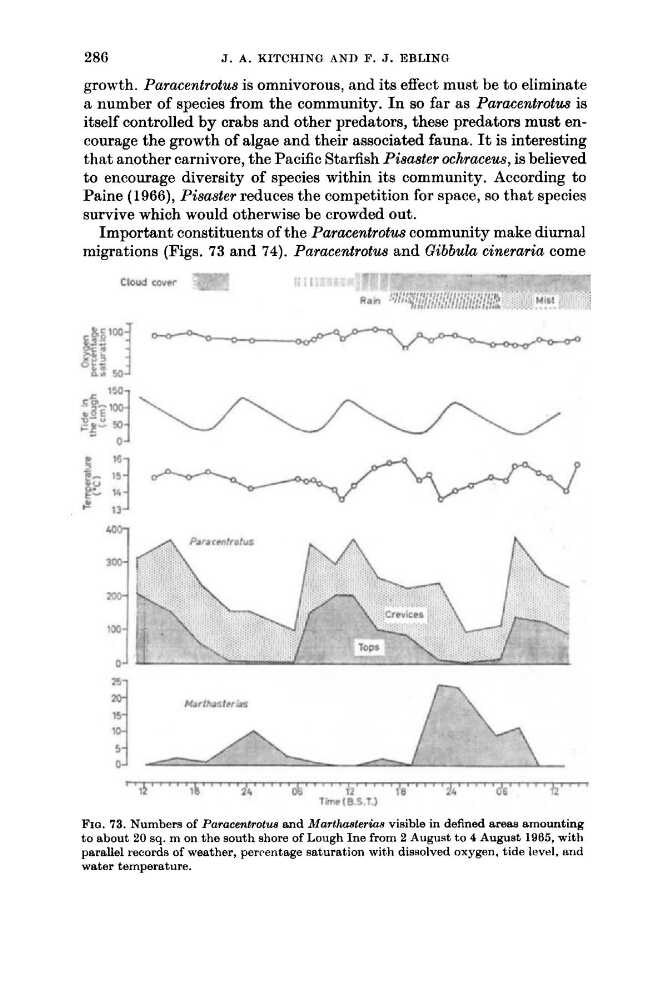
Important constituents of the Paracentrotus community make diurnal
migrations (Figs. 73 and 74). Paracentrotus and Gibbula cineraria come
FIG. 73. Numbers of Paracentrotus and Marlhasterias visible in defined areas amounting
to about 20 sq. m on the south shore of Lough Ine from 2 August to 4 August 1965, with
parallel records of weather, percentage saturation with dissolved oxygen, tide level, and
water temperature.
J. A. KITCHING AND F. J . EBLINO
growth. Paracentrotus is omnivorous, and its effect must be to eliminate
a number of species from the community. In so far as Paracentrotus is
itself controlled by crabs and other predators, these predators must encourage the growth of algae and their associated fauna. It is interesting
that another carnivore, the Pacific Starfish Pisaster ochraceus, is believed
to encourage diversity of species within its community. According to
Paine (1966), Pisaster reduces the competition for space, so that species
survive which would otherwise be crowded out.
Important constituents of the Paracentrotus community make diurnal
migrations (Figs. 73 and 74). Paracentrotus and Gibbula cineraria come
FIG. 73. Numbers of Paracentrotus and Marlhasterias visible in defined areas amounting
to about 20 sq. m on the south shore of Lough Ine from 2 August to 4 August 1965, with
parallel records of weather, percentage saturation with dissolved oxygen, tide level, and
water temperature.