

14
RICHARD S. MILLER
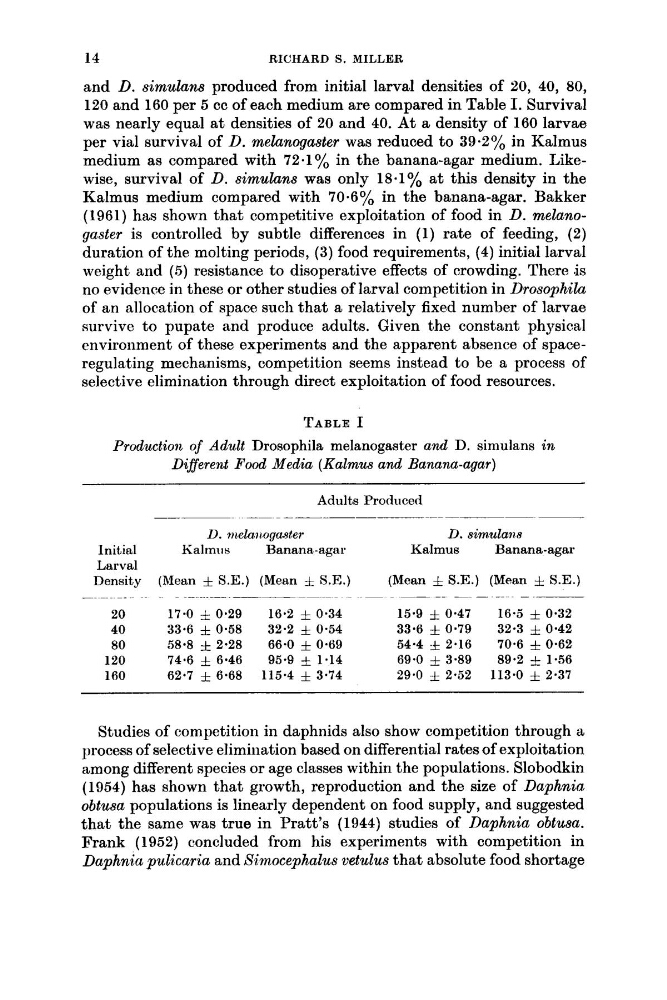
and D. simulans produced from initial larval densities of 20, 40, 130,
120 and 160 per 5 cc of each medium are compared in Table I. Survival
was nearly equal at densities of 20 and 40. At a density of 160 larvae
per vial survival of D. melanogaster was reduced to 39.2% in Kalmus
medium as compared with 72.1% in the banana-agar medium. Likewise, survival of D. simulans was only 18.1% at this density in the
Kalmus medium compared with 70.6% in the banana-agar. Bakker
(1961) has shown that competitive exploitation of food in D. melanogaster is controlled by subtle differences in (1) rate of feeding, (2)
duration of the molting periods, (3) food requirements, (4) initial larval
weight and (5) resistance to disoperative effects of crowding. There .is
no evidence in these or other studies of larval competition in Drosophila
of an allocation of space such that a relatively fixed number of larvae
survive to pupate and produce adults. Given the constant physical
environment of these experiments and the apparent absence of spaceregulating mechanisms, competition seems instead to be a process of
selective elimination through direct exploitation of food resources.
TABLE I
Production of Adult Drosophila melanogaster and D. simulans in
Different Food Media (Kalmus and Banana-agar)
Adults Produced
Initial
Larval
Density
D. nielaitopqter
Kalmii 8
Banana -agar
(Mean * S.E.) (Mean & S.E.)
20
40
80
120
160
17.0 i . 0.29
33.6 f 0.58
58.8 f 2.28
74.6 f 6.46
62-7 f 6.68
16.2 Jr 0.34
32.2 f 0.54
66.0 f 0.69
95.9 + 1.14
115.4 * 3.74
D. sirnulam
Kalmus
Banana-agar
(Mean f S.E.) (Mean & S.E.)
15.9 & 0.47
16.5 f 0.32
33.6 f 0.79
32.3 f 0.42
54.4
2.16
70.6 + 0.62
69.0 f 3-89
89.2 j= 1-56
29.0 f 2.52 112.0 f 2.37
Studies of competition in daphnids also show competition through a
process of selective elimination based on differential rates of exploitation
among different species or age classes within the populations. Slobodkin
(1954) has shown that growth, reproduction and the size of Daphnia
obtusa populations is linearly dependent on food supply, and suggested
that the same was true in Pratt’s (1944) studies of Daphnia obtusa.
Frank ( 1952) concluded from his experiments with competition in
Daphnia pulicaria and Simocephalus vetulus that absolute food shortage
RICHARD S. MILLER
and D. simulans produced from initial larval densities of 20, 40, 130,
120 and 160 per 5 cc of each medium are compared in Table I. Survival
was nearly equal at densities of 20 and 40. At a density of 160 larvae
per vial survival of D. melanogaster was reduced to 39.2% in Kalmus
medium as compared with 72.1% in the banana-agar medium. Likewise, survival of D. simulans was only 18.1% at this density in the
Kalmus medium compared with 70.6% in the banana-agar. Bakker
(1961) has shown that competitive exploitation of food in D. melanogaster is controlled by subtle differences in (1) rate of feeding, (2)
duration of the molting periods, (3) food requirements, (4) initial larval
weight and (5) resistance to disoperative effects of crowding. There .is
no evidence in these or other studies of larval competition in Drosophila
of an allocation of space such that a relatively fixed number of larvae
survive to pupate and produce adults. Given the constant physical
environment of these experiments and the apparent absence of spaceregulating mechanisms, competition seems instead to be a process of
selective elimination through direct exploitation of food resources.
TABLE I
Production of Adult Drosophila melanogaster and D. simulans in
Different Food Media (Kalmus and Banana-agar)
Adults Produced
Initial
Larval
Density
D. nielaitopqter
Kalmii 8
Banana -agar
(Mean * S.E.) (Mean & S.E.)
20
40
80
120
160
17.0 i . 0.29
33.6 f 0.58
58.8 f 2.28
74.6 f 6.46
62-7 f 6.68
16.2 Jr 0.34
32.2 f 0.54
66.0 f 0.69
95.9 + 1.14
115.4 * 3.74
D. sirnulam
Kalmus
Banana-agar
(Mean f S.E.) (Mean & S.E.)
15.9 & 0.47
16.5 f 0.32
33.6 f 0.79
32.3 f 0.42
54.4
2.16
70.6 + 0.62
69.0 f 3-89
89.2 j= 1-56
29.0 f 2.52 112.0 f 2.37
Studies of competition in daphnids also show competition through a
process of selective elimination based on differential rates of exploitation
among different species or age classes within the populations. Slobodkin
(1954) has shown that growth, reproduction and the size of Daphnia
obtusa populations is linearly dependent on food supply, and suggested
that the same was true in Pratt’s (1944) studies of Daphnia obtusa.
Frank ( 1952) concluded from his experiments with competition in
Daphnia pulicaria and Simocephalus vetulus that absolute food shortage