

PATTERN AND PSOUESS IN COMPETITION
13
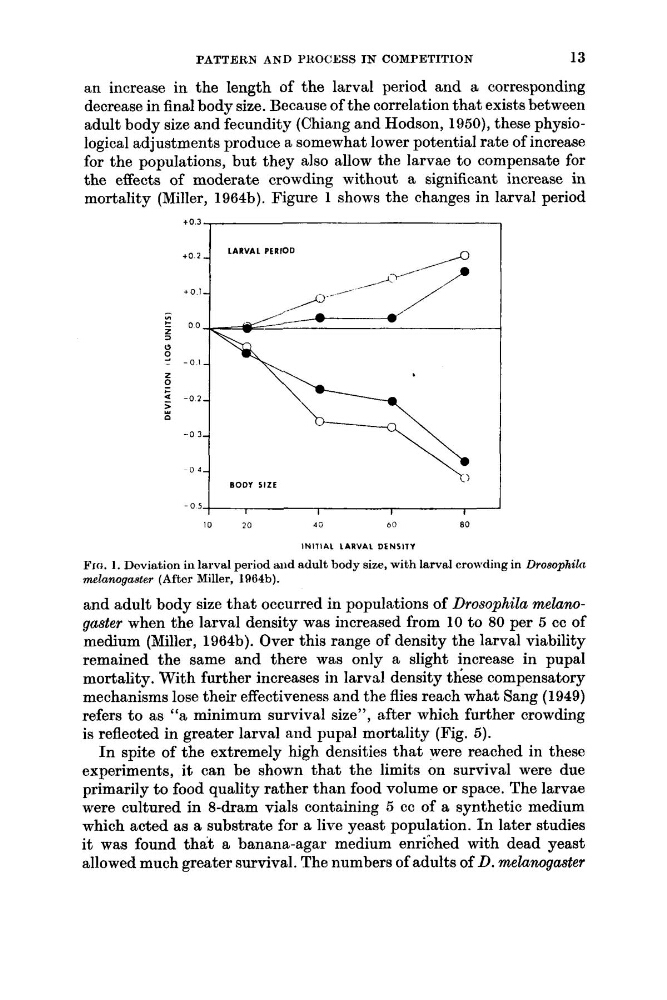
an increase in the length of the larval period and a corresponding
decrease in final body size. Because of the correlation that exists between
adult body size and fecundity (Chiang and Hodson, 1950), these physiological adjustments produce a somewhat lower potential rate of increase
for the populations, but they also allow the larvae to compensate for
the effects of moderate crowding without a significant increase in
mortality (Miller, 1964b). Figure 1 shows the changes in larval period
+0.3 ,
BODY S I Z E
- 0 5
I
I
I
I
10
20
4 G
60
80
INITIAL LARVAL DENSITY
FIG. 1. Deviation in larval period and adult body size, with larval crowding in Drosophiln
melanogaster (After Miller, 1964b).
and adult body size that occurred in populations of Drosophila melanogaster when the larval density was increased from 10 to 80 per 5 cc of
medium (Miller, 1964b). Over this range of density the larval viability
remained the same and there was only a slight increase in pupal
mortality. With further increases in larval density these compensatory
mechanisms lose their effectiveness and the flies reach what Sang (1949)
refers to as “a minimum survival size”, after which further crowding
is reflected in greater larval and pupal mortality (Fig. 5).
In spite of the extremely high densities that were reached in these
experiments, it can be shown that the limits on survival were due
primarily to food quality rather than food volume or space. The larvae
were cultured in 8-dram vials containing 5 cc of a synthetic medium
which acted as a substrate for a live yeast population. In later studies
it was found that a banana-agar medium enriched with dead yeast
allowed much greater survival. The numbers of adults of D. melanogaster
13
an increase in the length of the larval period and a corresponding
decrease in final body size. Because of the correlation that exists between
adult body size and fecundity (Chiang and Hodson, 1950), these physiological adjustments produce a somewhat lower potential rate of increase
for the populations, but they also allow the larvae to compensate for
the effects of moderate crowding without a significant increase in
mortality (Miller, 1964b). Figure 1 shows the changes in larval period
+0.3 ,
BODY S I Z E
- 0 5
I
I
I
I
10
20
4 G
60
80
INITIAL LARVAL DENSITY
FIG. 1. Deviation in larval period and adult body size, with larval crowding in Drosophiln
melanogaster (After Miller, 1964b).
and adult body size that occurred in populations of Drosophila melanogaster when the larval density was increased from 10 to 80 per 5 cc of
medium (Miller, 1964b). Over this range of density the larval viability
remained the same and there was only a slight increase in pupal
mortality. With further increases in larval density these compensatory
mechanisms lose their effectiveness and the flies reach what Sang (1949)
refers to as “a minimum survival size”, after which further crowding
is reflected in greater larval and pupal mortality (Fig. 5).
In spite of the extremely high densities that were reached in these
experiments, it can be shown that the limits on survival were due
primarily to food quality rather than food volume or space. The larvae
were cultured in 8-dram vials containing 5 cc of a synthetic medium
which acted as a substrate for a live yeast population. In later studies
it was found that a banana-agar medium enriched with dead yeast
allowed much greater survival. The numbers of adults of D. melanogaster