

60
T. B. REYNOLDSON
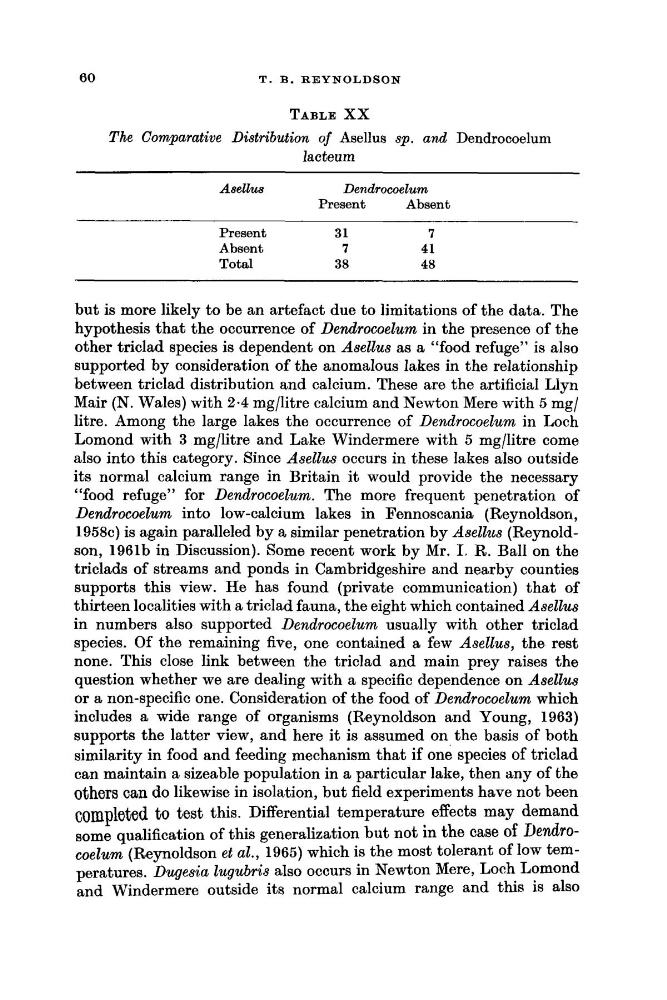
TABLE XX
The Comparative Distribution of Asellus sp. and Dendrocoelum
lacteum
Asellus
Dendrowelum
Present
Absent
Present
31
7
Absent
7
41
Total
38
48
but is more likely to be an artefact due to limitations of the data. The
hypothesis that the occurrence of Dendrocoelum in the presence of the
other triclad species is dependent on Asellus as a “food refuge” is also
supported by consideration of the anomalous lakes in the relationship
between triclad distribution and calcium. These are the artificial LIyn
Mair (N. Wales) with 2.4 mg/litre calcium and Newton Mere with 5 mg/
litre. Among the large lakes the occurrence of Dendrocoelum in Loch
Lomond with 3 mg/litre and Lake Windermere with 5 mg/litre come
also into this category. Since Asellus occurs in these lakes also outside
its normal calcium range in Britain it would provide the necessary
“food refuge” for Dendrocoelum. The more frequent penetration of
Dendrocoelum into low-calcium lakes in Fennoscania (Reynoldson,
195%) is again paralleled by a similar penetration by Asellus (Reynoldson, 1961b in Discussion). Some recent work by Mr. I. R. Ball on the
triclads of streams and ponds in Cambridgeshire and nearby counties
supports this view. He has found (private communication) that of
thirteen localities with a triclad fauna, the eight which contained Asellus
in numbers also supported Dendrocoelum usually with other triclad
species. Of the remaining five, one contained a few Asellus, the rest
none. This close link between the triclad and main prey raises the
question whether we are dealing with a specific dependence on Asellus
or a non-specific one. Consideration of the food of Dendrocoelum which
includes a wide range of organisms (Reynoldson and Young, 1963)
supports the latter view, and here it is assumed on the basis of both
similarity in food and feeding mechanism that if one species of triclad
can maintain a sizeable population in a particular lake, then any of the
others can do likewise in isolation, but field experiments have not been
completed to test this. Differential temperature effects may demand
some qualification of this generalization but not in the case of ~ e ~ r o -
coelum (Repoldson et al., 1965) which is the most tolerant Of low ternperatures. Dugesia lugubris also occurs in Newton Mere, Loch Lomond
and Windermere outside its normal calcium range and this is also
T. B. REYNOLDSON
TABLE XX
The Comparative Distribution of Asellus sp. and Dendrocoelum
lacteum
Asellus
Dendrowelum
Present
Absent
Present
31
7
Absent
7
41
Total
38
48
but is more likely to be an artefact due to limitations of the data. The
hypothesis that the occurrence of Dendrocoelum in the presence of the
other triclad species is dependent on Asellus as a “food refuge” is also
supported by consideration of the anomalous lakes in the relationship
between triclad distribution and calcium. These are the artificial LIyn
Mair (N. Wales) with 2.4 mg/litre calcium and Newton Mere with 5 mg/
litre. Among the large lakes the occurrence of Dendrocoelum in Loch
Lomond with 3 mg/litre and Lake Windermere with 5 mg/litre come
also into this category. Since Asellus occurs in these lakes also outside
its normal calcium range in Britain it would provide the necessary
“food refuge” for Dendrocoelum. The more frequent penetration of
Dendrocoelum into low-calcium lakes in Fennoscania (Reynoldson,
195%) is again paralleled by a similar penetration by Asellus (Reynoldson, 1961b in Discussion). Some recent work by Mr. I. R. Ball on the
triclads of streams and ponds in Cambridgeshire and nearby counties
supports this view. He has found (private communication) that of
thirteen localities with a triclad fauna, the eight which contained Asellus
in numbers also supported Dendrocoelum usually with other triclad
species. Of the remaining five, one contained a few Asellus, the rest
none. This close link between the triclad and main prey raises the
question whether we are dealing with a specific dependence on Asellus
or a non-specific one. Consideration of the food of Dendrocoelum which
includes a wide range of organisms (Reynoldson and Young, 1963)
supports the latter view, and here it is assumed on the basis of both
similarity in food and feeding mechanism that if one species of triclad
can maintain a sizeable population in a particular lake, then any of the
others can do likewise in isolation, but field experiments have not been
completed to test this. Differential temperature effects may demand
some qualification of this generalization but not in the case of ~ e ~ r o -
coelum (Repoldson et al., 1965) which is the most tolerant Of low ternperatures. Dugesia lugubris also occurs in Newton Mere, Loch Lomond
and Windermere outside its normal calcium range and this is also