

LAKE DWELIdINO TEICLADS
59
TABLE XIX
The Distribution of Two Main Pwy Or
Area
(:a (mgllitre)
t 5 . 0
5.1-10.0
> 10.0
N. Ireland
014
114
8/11
Mid-Scotland
3/11
515
13/15
N. Wales
2/14
111
9/12
811 1
41/49
-~~
111
11/11
Shropshire
111
Total
6/30
b. Asdlus
711 1
11/15
N. Ireland
014
114
Mid-Scotland
011 1
415
N. Wales
2/14
111
12/12
Shropshire
111
111
11/11
Total
3/30
7/11
41/49
It would appear therefore that the key to understanding the distribution of these triclad species is LO be sought in the faunas of the
lakes, and these have been examined from data collected a t the same
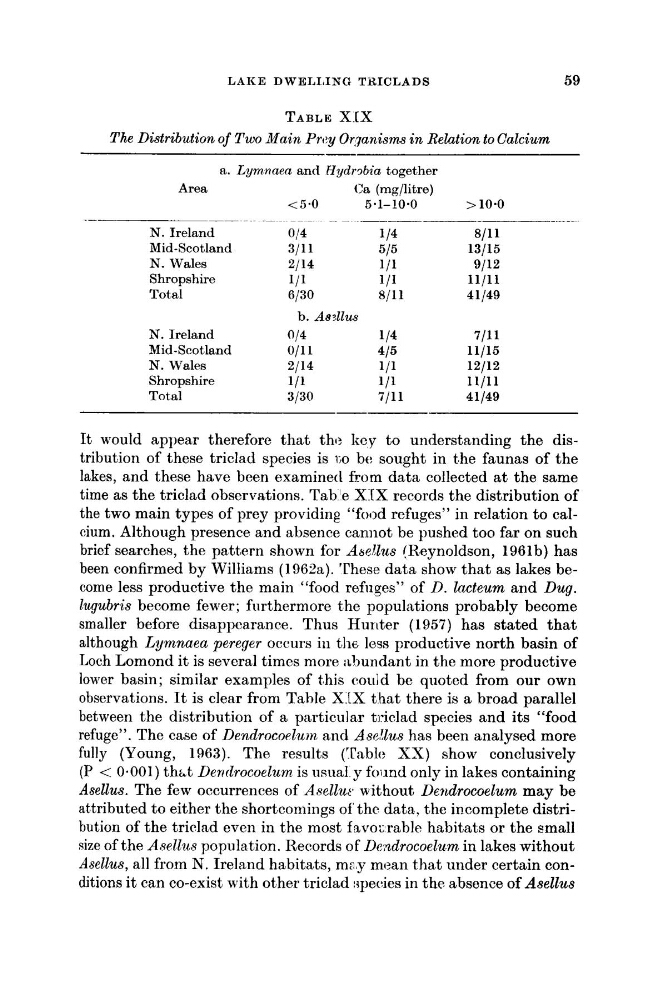
time as the triclad observations. Table X [X records the distribution of
the two main types of prey providing “food refuges” in relation to calcium. Although presence and absence cannot be pushed too far on such
brief searches, the pattern shown for A s e h s (Reynoldson, 196lb) has
been confirmed by Williams (196%~). These data show that as lakes become less productive the main “food refuges” of D. lncfeum and Dug.
lugubris become fewer; fiirthermore the populations probably become
smaller before disappearance. Thus Hunter ( 1957) has stated that
although Lymnaea pereger occurs in the less productive north basin of
Loch Lomond it is several times more iL5undant in the more productive
lower basin; similar examples of this could be quoted from our own
observations. It is clear from Table X L X that there is a broad parallel
between the distribution of a particular ti-iclad species and its “food
refuge”. The case of Dendrocoelum and Asellus has been analysed more
fully (Young, 1963). The results (Tablo X S ) show conclusively
(P < 0.001) that Dendrocoelum is usual y fmnd only in lakes containing
Asellus. The few occurrences of Asellues without Dendrocoelum may be
attributed to either the shortcomings of the data, the incomplete distribution of the triclad even in the most f s v o ~ r a b l t
habitats or the small
size of the Asellus population. Records of Dcndrocoelum in lakes without
Asellus, all from N. Ireland habitats, may mean that under certain conditions it can co-exist with other triclad species in the absence of Asellus
59
TABLE XIX
The Distribution of Two Main Pwy Or
Area
(:a (mgllitre)
t 5 . 0
5.1-10.0
> 10.0
N. Ireland
014
114
8/11
Mid-Scotland
3/11
515
13/15
N. Wales
2/14
111
9/12
811 1
41/49
-~~
111
11/11
Shropshire
111
Total
6/30
b. Asdlus
711 1
11/15
N. Ireland
014
114
Mid-Scotland
011 1
415
N. Wales
2/14
111
12/12
Shropshire
111
111
11/11
Total
3/30
7/11
41/49
It would appear therefore that the key to understanding the distribution of these triclad species is LO be sought in the faunas of the
lakes, and these have been examined from data collected a t the same
time as the triclad observations. Table X [X records the distribution of
the two main types of prey providing “food refuges” in relation to calcium. Although presence and absence cannot be pushed too far on such
brief searches, the pattern shown for A s e h s (Reynoldson, 196lb) has
been confirmed by Williams (196%~). These data show that as lakes become less productive the main “food refuges” of D. lncfeum and Dug.
lugubris become fewer; fiirthermore the populations probably become
smaller before disappearance. Thus Hunter ( 1957) has stated that
although Lymnaea pereger occurs in the less productive north basin of
Loch Lomond it is several times more iL5undant in the more productive
lower basin; similar examples of this could be quoted from our own
observations. It is clear from Table X L X that there is a broad parallel
between the distribution of a particular ti-iclad species and its “food
refuge”. The case of Dendrocoelum and Asellus has been analysed more
fully (Young, 1963). The results (Tablo X S ) show conclusively
(P < 0.001) that Dendrocoelum is usual y fmnd only in lakes containing
Asellus. The few occurrences of Asellues without Dendrocoelum may be
attributed to either the shortcomings of the data, the incomplete distribution of the triclad even in the most f s v o ~ r a b l t
habitats or the small
size of the Asellus population. Records of Dcndrocoelum in lakes without
Asellus, all from N. Ireland habitats, may mean that under certain conditions it can co-exist with other triclad species in the absence of Asellus