

DYNAMICS OF FIELD POPULATION OF PINE LOOPER
287
species including Bupalus, and reached the saime conclusion along
similar lines of reasoning (Klomp, 1962).
However, reaching this conclusion on theoretical grounds does not
relieve us of the task of providing practical proof that regulation in fact
operates in the Bupalus population under study, and especially to show
how it operates.
The incidence of regulatory processes in the Bupalus population can
be demonstrated by the use of statistics. Therefcre we computed the
regression of K-values of generation mortality on the logarithm of
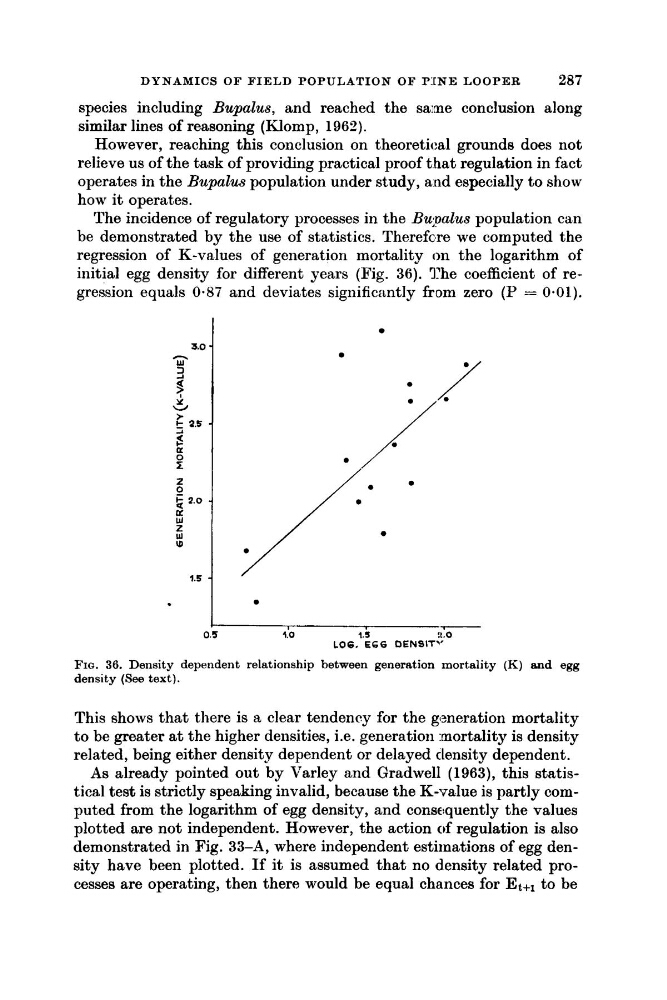
initial egg density for different years (Fig. 36). l'he coefficient of regression equals 0.87 and deviates significantly from zero (P = 0.01).
3.0 1
h
w
3
$
Y
v
2.5 -
-1
J
P
I
I
0.5
1.0
1.5
!LO
FIQ. 36. Density dependent relationship between generation mortality (K) and egg
density (See text).
L 0 6 . € 6 6 DENSIT"
This shows that there is a clear tendency for the gmeration mortality
to be greater at the higher densities, i.e. generation :mortality is density
related, being either density dependent or delayed density dependent.
As already pointed out by Varley and Gradwell (1963), this statistical test is strictly speaking invalid, because the K-value is partly computed from the logarithm of egg density, and consequently the values
plotted are not independent. However, the action of regulation is also
demonstrated in Fig. 33-A, where independent estimations of egg density have been plotted. If it is assumed that no density related processes are operating, then there would be equal chances for Et+l to be
287
species including Bupalus, and reached the saime conclusion along
similar lines of reasoning (Klomp, 1962).
However, reaching this conclusion on theoretical grounds does not
relieve us of the task of providing practical proof that regulation in fact
operates in the Bupalus population under study, and especially to show
how it operates.
The incidence of regulatory processes in the Bupalus population can
be demonstrated by the use of statistics. Therefcre we computed the
regression of K-values of generation mortality on the logarithm of
initial egg density for different years (Fig. 36). l'he coefficient of regression equals 0.87 and deviates significantly from zero (P = 0.01).
3.0 1
h
w
3
$
Y
v
2.5 -
-1
J
P
I
I
0.5
1.0
1.5
!LO
FIQ. 36. Density dependent relationship between generation mortality (K) and egg
density (See text).
L 0 6 . € 6 6 DENSIT"
This shows that there is a clear tendency for the gmeration mortality
to be greater at the higher densities, i.e. generation :mortality is density
related, being either density dependent or delayed density dependent.
As already pointed out by Varley and Gradwell (1963), this statistical test is strictly speaking invalid, because the K-value is partly computed from the logarithm of egg density, and consequently the values
plotted are not independent. However, the action of regulation is also
demonstrated in Fig. 33-A, where independent estimations of egg density have been plotted. If it is assumed that no density related processes are operating, then there would be equal chances for Et+l to be