

286
H . KLOIII’
TABLE XXVI
Results of Key-.fuctor diiulysis of Larval Density Fluctuations
log P
Coefficient of
plotted
~~
-
Component
over
correlation
regression
Density of first instar larvae
log LI
0-65
0.73
Juvenile mortality
log Ls
0.87
0.8‘
Mortality of advanced larvae
lop N
0.94
1 a35
Preptipal mortality
log P
1 *oo
1 -00
L I , L., N, and I’ refer to the densities of Hrst instar larvae. September larvae, nymphs, and pupae.
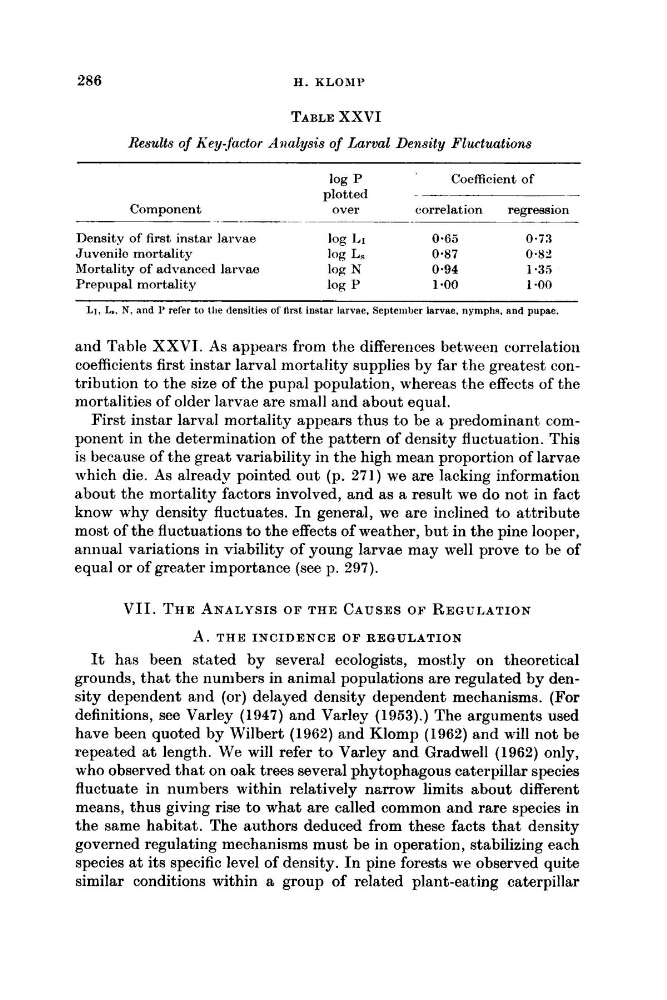
and Table XXVI. As appears from the differences between correlation
coefficients first instar larval mortality supplies by far the greatest contribution to the size of the pupal population, whereas the effects of the
mortalities of older larvae are small and about equal.
First instar larval mortality appears thus to be a predominant component in the determination of the pattern of density fluctuation. This
is because of the great variability in the high mean proportion of larvae
which die. As already pointed out (p. 271) we are lacking information
about the mortality factors involved, and as a result we do not in fact
know why density fluctuates. I n general, we are inclined to attribute
most of the fluctuations to the effects of weather, but in the pine looper,
annual variations in viability of young larvae may well prove to be of
equal or of greater importance (see p. 297).
V I I . THE ANALYSIS OF THE CAUSES OF REGULATION
A . T H E I N C I D E N C E O F R E Q U L A T I O N
It has been stated by several ecologists, mostly on theoretical
grounds, that the numbers in animal populations are regulated by density dependent and (or) delayed density dependent mechanisms. (For
definitions, see Varley (1947) and Varley (1953).) The arguments used
have been quoted by Wilbert (1962) and Klomp (1962) and will not be
repeated at length. We will refer to Varley and Gradwell (1962) only,
who observed that on oak trees several phytophagous caterpillar species
fluctuate in numbers within relatively nmrow limits about different
means, thus giving rise to what are called common and rare species in
the same habitat. The authors deduced from these facts that density
governed regulating mechanisms must be in operation, stabilizing each
species at its specific level of density. I n pine forests we observed quite
similar conditions within a group of related plant-eating caterpillar
H . KLOIII’
TABLE XXVI
Results of Key-.fuctor diiulysis of Larval Density Fluctuations
log P
Coefficient of
plotted
~~
-
Component
over
correlation
regression
Density of first instar larvae
log LI
0-65
0.73
Juvenile mortality
log Ls
0.87
0.8‘
Mortality of advanced larvae
lop N
0.94
1 a35
Preptipal mortality
log P
1 *oo
1 -00
L I , L., N, and I’ refer to the densities of Hrst instar larvae. September larvae, nymphs, and pupae.
and Table XXVI. As appears from the differences between correlation
coefficients first instar larval mortality supplies by far the greatest contribution to the size of the pupal population, whereas the effects of the
mortalities of older larvae are small and about equal.
First instar larval mortality appears thus to be a predominant component in the determination of the pattern of density fluctuation. This
is because of the great variability in the high mean proportion of larvae
which die. As already pointed out (p. 271) we are lacking information
about the mortality factors involved, and as a result we do not in fact
know why density fluctuates. I n general, we are inclined to attribute
most of the fluctuations to the effects of weather, but in the pine looper,
annual variations in viability of young larvae may well prove to be of
equal or of greater importance (see p. 297).
V I I . THE ANALYSIS OF THE CAUSES OF REGULATION
A . T H E I N C I D E N C E O F R E Q U L A T I O N
It has been stated by several ecologists, mostly on theoretical
grounds, that the numbers in animal populations are regulated by density dependent and (or) delayed density dependent mechanisms. (For
definitions, see Varley (1947) and Varley (1953).) The arguments used
have been quoted by Wilbert (1962) and Klomp (1962) and will not be
repeated at length. We will refer to Varley and Gradwell (1962) only,
who observed that on oak trees several phytophagous caterpillar species
fluctuate in numbers within relatively nmrow limits about different
means, thus giving rise to what are called common and rare species in
the same habitat. The authors deduced from these facts that density
governed regulating mechanisms must be in operation, stabilizing each
species at its specific level of density. I n pine forests we observed quite
similar conditions within a group of related plant-eating caterpillar