

12
T . B . REYNOLDSON
the penis examined under the microscope to separate tenuis and nigra.
Sma.11 specimens of Polycelis were allocated to species according to
colour pattern. Of t'he numerous P. nigra populations which have been
collected only one has been found in which the colour was sufficiently
mottled to confuse with P. tenuis and this lived in brackish conditions
near Cullercoats, Northumberland. Mostly P. tenuis are mottled though
several uniformly black populations, indistinguishable from P. nigra
externally, occur in the more northerly parts of Britain.
B. RESULTS
The data from areas showing a restricted triclad fauna have been
omitted from immediate consideration since they could be misleading
in both the qualitative and quantitative contexts. Thus the proportion
of lakes occupied by a particular species would be affected and any competitive element absent or reduced. In addition, size differences in the
adults would influence quantitative relations. The three main areas
sampled with such a restricted fauna were the islands of Anglesey off the
Welsh coast, Islay off the west Scottish coast, and the extreme north of
Scotland beyond the Highland Fault (Caledonian Canal) (Fig. 1). The
results from the lakes in these three areas and from the two large lakes of
Windermere and Lomond are used to illustrate special aspects (pp. 27,
30).
1. The Distribution of the Species
Data from 107 lakes considered here are derived mainly from midand north Scotland (34), N. Ireland (19), the Snowdonia area of N. Wales
(29), Shropshire (12), the Lake District (11) and two Y'orkshire lakes.
They show a wide range of physico-chemical properties from high lakes
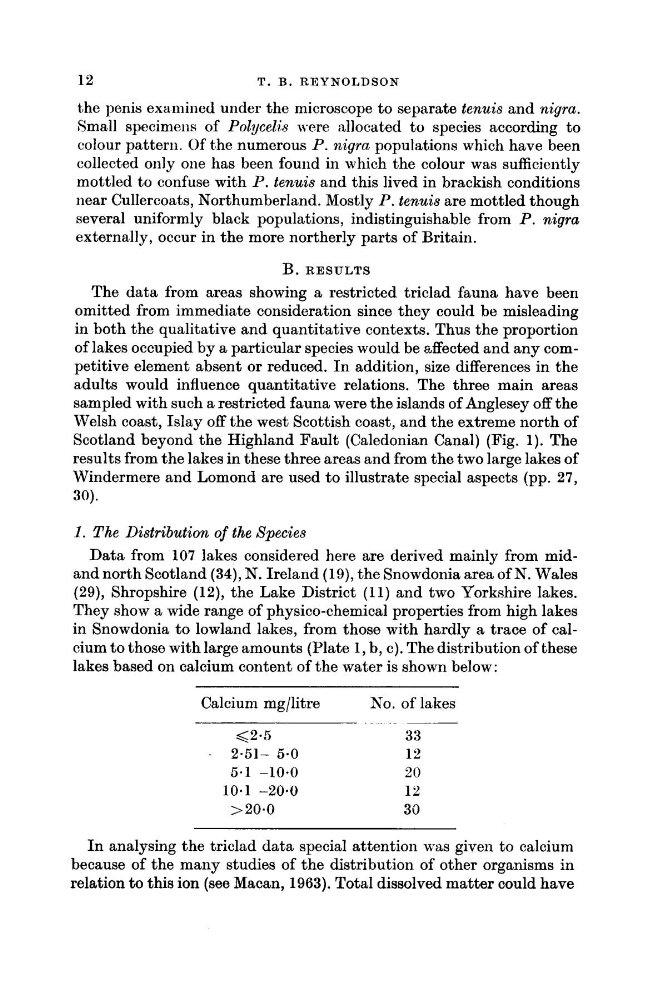
in Snowdonia to lowland lakes, from those with hardly a trace of calcium to those with large amounts (Plate l , b, c). The distribution of these
lakes based on calcium content of the water is shown below:
Calcium mg/litre
No. of lakes
G2.5
33
-
2.51- 5.0
12
5.1 -10.0
20
10.1 -20.0
1.2
> 20.0
30
~~
In analysing the triclad data special attention was given to calcium
because of the many studies of the distribution of other organisms in
relation to this ion (see Macan, 1963). Total dissolved matter could have
T . B . REYNOLDSON
the penis examined under the microscope to separate tenuis and nigra.
Sma.11 specimens of Polycelis were allocated to species according to
colour pattern. Of t'he numerous P. nigra populations which have been
collected only one has been found in which the colour was sufficiently
mottled to confuse with P. tenuis and this lived in brackish conditions
near Cullercoats, Northumberland. Mostly P. tenuis are mottled though
several uniformly black populations, indistinguishable from P. nigra
externally, occur in the more northerly parts of Britain.
B. RESULTS
The data from areas showing a restricted triclad fauna have been
omitted from immediate consideration since they could be misleading
in both the qualitative and quantitative contexts. Thus the proportion
of lakes occupied by a particular species would be affected and any competitive element absent or reduced. In addition, size differences in the
adults would influence quantitative relations. The three main areas
sampled with such a restricted fauna were the islands of Anglesey off the
Welsh coast, Islay off the west Scottish coast, and the extreme north of
Scotland beyond the Highland Fault (Caledonian Canal) (Fig. 1). The
results from the lakes in these three areas and from the two large lakes of
Windermere and Lomond are used to illustrate special aspects (pp. 27,
30).
1. The Distribution of the Species
Data from 107 lakes considered here are derived mainly from midand north Scotland (34), N. Ireland (19), the Snowdonia area of N. Wales
(29), Shropshire (12), the Lake District (11) and two Y'orkshire lakes.
They show a wide range of physico-chemical properties from high lakes
in Snowdonia to lowland lakes, from those with hardly a trace of calcium to those with large amounts (Plate l , b, c). The distribution of these
lakes based on calcium content of the water is shown below:
Calcium mg/litre
No. of lakes
G2.5
33
-
2.51- 5.0
12
5.1 -10.0
20
10.1 -20.0
1.2
> 20.0
30
~~
In analysing the triclad data special attention was given to calcium
because of the many studies of the distribution of other organisms in
relation to this ion (see Macan, 1963). Total dissolved matter could have