

DYNAMICS O F FIELD POPULATION OF P I N E LOOPER
233
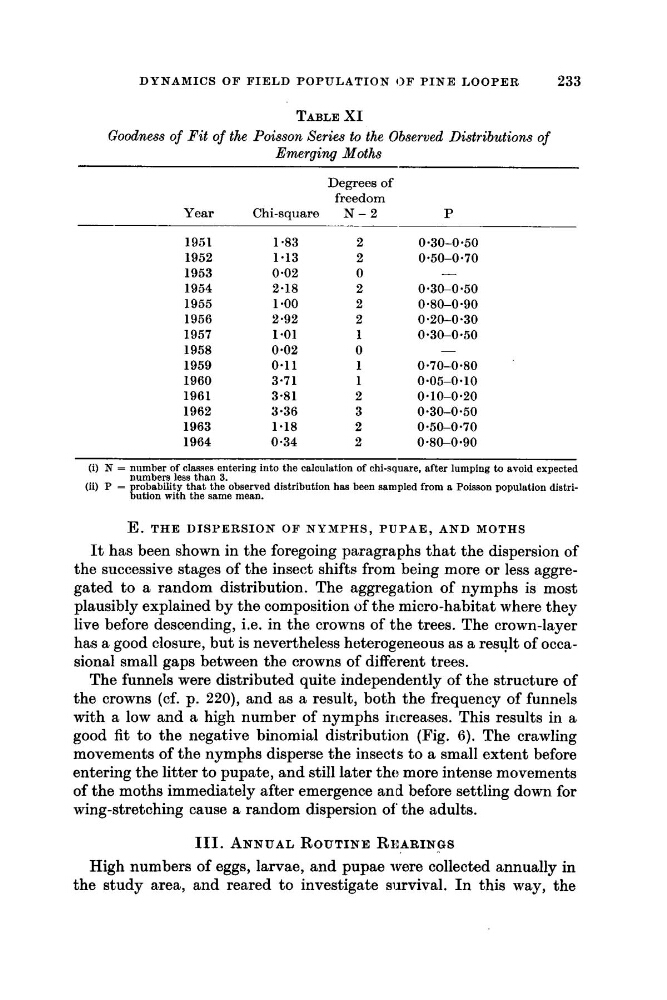
TABLE XI
Goodness of Fit of the Poisson Series to the Observed Distributions of
Emerginq Moths
Degrees of
freedom
Year
Chi-square
N - 2
P
1951
1952
1953
1954
1955
1956
1957
1958
1959
1960
1961
1962
1963
1964
1.83
1.13
0.02
2-18
1.00
2.92
1.01
0.02
0.11
3.71
3.81
3.36
1.18
0-34
2
2
0
2
2
2
1
0
1
1
2
3
2
2
0.30-0.50
0.50-0.70
-
0-30-0.50
0.80-0.90
0.20-0.30
0.30-0.50
-
0.70-0.80
0-05-0.1 0
0 - 10-0 -20
0.30-0-50
0 -50-0 -70
0.80-0*90
(i) N = number of classes entering into the calculabion of chi-square, after lumping to avoid expected
(ii) P = probability that the observed distribution has been sampled from a Poisson population distrinumbers less than 3.
bution with the same mean.
E. THE DISPERSION OF NYMPHS, PUPAE, A N D MOTHS
It has been shown in the foregoing paragraphs that the dispersion of
the successive stages of the insect shifts from being more or less aggregated to a, random distribution. The aggregation of nymphs is most
plausibly explained by the composition of the micro-habitat where they
live before descending, i.e. in the crowns of the trees. The crown-layer
has a good closure, but is nevertheless heterogeneous as a result of occasional small gaps between the crowns of different trees.
The funnels were distributed quite independently of the structure of
the crowns (cf. p. 220), and as a result, both the frequency of funnels
with a low and a high number of nymphs increases. This results in a
good fit to the negative binomial distribution (Fig. 6). The crawling
movements of the nymphs disperse the insects to a small extent before
entering the litter to pupate, and still later the more intense movements
of the moths immediately after emergence and before settling down for
wing-stretching cause a random dispersion of’ the adults.
111. ANNUAL ROUTINE REARINGS
High numbers of eggs, larvae, and pupae were collected annually in
the study a.rea, and reared to investigate survival. In this way, the
233
TABLE XI
Goodness of Fit of the Poisson Series to the Observed Distributions of
Emerginq Moths
Degrees of
freedom
Year
Chi-square
N - 2
P
1951
1952
1953
1954
1955
1956
1957
1958
1959
1960
1961
1962
1963
1964
1.83
1.13
0.02
2-18
1.00
2.92
1.01
0.02
0.11
3.71
3.81
3.36
1.18
0-34
2
2
0
2
2
2
1
0
1
1
2
3
2
2
0.30-0.50
0.50-0.70
-
0-30-0.50
0.80-0.90
0.20-0.30
0.30-0.50
-
0.70-0.80
0-05-0.1 0
0 - 10-0 -20
0.30-0-50
0 -50-0 -70
0.80-0*90
(i) N = number of classes entering into the calculabion of chi-square, after lumping to avoid expected
(ii) P = probability that the observed distribution has been sampled from a Poisson population distrinumbers less than 3.
bution with the same mean.
E. THE DISPERSION OF NYMPHS, PUPAE, A N D MOTHS
It has been shown in the foregoing paragraphs that the dispersion of
the successive stages of the insect shifts from being more or less aggregated to a, random distribution. The aggregation of nymphs is most
plausibly explained by the composition of the micro-habitat where they
live before descending, i.e. in the crowns of the trees. The crown-layer
has a good closure, but is nevertheless heterogeneous as a result of occasional small gaps between the crowns of different trees.
The funnels were distributed quite independently of the structure of
the crowns (cf. p. 220), and as a result, both the frequency of funnels
with a low and a high number of nymphs increases. This results in a
good fit to the negative binomial distribution (Fig. 6). The crawling
movements of the nymphs disperse the insects to a small extent before
entering the litter to pupate, and still later the more intense movements
of the moths immediately after emergence and before settling down for
wing-stretching cause a random dispersion of’ the adults.
111. ANNUAL ROUTINE REARINGS
High numbers of eggs, larvae, and pupae were collected annually in
the study a.rea, and reared to investigate survival. In this way, the