

THE PRODUCTION O F MARINE PLANKTON
167
the grazing activity of zooplankton. The phosphate distribution, as one
of the major limiting nutrients in the upper lityers, may be computed
by an assessment of the eddy diffusion in the water layers and the concentration of phosphate in deeper water. An equation for phytoplankton
p at depth z, introducing these terms is as follows:
where v = sinking rate, p = density of water, A = coefficient of vertical
eddy diffusion. Such a type of equation may be applied to two depth
intervals to deduce grazing and sinking rates. A succession of depth
- . . . , 0 0 1
h
Husan
I \
I
IAI
300
100
1932
1933
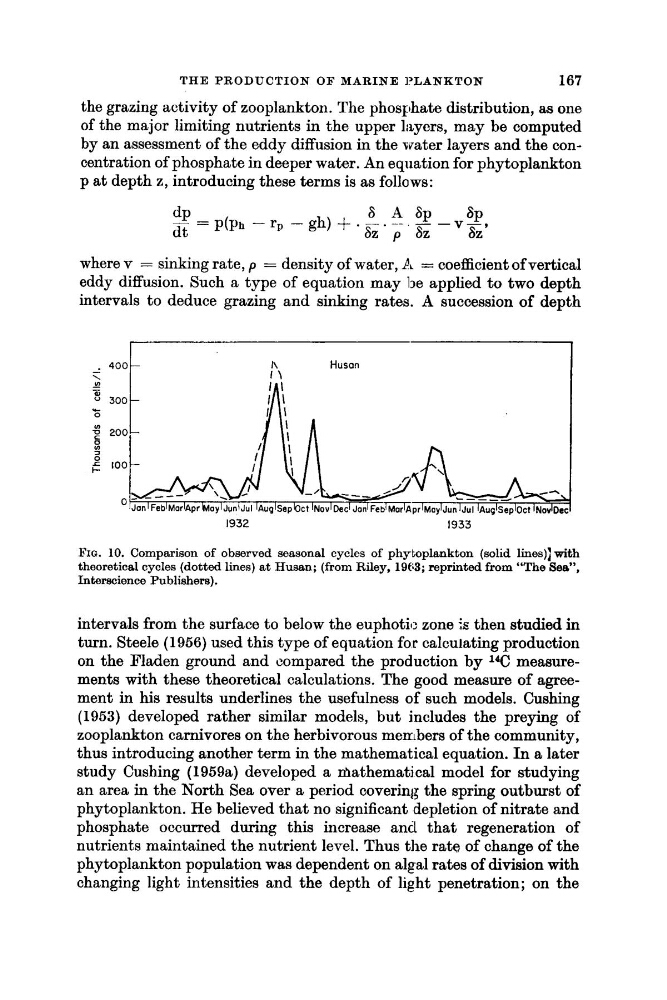
FIQ. 10. Comparison of observed seasonal cycles of phyboplankton (solid lines)] with
theoretical cycles (dotted lines) at Husan; (from Riley, 1963; reprinted from “The Sea”,
Interscience Publishers).
intervals from the surface to below the euphotic zone ks then studied in
turn. Steele (1956) used this type of equation for calculating production
on the Fladen ground and compared the production by 1% measurements with these theoretical calculations. The good measure of agreement in his results underlines the usefulness of such models. Cushing
(1953) developed rather similar models, but includes the preying of
zooplankton carnivores on the herbivorous members of the community,
thus introducing another term in the mathematical equation. In a later
study Cushing (1959a) developed a ldathematjcal model for studying
an area in the North Sea over a period covering the spring outburst of
phytoplankton. He believed that no significant depletion of nitrate and
phosphate occurred during this increase and that regeneration of
nutrients maintained the nutrient level. Thus the rats of change of the
phytoplankton population was dependent on algal rates of division with
changing light intensities and the depth of light penetration; on the
167
the grazing activity of zooplankton. The phosphate distribution, as one
of the major limiting nutrients in the upper lityers, may be computed
by an assessment of the eddy diffusion in the water layers and the concentration of phosphate in deeper water. An equation for phytoplankton
p at depth z, introducing these terms is as follows:
where v = sinking rate, p = density of water, A = coefficient of vertical
eddy diffusion. Such a type of equation may be applied to two depth
intervals to deduce grazing and sinking rates. A succession of depth
- . . . , 0 0 1
h
Husan
I \
I
IAI
300
100
1932
1933
FIQ. 10. Comparison of observed seasonal cycles of phyboplankton (solid lines)] with
theoretical cycles (dotted lines) at Husan; (from Riley, 1963; reprinted from “The Sea”,
Interscience Publishers).
intervals from the surface to below the euphotic zone ks then studied in
turn. Steele (1956) used this type of equation for calculating production
on the Fladen ground and compared the production by 1% measurements with these theoretical calculations. The good measure of agreement in his results underlines the usefulness of such models. Cushing
(1953) developed rather similar models, but includes the preying of
zooplankton carnivores on the herbivorous members of the community,
thus introducing another term in the mathematical equation. In a later
study Cushing (1959a) developed a ldathematjcal model for studying
an area in the North Sea over a period covering the spring outburst of
phytoplankton. He believed that no significant depletion of nitrate and
phosphate occurred during this increase and that regeneration of
nutrients maintained the nutrient level. Thus the rats of change of the
phytoplankton population was dependent on algal rates of division with
changing light intensities and the depth of light penetration; on the