

150
J . E. a. RAYMONT
mixed ( i t . unstratified) water layer has been emphasized by Riley
(1942-46) and also by Sverdrup (1963). Sverdrup has used the term
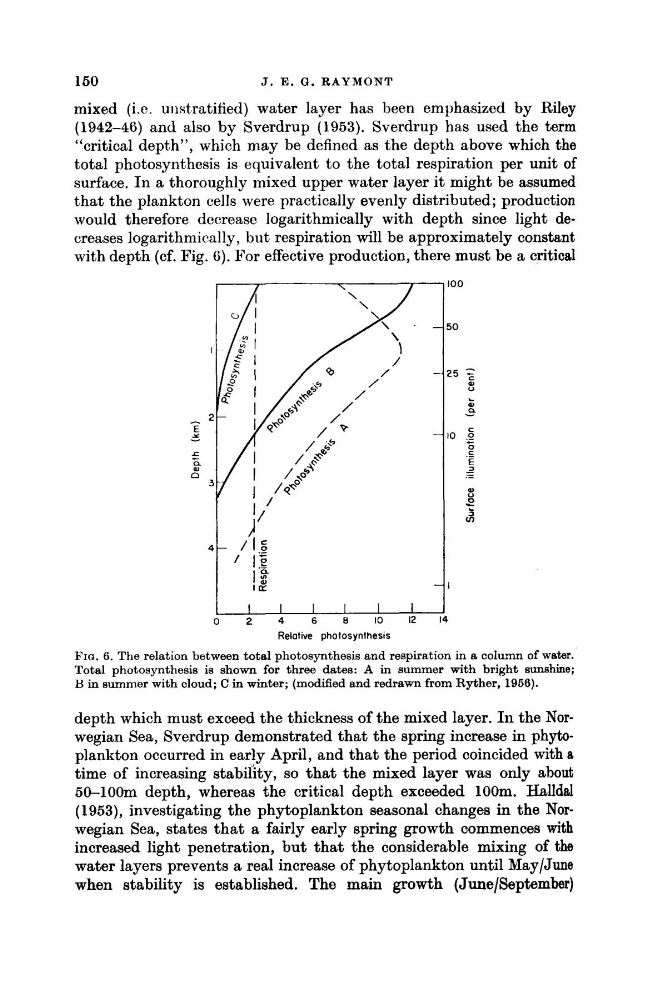
“critical depth”, which may be defined as the depth above which the
total photosynthesis is equivalent to the total respiration per unit of
surface. In a thoroughly mixed upper water layer it might be assumed
that the plankton cells were practically evenly distributed; production
would therefore decrease logarithmically with depth since light decreases logarithmically, but respiration will be approximately constant
with depth (cf. Fig. 6). For effective production, there must be a critical
d
0
2
4
6
8
10
1 2 1 4
Relative photosynthesis
PIG. 6. The relation between total photosynthesis and respiration in a column of water.
Total photosynthesis is shown for three dates: A in summer with bright sunshine;
B i n summer with cloud; C in winter; (modified and redrawn from Ryther. 1966).
depth which must exceed the thickness of the mixed layer. I n the Norwegian Sea, Sverdrup demonstrated that the spring increase in phytoplankton occurred in early April, and that the period coincided with
time of increasing stabifity, so that the mixed layer was only about
50-100m depth, whereas the critical depth exceeded 100m. Kalldal
(1953), investigating the phytoplankton seasonal changes in the Norwegian Sea, states that a fairly early spring growth commences with
increased light penetration, but that the considerable mixing of the
water layers prevents a real increase of phytoplankton until May/June
when stability is established. The main growth (June/September)
J . E. a. RAYMONT
mixed ( i t . unstratified) water layer has been emphasized by Riley
(1942-46) and also by Sverdrup (1963). Sverdrup has used the term
“critical depth”, which may be defined as the depth above which the
total photosynthesis is equivalent to the total respiration per unit of
surface. In a thoroughly mixed upper water layer it might be assumed
that the plankton cells were practically evenly distributed; production
would therefore decrease logarithmically with depth since light decreases logarithmically, but respiration will be approximately constant
with depth (cf. Fig. 6). For effective production, there must be a critical
d
0
2
4
6
8
10
1 2 1 4
Relative photosynthesis
PIG. 6. The relation between total photosynthesis and respiration in a column of water.
Total photosynthesis is shown for three dates: A in summer with bright sunshine;
B i n summer with cloud; C in winter; (modified and redrawn from Ryther. 1966).
depth which must exceed the thickness of the mixed layer. I n the Norwegian Sea, Sverdrup demonstrated that the spring increase in phytoplankton occurred in early April, and that the period coincided with
time of increasing stabifity, so that the mixed layer was only about
50-100m depth, whereas the critical depth exceeded 100m. Kalldal
(1953), investigating the phytoplankton seasonal changes in the Norwegian Sea, states that a fairly early spring growth commences with
increased light penetration, but that the considerable mixing of the
water layers prevents a real increase of phytoplankton until May/June
when stability is established. The main growth (June/September)