

148
J . E . G. RAYhZONT
other hand, in temperate and high latitudes the change in the compensation depth from winter to summer is very appreciable. An indication of the steadily rising amount of light energy reaching increasing
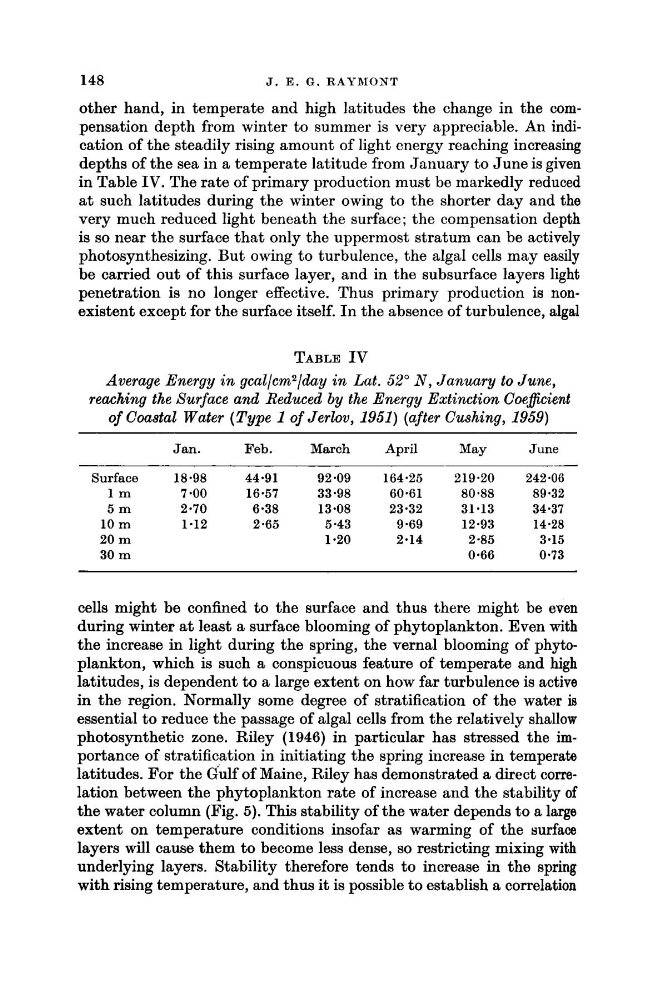
depths of the sea in a temperate latitude from January to June is given
in Table IV. The rate of primary production must be markedly reduced
at such latitudes during the winter owing to the shorter day and the
very much reduced light beneath the surface ; the compensation depth
is so near the surface that only the uppermost stratum can be actively
photosynthesizing. But owing to turbulence, the algal cells may easily
be carried out of this surface layer, and in the subsurface layers light
penetration is no longer effective. Thus primary production is nonexistent except for the surface itself. In the absence of turbulence, algal
TABLE IV
Average Energy in gcallcm2/day in Lat. 52" N , January to June,
reaching the Surface and Reduced by the Energy Extinction Coeficient
of Coastal Water (Type 1 of Jerlov, 1951) (after Cushing, 1959)
Jan.
Feb.
March
April
May
June
Surface
18-98
44.91
92-09
164.25
219.20
242.06
l m
7 -00
16.57
33.98
60.61
80.88
89.32
5 m
2-70
6-38
13.08
23-32
31-13
34-37
10 m
1.12
2.65
5 *43
9-69
12-93
14.28
20 m
1-20
2.14
2-85
3.15
30 m
0.66
0 ~ ~ 7 3
cells might be confined to the surface and thus there might be even
during winter at least a surface blooming of phytoplankton. Even with
the increase in light during the spring, the vernal blooming of phytoplankton, which is such a conspicuous feature of temperate and high
latitudes, is dependent to a large extent on how far turbulence is active
in the region. Normally some degree of stratification of the water is
essential to reduce the passage of algal cells from the relatively shallow
photosynthetic zone. Riley (1946) in particular has stressed the importance of stratification in initiating the spring increase in temperate
latitudes. For the Gulf of Maine, Riley has demonstrated a direct correlation between the phytoplankton rate of increase and the stability of
the water column (Fig. 5). This stability of the water depends to a large
extent on temperature conditions insofar as warming of the surface
layers will cause them to become less dense, so restricting mixing with
underlying layers. Stability therefore tends to increase in the spring
with rising temperature, and thus it is possible to establish a correlation
J . E . G. RAYhZONT
other hand, in temperate and high latitudes the change in the compensation depth from winter to summer is very appreciable. An indication of the steadily rising amount of light energy reaching increasing
depths of the sea in a temperate latitude from January to June is given
in Table IV. The rate of primary production must be markedly reduced
at such latitudes during the winter owing to the shorter day and the
very much reduced light beneath the surface ; the compensation depth
is so near the surface that only the uppermost stratum can be actively
photosynthesizing. But owing to turbulence, the algal cells may easily
be carried out of this surface layer, and in the subsurface layers light
penetration is no longer effective. Thus primary production is nonexistent except for the surface itself. In the absence of turbulence, algal
TABLE IV
Average Energy in gcallcm2/day in Lat. 52" N , January to June,
reaching the Surface and Reduced by the Energy Extinction Coeficient
of Coastal Water (Type 1 of Jerlov, 1951) (after Cushing, 1959)
Jan.
Feb.
March
April
May
June
Surface
18-98
44.91
92-09
164.25
219.20
242.06
l m
7 -00
16.57
33.98
60.61
80.88
89.32
5 m
2-70
6-38
13.08
23-32
31-13
34-37
10 m
1.12
2.65
5 *43
9-69
12-93
14.28
20 m
1-20
2.14
2-85
3.15
30 m
0.66
0 ~ ~ 7 3
cells might be confined to the surface and thus there might be even
during winter at least a surface blooming of phytoplankton. Even with
the increase in light during the spring, the vernal blooming of phytoplankton, which is such a conspicuous feature of temperate and high
latitudes, is dependent to a large extent on how far turbulence is active
in the region. Normally some degree of stratification of the water is
essential to reduce the passage of algal cells from the relatively shallow
photosynthetic zone. Riley (1946) in particular has stressed the importance of stratification in initiating the spring increase in temperate
latitudes. For the Gulf of Maine, Riley has demonstrated a direct correlation between the phytoplankton rate of increase and the stability of
the water column (Fig. 5). This stability of the water depends to a large
extent on temperature conditions insofar as warming of the surface
layers will cause them to become less dense, so restricting mixing with
underlying layers. Stability therefore tends to increase in the spring
with rising temperature, and thus it is possible to establish a correlation