

130
J. E. a. RAYMONT
intensities of about 5 000-7 500 lux; diatoms such as Nitzschia, Coecinodiscus, and Skeletonema became light saturated at rather higher intensities from about 10 000 to more than 20 000 lux; while species of
dinoflagellates (e.g. Exuviella, Gyrodinium, Gymnodinium) were light
saturated at much higher intensities of about 25 000-30 000 lux. For all
the species investigated, however, inhibition occurred at intensities
about 10 000 lux above the light saturation values. Steemann Nielsen
and Hansen (1959) have called attention to the different light requirements of phytoplankton from various regions and different depths.
Thus they distinguish surface arctic, surface temperate, and surface
tropical populations from other phytoplankton assemblages which occur
deeper in the euphotic zone at each of these geographical latitudes. The
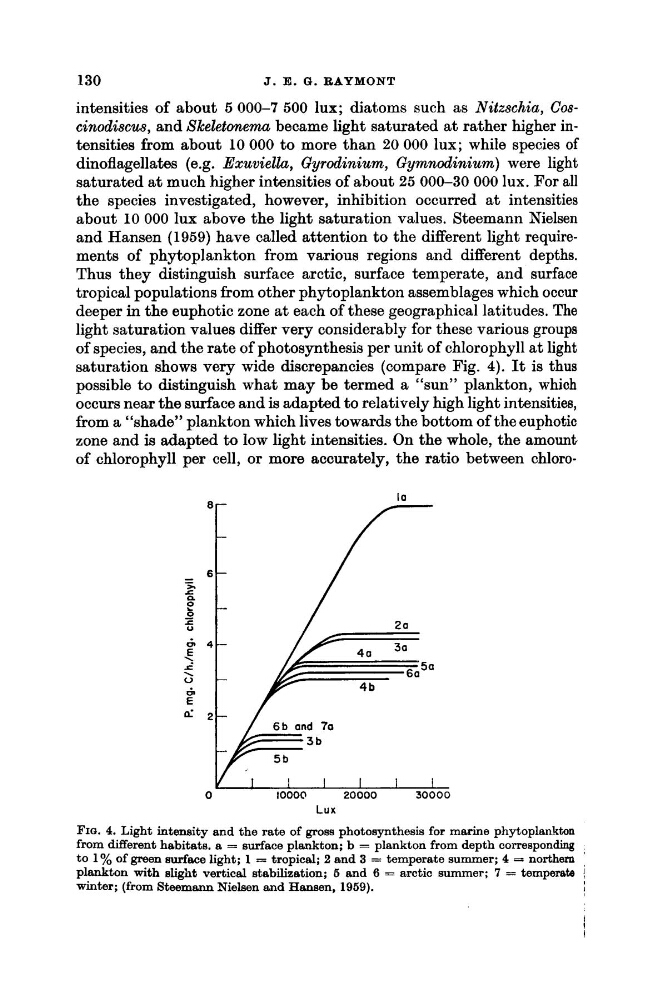
light saturation values differ very considerably for these various groups
of species, and the rate of photosynthesis per unit of chlorophyll at light
saturation shows very wide discrepancies (compare Fig. 4). It is thus
possible to distinguish what may be termed a “sun” plankton, which
occurs near the surface and is adapted to relatively high light intensities,
from a “shade” plankton which lives towards the bottom of the euphotic
zone and is adapted to low light intensities. On the whole, the amount
of chlorophyll per cell, or more accurately, the ratio between chloroLux
FIQ. 4. Light intensity and the rate of gross photosynthesis for marine phytoplanltton
from different habitats. a = surface plankton; b = plankton from depth corresponding ,
to 1% of green surface light; 1 = tropical; 2 and 3 = temperate summer; 4 = northern
plankton with slight vertical stabilizetion; 6 and 6 = arctic summer; 7 = temperate I
winter; (from Steemtmu Nielsen and Hansen, 1969).
I
J. E. a. RAYMONT
intensities of about 5 000-7 500 lux; diatoms such as Nitzschia, Coecinodiscus, and Skeletonema became light saturated at rather higher intensities from about 10 000 to more than 20 000 lux; while species of
dinoflagellates (e.g. Exuviella, Gyrodinium, Gymnodinium) were light
saturated at much higher intensities of about 25 000-30 000 lux. For all
the species investigated, however, inhibition occurred at intensities
about 10 000 lux above the light saturation values. Steemann Nielsen
and Hansen (1959) have called attention to the different light requirements of phytoplankton from various regions and different depths.
Thus they distinguish surface arctic, surface temperate, and surface
tropical populations from other phytoplankton assemblages which occur
deeper in the euphotic zone at each of these geographical latitudes. The
light saturation values differ very considerably for these various groups
of species, and the rate of photosynthesis per unit of chlorophyll at light
saturation shows very wide discrepancies (compare Fig. 4). It is thus
possible to distinguish what may be termed a “sun” plankton, which
occurs near the surface and is adapted to relatively high light intensities,
from a “shade” plankton which lives towards the bottom of the euphotic
zone and is adapted to low light intensities. On the whole, the amount
of chlorophyll per cell, or more accurately, the ratio between chloroLux
FIQ. 4. Light intensity and the rate of gross photosynthesis for marine phytoplanltton
from different habitats. a = surface plankton; b = plankton from depth corresponding ,
to 1% of green surface light; 1 = tropical; 2 and 3 = temperate summer; 4 = northern
plankton with slight vertical stabilizetion; 6 and 6 = arctic summer; 7 = temperate I
winter; (from Steemtmu Nielsen and Hansen, 1969).
I