

THE PRODUCTION O F MARINE PLANKTON
120
values. But for all of them a similar curve may be constructed for the
relationship between photosynthetic activity and light energy. A t low
light intensities the photosynthetic rate rises almost linearly with light
intensity; a less rapid rise then follows to an optimal value a t light
,
Time (h)
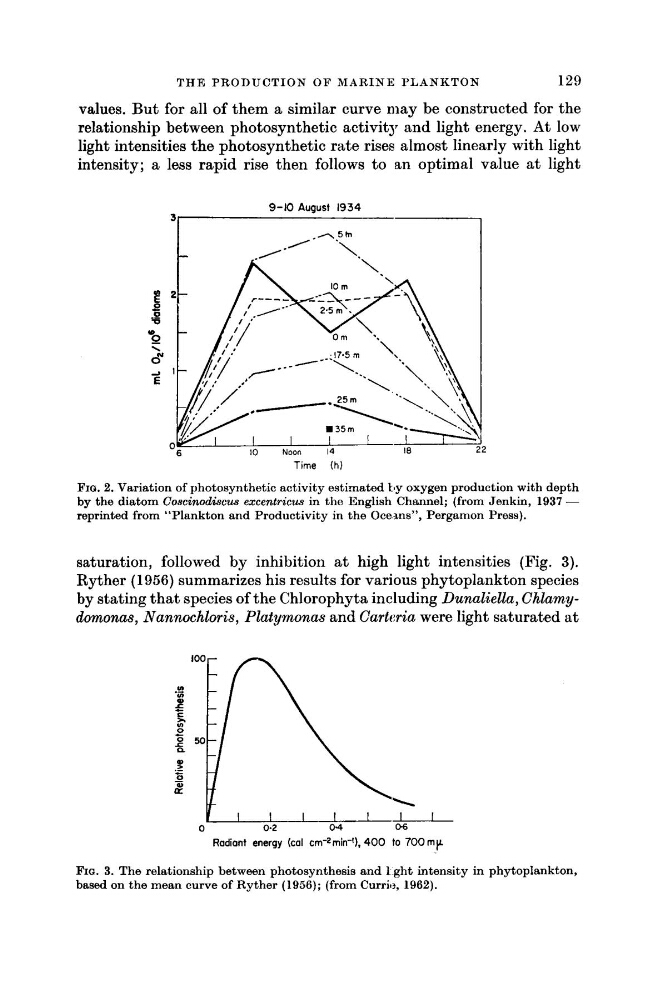
FIO. 2. Variation of photosynthetic activity estimated hy oxygen production with depth
by the diatom Coscinodkcus ezcentricus in the English Channel; (from Jenkin, 1937 -
reprinted from “Plankton and Productivity in the Oceans”, Pergamon Press).
saturation, followed by inhibition at high light intensities (Fig. 3).
Ryther (1 956) summarizes his results for various phytoplankton species
by stating that species of the Chlorophyta including Dunaliella, Chlamydomonas, Nannochloris, Platymonas and Carttiria were light saturated a t
Radiant energy (cal crn-2rnin-’1. 400 to 700 rn)L
FIO. 3. The relationship between photosynthesis and 1 ght intensity in phytoplankton,
based on the mean curve of Ryther (1956); (from Currh, 1962).
120
values. But for all of them a similar curve may be constructed for the
relationship between photosynthetic activity and light energy. A t low
light intensities the photosynthetic rate rises almost linearly with light
intensity; a less rapid rise then follows to an optimal value a t light
,
Time (h)
FIO. 2. Variation of photosynthetic activity estimated hy oxygen production with depth
by the diatom Coscinodkcus ezcentricus in the English Channel; (from Jenkin, 1937 -
reprinted from “Plankton and Productivity in the Oceans”, Pergamon Press).
saturation, followed by inhibition at high light intensities (Fig. 3).
Ryther (1 956) summarizes his results for various phytoplankton species
by stating that species of the Chlorophyta including Dunaliella, Chlamydomonas, Nannochloris, Platymonas and Carttiria were light saturated a t
Radiant energy (cal crn-2rnin-’1. 400 to 700 rn)L
FIO. 3. The relationship between photosynthesis and 1 ght intensity in phytoplankton,
based on the mean curve of Ryther (1956); (from Currh, 1962).