

234
J. HESLOP-HARRISON
species on a vernalization response, and in another upon spring photoperiod. This kind of variation could account for the exceptions to the
general rules observed in the studies of Vaartaja (1959) and McMillan
(1959).
We may take as a final example of a comprehensive investigation of
climatic adaptation the study of Oxyria digyna by Mooney and Billings
(1961). This work has combined a thorough study of the physiology of
natural populations with the imaginative use of controlled environment
cabinets, with the aim of elucidating the adaptive significance of interpopulation differences. 0. digyna in North America occurs in the arctic
tundra as far north as 83" N, and as far south as the mountains of Arizona. The populations can be ranked into two primary groups largely on
the presence or absence of rhizomes, the rhizomatous forms occurring in
the northern part of the range, and the non-rhizomatous from Alberta
southwards. Mooney and Billings studied populations from fifteen
localities throughout the North American range, and representatives of
several of these were examined under controlled environment conditions.
The principal comparison was between performances of plants of different provenance in two environments simulating '(arctic" and "alpine"
conditons respectively. The '(arctic" chamber provided growing season
conditions comparable with those of the Alaskan Arctic Coastal Plain at
71" N, with constant light and alternating 12-h thermoperiods of 55" F
and 35" P. The "alpine" chamber simulated conditions in the Medicine
Bow Mountains in Wyoming, with a 15-h photoperiod and alternating
12-h thermoperiods of 65" F day and 40" F night. Growth and development were followed under the contrasting conditions, and plants were
I
,
,
,
I
0 - 4
5-9
10-14 15-19 20-24 25-29 30-34 35-39 40-44
Temperature ("C)
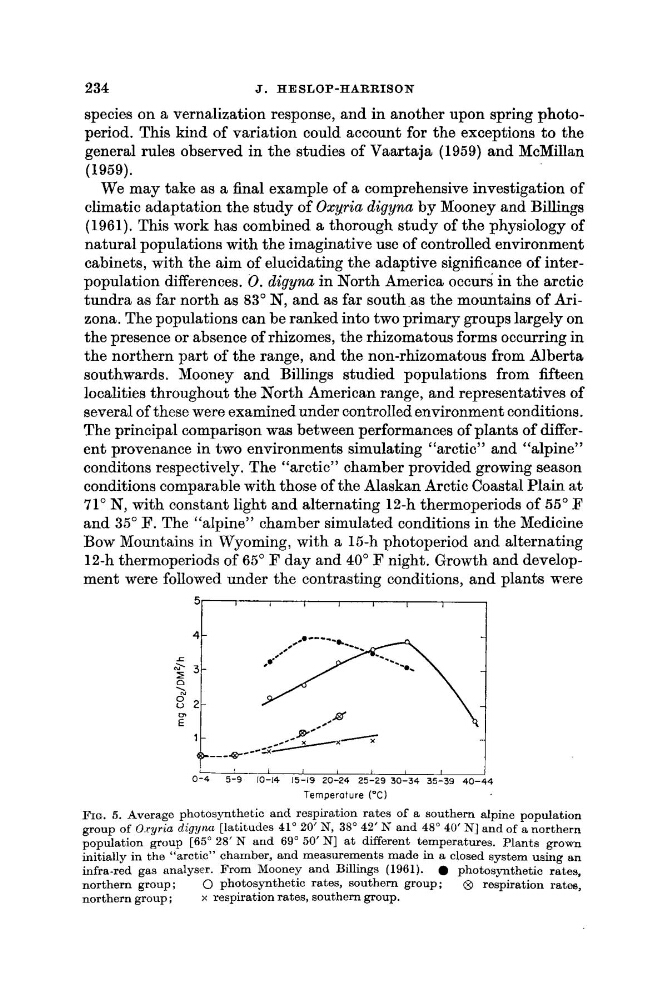
FIG. 5. Average photosynthetic and respiration rates of southern alpine population
group of 0.ryria digynn [latitudes 41" 20' N, 35" 42' N and 48" 40' N] and of a northern
population group [65O 25' N and 69" 50' N] at different temperatures. Plants grown
initially in the "arctic" chamber, and measurements made in a closed system using an
infra-red gas analyser. From Mooney and Billings (1961). 0 photosynthetic rates,
northern group;
0 photosynthetic rates, southern group; @ respiration rates,
northern group;
x respiration rates, southern group.
J. HESLOP-HARRISON
species on a vernalization response, and in another upon spring photoperiod. This kind of variation could account for the exceptions to the
general rules observed in the studies of Vaartaja (1959) and McMillan
(1959).
We may take as a final example of a comprehensive investigation of
climatic adaptation the study of Oxyria digyna by Mooney and Billings
(1961). This work has combined a thorough study of the physiology of
natural populations with the imaginative use of controlled environment
cabinets, with the aim of elucidating the adaptive significance of interpopulation differences. 0. digyna in North America occurs in the arctic
tundra as far north as 83" N, and as far south as the mountains of Arizona. The populations can be ranked into two primary groups largely on
the presence or absence of rhizomes, the rhizomatous forms occurring in
the northern part of the range, and the non-rhizomatous from Alberta
southwards. Mooney and Billings studied populations from fifteen
localities throughout the North American range, and representatives of
several of these were examined under controlled environment conditions.
The principal comparison was between performances of plants of different provenance in two environments simulating '(arctic" and "alpine"
conditons respectively. The '(arctic" chamber provided growing season
conditions comparable with those of the Alaskan Arctic Coastal Plain at
71" N, with constant light and alternating 12-h thermoperiods of 55" F
and 35" P. The "alpine" chamber simulated conditions in the Medicine
Bow Mountains in Wyoming, with a 15-h photoperiod and alternating
12-h thermoperiods of 65" F day and 40" F night. Growth and development were followed under the contrasting conditions, and plants were
I
,
,
,
I
0 - 4
5-9
10-14 15-19 20-24 25-29 30-34 35-39 40-44
Temperature ("C)
FIG. 5. Average photosynthetic and respiration rates of southern alpine population
group of 0.ryria digynn [latitudes 41" 20' N, 35" 42' N and 48" 40' N] and of a northern
population group [65O 25' N and 69" 50' N] at different temperatures. Plants grown
initially in the "arctic" chamber, and measurements made in a closed system using an
infra-red gas analyser. From Mooney and Billings (1961). 0 photosynthetic rates,
northern group;
0 photosynthetic rates, southern group; @ respiration rates,
northern group;
x respiration rates, southern group.