

FORTY YEARS OF GENECOLOGY
233
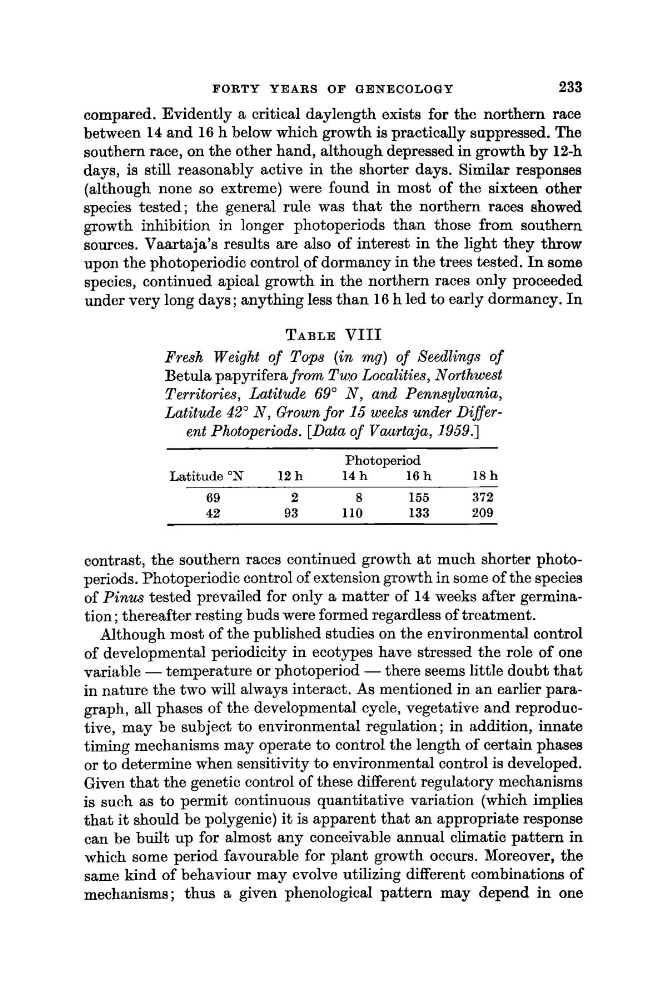
compared. Evidently a critical daylength exists for the northern race
between 14 and 16 h below which growth is practically suppressed. The
southern race, on the other hand, although depressed in growth by 12-h
days, is still reasonably active in the shorter days. Similar responses
(although none so extreme) were found in most of the sixteen other
species tested; the general rule was that the northern races showed
growth inhibition in longer photoperiods than those from southern
sources. Vaartaja's results are also of interest in the light they throw
upon the photoperiodic control.of dormancy in the trees tested. I n some
species, continued apical growth in the northern races only proceeded
under very long days ; anything less than 16 h led to early dormancy. In
TABLE V I I I
Fresh Weight of Tops (in mg) of Seedlings of
Betula papyrifera from Two Localities, Northwest
Territories, Latitude 69" N , and Pennsylvania,
Latitude 42" N , Grown for 15 weeks under Different Photoperiods. [Data of Vaurtaja, 1959.1
Photoperiod
Latitude ON
12 h
14 h
16 h
18 h
69
2
8
155
372
42
93
110
133
209
contrast, the southern races continued growth at much shorter photoperiods. Photoperiodic control of extension growth in some of the species
of Pinus tested prevailed for only a matter of 14 weeks after germination ; thereafter resting buds were formed regardless of treatment.
Although most of the published studies on the environmental control
of developmental periodicity in ecotypes have stressed the role of one
variable -temperature or photoperiod - there seems little doubt that
in nature the two will always interact. As mentioned in an earlier paragraph, all phases of the developmental cycle, vegetative and reproductive, may be subject to environmental regulation; in addition, innate
timing mechanisms may operate to control the length of certain phases
or to determine when sensitivity to environmental control is developed.
Given that the genetic control of these different regulatory mechanisms
is such as to permit continuous quantitative variation (which implies
that it should be polygenic) it is apparent that an appropriate response
can be built up for almost any conceivable annual climatic pattern in
which some period favourable for plant growth occurs. Moreover, the
same kind of behaviour may evolve utilizing different combinations of
mechanisms; thus a given phenological pattern may depend in one
233
compared. Evidently a critical daylength exists for the northern race
between 14 and 16 h below which growth is practically suppressed. The
southern race, on the other hand, although depressed in growth by 12-h
days, is still reasonably active in the shorter days. Similar responses
(although none so extreme) were found in most of the sixteen other
species tested; the general rule was that the northern races showed
growth inhibition in longer photoperiods than those from southern
sources. Vaartaja's results are also of interest in the light they throw
upon the photoperiodic control.of dormancy in the trees tested. I n some
species, continued apical growth in the northern races only proceeded
under very long days ; anything less than 16 h led to early dormancy. In
TABLE V I I I
Fresh Weight of Tops (in mg) of Seedlings of
Betula papyrifera from Two Localities, Northwest
Territories, Latitude 69" N , and Pennsylvania,
Latitude 42" N , Grown for 15 weeks under Different Photoperiods. [Data of Vaurtaja, 1959.1
Photoperiod
Latitude ON
12 h
14 h
16 h
18 h
69
2
8
155
372
42
93
110
133
209
contrast, the southern races continued growth at much shorter photoperiods. Photoperiodic control of extension growth in some of the species
of Pinus tested prevailed for only a matter of 14 weeks after germination ; thereafter resting buds were formed regardless of treatment.
Although most of the published studies on the environmental control
of developmental periodicity in ecotypes have stressed the role of one
variable -temperature or photoperiod - there seems little doubt that
in nature the two will always interact. As mentioned in an earlier paragraph, all phases of the developmental cycle, vegetative and reproductive, may be subject to environmental regulation; in addition, innate
timing mechanisms may operate to control the length of certain phases
or to determine when sensitivity to environmental control is developed.
Given that the genetic control of these different regulatory mechanisms
is such as to permit continuous quantitative variation (which implies
that it should be polygenic) it is apparent that an appropriate response
can be built up for almost any conceivable annual climatic pattern in
which some period favourable for plant growth occurs. Moreover, the
same kind of behaviour may evolve utilizing different combinations of
mechanisms; thus a given phenological pattern may depend in one