

226
J. HESLOP-HARRISON
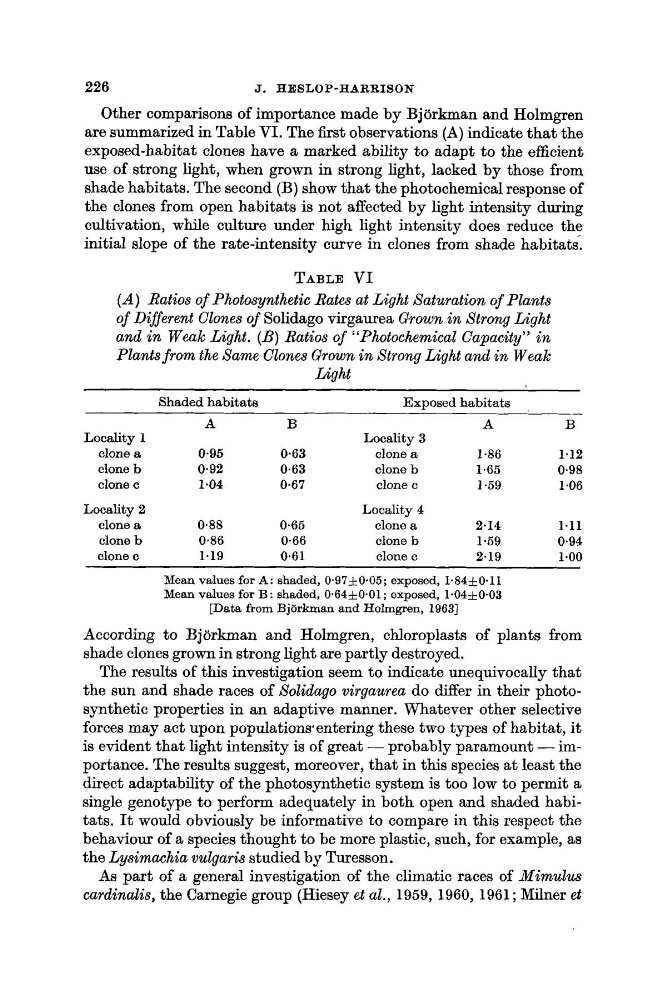
Other comparisons of importance made by Bjarkman and Holmgren
are summarized in Table VI. The first observations (A) indicate that the
exposed-habitat clones have a marked ability to adapt to the efficient
use of strong light, when grown in strong light, lacked by those from
shade habitats. The second (B) show that the photochemical response of
the clones from open habitats is not affected by light intensity during
cultivation, while culture under high light intensity does reduce the
initial slope of the rate-intensity curve in clones from shade habitats.
TABLE VI
( A ) Ratios of Photosynthetic Rates at Light Xaturation of Plants
of Different Clones of Solidago virgaurea Crown in Strong Light
and in Weak Light. (B) Ratios of “Photochemical Capacity” in
Plants from the Same Clones Crown in Strong Light and in Weak
Light
Shaded habitats
~
Exposed habitats
A
Locality 1
clone a
0.96
clone b
0.92
clone c
1.04
Locality 2
clone a
0.88
clone b
0.86
clone c
1.19
B
A
B
0.63
clone a
1.86
1.12
0.63
clone b
1.65
0.98
0.67
clone c
1.59
1.06
Locality 3
Locality 4
0.65
clone a
2.14
1.11
0.66
clone b
1.59
0.94
0.61
clone c
2-19
1.00
Mean values for A: shaded, 0.9750.05; exposed, 1+34&0.11
Mean values for B: shaded, 0*64&0.01; exposed, 1.0450.03
[Data from Bjorkman and Eolmgren, 19631
According to Bjarkman and Holmgren, chloroplasts of plants from
shade clones grown in strong light are partly destroyed.
The results of this investigation seem to indicate unequivocally that
the sun and shade races of Solidago virgaurea do differ in their photosynthetic properties in an adaptive manner. Whatever other selective
forces may act upon populationssentering these two types of habitat, it
is evident that light intensity is of great - probably paramount - importance. The results suggest, moreover, that in this species at least the
direct adaptability of the photosynthetic system is too low to permit a
single genotype to perform adequately in both open and shaded habitats. It would obviously be informative to compare in this respect the
behaviour of a species thought to be more plastic, such, for example, as
the Lysimachia vulgaris studied by Turesson.
As part of a general investigation of the climatic races of Mimulus
cardinalis, the Carnegie group (Hiesey et al., 1959, 1960, 1961 ; Milner et
J. HESLOP-HARRISON
Other comparisons of importance made by Bjarkman and Holmgren
are summarized in Table VI. The first observations (A) indicate that the
exposed-habitat clones have a marked ability to adapt to the efficient
use of strong light, when grown in strong light, lacked by those from
shade habitats. The second (B) show that the photochemical response of
the clones from open habitats is not affected by light intensity during
cultivation, while culture under high light intensity does reduce the
initial slope of the rate-intensity curve in clones from shade habitats.
TABLE VI
( A ) Ratios of Photosynthetic Rates at Light Xaturation of Plants
of Different Clones of Solidago virgaurea Crown in Strong Light
and in Weak Light. (B) Ratios of “Photochemical Capacity” in
Plants from the Same Clones Crown in Strong Light and in Weak
Light
Shaded habitats
~
Exposed habitats
A
Locality 1
clone a
0.96
clone b
0.92
clone c
1.04
Locality 2
clone a
0.88
clone b
0.86
clone c
1.19
B
A
B
0.63
clone a
1.86
1.12
0.63
clone b
1.65
0.98
0.67
clone c
1.59
1.06
Locality 3
Locality 4
0.65
clone a
2.14
1.11
0.66
clone b
1.59
0.94
0.61
clone c
2-19
1.00
Mean values for A: shaded, 0.9750.05; exposed, 1+34&0.11
Mean values for B: shaded, 0*64&0.01; exposed, 1.0450.03
[Data from Bjorkman and Eolmgren, 19631
According to Bjarkman and Holmgren, chloroplasts of plants from
shade clones grown in strong light are partly destroyed.
The results of this investigation seem to indicate unequivocally that
the sun and shade races of Solidago virgaurea do differ in their photosynthetic properties in an adaptive manner. Whatever other selective
forces may act upon populationssentering these two types of habitat, it
is evident that light intensity is of great - probably paramount - importance. The results suggest, moreover, that in this species at least the
direct adaptability of the photosynthetic system is too low to permit a
single genotype to perform adequately in both open and shaded habitats. It would obviously be informative to compare in this respect the
behaviour of a species thought to be more plastic, such, for example, as
the Lysimachia vulgaris studied by Turesson.
As part of a general investigation of the climatic races of Mimulus
cardinalis, the Carnegie group (Hiesey et al., 1959, 1960, 1961 ; Milner et