

FORTY YEARS OF GENECOLOGY
225
humidity was maintained at 70 f 5% R.H. After 4 to 8 weeks of preliminary growth, photosynthesis measurements were made and anatomical differences investigated. Mature rosette leaves were detached
and irradiated in temperature regulated, humidity controlled cells with
light from a xenon arc source. Photosynthesis was measured by monitoring the utilization of CO, with an infrared absorptiometer. Two expressions of photosynthetic activity are of importance in a comparison of
this nature : (a) the relationship between photosynthetic rate and light
intensity at low light levels (a satisfactory measure being the initial
slope of the rate-intensity curve), and (b) the photosynthetic rate at
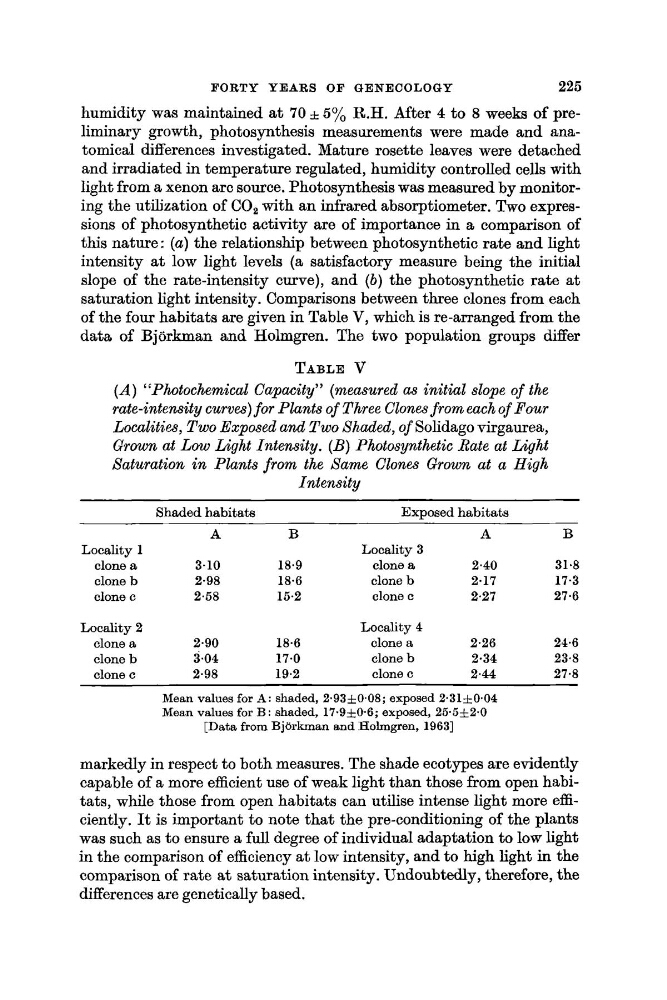
saturation light intensity. Comparisons between three clones from each
of the four habitats are given in Table V, which is re-arranged from the
data of Bjorkman and Holmgren. The two population groups differ
TABLE V
( A ) “Photochemical Capacity” (measured as initial slope of the
rate-intensity curves) for Plants of Three Clones from each of Four
Localities, Two Exposed and Two Shaded, of Solidago virgaurea,
Grown at Low Light Intensity. (B) Photosynthetic Rate at Light
Saturation in Plants from the Same Clones Grown at a High
Intensity
Shaded habit&
Exposed habitats
A
B
A
B
Locality 1
Locality 3
clone a
3.10
18.9
clone a
2.40
31.8
clone b
2.98
18.6
clone b
2.17
17.3
clone c
2.58
15.2
clone c
2.27
27.6
Locality 2
Locality 4
clone a
2.90
18.6
clone a
2.26
2 4 6
clone b
3.04
17.0
clone b
2-34
23.8
clone c
2.98
19.2
clone c
2.44
27.8
Mean values for A: shaded, 2.93h0.08; exposed 2.31&0.04
Mean values for B: shaded, 17-9&0.6; exposed, 25.552-0
[Data from Bjbrkman and Holmgren, 19631
markedly in respect to both measures. The shade ecotypes are evidently
capable of a more efficient use of weak light than those from open habitats, while those from open habitats can utilise intense light more efficiently. It is important to note that the pre-conditioning of the plants
was such as to ensure a full degree of individual adaptation to low light
in the comparison of efficiency at low intensity, and to high light in the
comparison of rate at saturation intensity. Undoubtedly, therefore, the
differences are genetically based.
225
humidity was maintained at 70 f 5% R.H. After 4 to 8 weeks of preliminary growth, photosynthesis measurements were made and anatomical differences investigated. Mature rosette leaves were detached
and irradiated in temperature regulated, humidity controlled cells with
light from a xenon arc source. Photosynthesis was measured by monitoring the utilization of CO, with an infrared absorptiometer. Two expressions of photosynthetic activity are of importance in a comparison of
this nature : (a) the relationship between photosynthetic rate and light
intensity at low light levels (a satisfactory measure being the initial
slope of the rate-intensity curve), and (b) the photosynthetic rate at
saturation light intensity. Comparisons between three clones from each
of the four habitats are given in Table V, which is re-arranged from the
data of Bjorkman and Holmgren. The two population groups differ
TABLE V
( A ) “Photochemical Capacity” (measured as initial slope of the
rate-intensity curves) for Plants of Three Clones from each of Four
Localities, Two Exposed and Two Shaded, of Solidago virgaurea,
Grown at Low Light Intensity. (B) Photosynthetic Rate at Light
Saturation in Plants from the Same Clones Grown at a High
Intensity
Shaded habit&
Exposed habitats
A
B
A
B
Locality 1
Locality 3
clone a
3.10
18.9
clone a
2.40
31.8
clone b
2.98
18.6
clone b
2.17
17.3
clone c
2.58
15.2
clone c
2.27
27.6
Locality 2
Locality 4
clone a
2.90
18.6
clone a
2.26
2 4 6
clone b
3.04
17.0
clone b
2-34
23.8
clone c
2.98
19.2
clone c
2.44
27.8
Mean values for A: shaded, 2.93h0.08; exposed 2.31&0.04
Mean values for B: shaded, 17-9&0.6; exposed, 25.552-0
[Data from Bjbrkman and Holmgren, 19631
markedly in respect to both measures. The shade ecotypes are evidently
capable of a more efficient use of weak light than those from open habitats, while those from open habitats can utilise intense light more efficiently. It is important to note that the pre-conditioning of the plants
was such as to ensure a full degree of individual adaptation to low light
in the comparison of efficiency at low intensity, and to high light in the
comparison of rate at saturation intensity. Undoubtedly, therefore, the
differences are genetically based.