

222
J. HESLOP-HARRISON
whether genetic adaptation occurs when species encounter less distinctive soil types. The best evidence so far available, that it does is that
given by Snaydon and Bradshaw (1961) for Festuca ovina. I n this study,
samples from populations growing on soils with free CaCO, (pH 7.8-8-9)
and on soils low in calcium (1.5-6.8 m.e. per lOOg Ca; pH 4.3-4-6) were
examined for their response to calcium in culture solution at levels of
5, 10, 20, 75 and 150 p.p..m. An analysis of variance showed that the
within-type x treatment interaction was insignificant, justifying the
placing of the populations in two groups, “calcareous” and “acidic”.
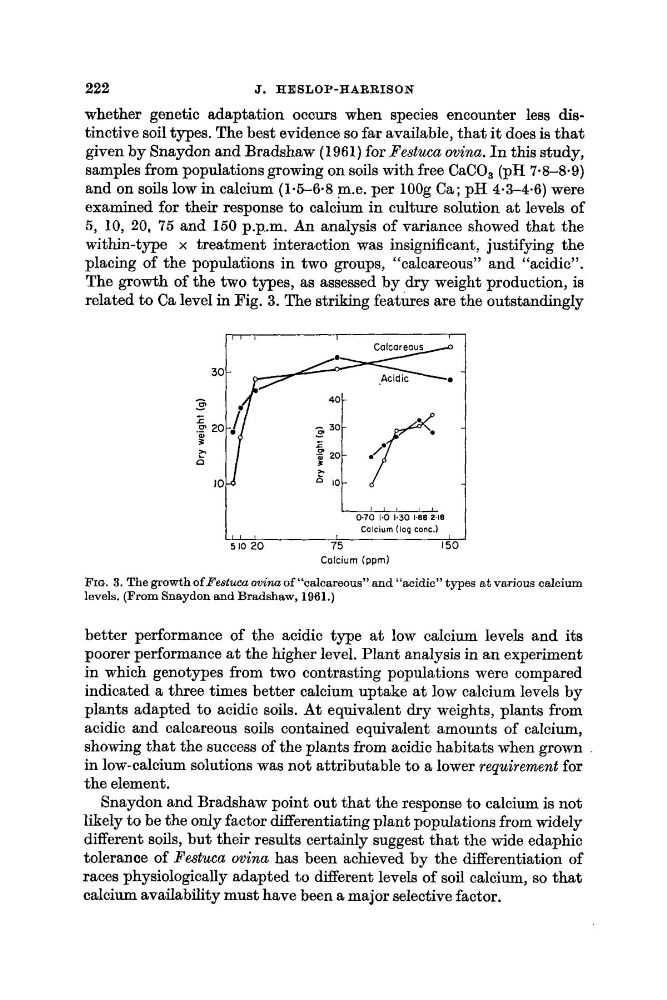
The growth of the two types, as assessed by dry weight production, is
related to Ca level in Fig. 3. The striking features are the outstandingly
I ,
1
I
I
Calcareous/
301 - 0
Acidic
I d
40 t
0.70 1. 0 1.30 1.88 2.M
Calcium (log conc.)
I
- , I
510 20
75
I50
Calcium (pprni
FIG. 3. The growth ofFestuca ovina of L‘calcareou”’ and “acidic” types at various calcium
levels. (From Snaydon and Bradshaw, 1961.)
better performance of the acidic type at low calcium levels and its
poorer performance a t the higher level. Plant analysis in an experiment
in which genotypes from two contrasting populations were compared
indicated a three times better calcium uptake at low calcium levels by
plants adapted to acidic soils. At equivalent dry weights, plants from
acidic and calcareous soils contained equivalent amounts of calcium,
showing that the success of the plants from acidic habitats when grown
in low-calcium solutions was not attributable to a lower requirement for
the element.
Snaydon and Bradshaw point out that the response to calcium is not
likely to be the only factor differentiating plant populations from widely
different soils, but their results certainly suggest that the wide edaphic
tolerance of Festuca ovina has been achieved by the differentiation of
races physiologically adapted to different levels of soil calcium, so that
calcium availability must have been a major selective factor.
J. HESLOP-HARRISON
whether genetic adaptation occurs when species encounter less distinctive soil types. The best evidence so far available, that it does is that
given by Snaydon and Bradshaw (1961) for Festuca ovina. I n this study,
samples from populations growing on soils with free CaCO, (pH 7.8-8-9)
and on soils low in calcium (1.5-6.8 m.e. per lOOg Ca; pH 4.3-4-6) were
examined for their response to calcium in culture solution at levels of
5, 10, 20, 75 and 150 p.p..m. An analysis of variance showed that the
within-type x treatment interaction was insignificant, justifying the
placing of the populations in two groups, “calcareous” and “acidic”.
The growth of the two types, as assessed by dry weight production, is
related to Ca level in Fig. 3. The striking features are the outstandingly
I ,
1
I
I
Calcareous/
301 - 0
Acidic
I d
40 t
0.70 1. 0 1.30 1.88 2.M
Calcium (log conc.)
I
- , I
510 20
75
I50
Calcium (pprni
FIG. 3. The growth ofFestuca ovina of L‘calcareou”’ and “acidic” types at various calcium
levels. (From Snaydon and Bradshaw, 1961.)
better performance of the acidic type at low calcium levels and its
poorer performance a t the higher level. Plant analysis in an experiment
in which genotypes from two contrasting populations were compared
indicated a three times better calcium uptake at low calcium levels by
plants adapted to acidic soils. At equivalent dry weights, plants from
acidic and calcareous soils contained equivalent amounts of calcium,
showing that the success of the plants from acidic habitats when grown
in low-calcium solutions was not attributable to a lower requirement for
the element.
Snaydon and Bradshaw point out that the response to calcium is not
likely to be the only factor differentiating plant populations from widely
different soils, but their results certainly suggest that the wide edaphic
tolerance of Festuca ovina has been achieved by the differentiation of
races physiologically adapted to different levels of soil calcium, so that
calcium availability must have been a major selective factor.