

LITTER PRODUCTION I N FORESTS OF THE WORLD
136
OTHER
A
LEAVES
*A,
... ,
-
-. -, #'
40
20
0
2 40
-t
-t
a
w 20
I5
0
2 40
a
2 0
IW
0
: o
3
a
40
I
I2 0
z
0
E
O
40
20
0
(4)
- 20
:AST AUSTRALIAN FORESTS, LEAVES
SCLEROPHYLL
0
I I R G l N EUCALYPTUS MARGINATA, WEST AUSTRALIA
OTHER
PlNUS NIGRA, NEW Z E A L A N D
LEAVES
0
40
.___-______ --PlNUS RADIATA, NEW Z E A L A N D
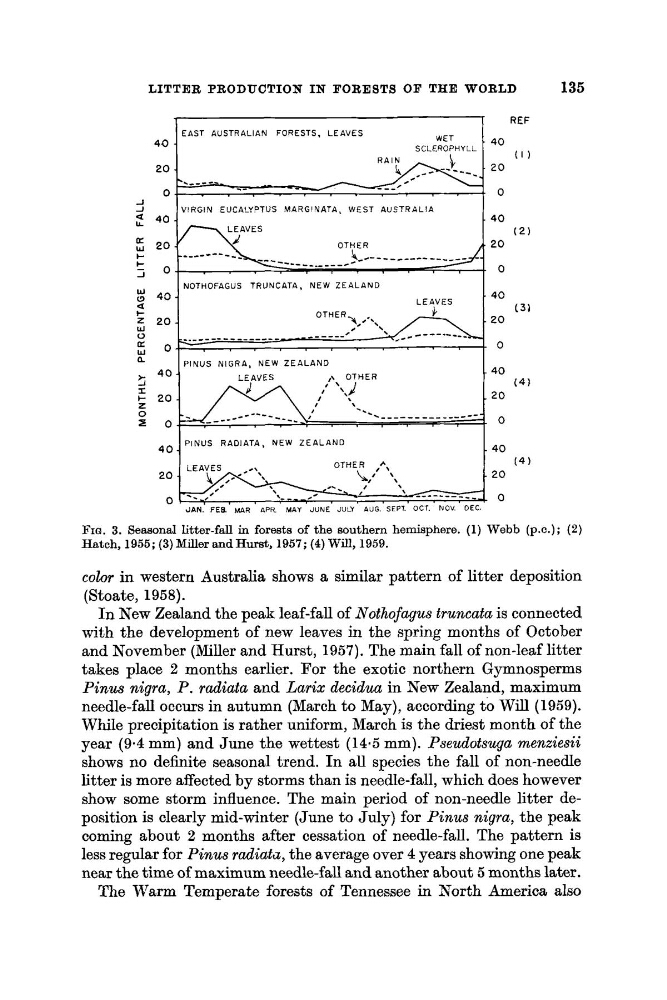
FIG. 3. Seasonal Litter-fd in forests of the southern hemkphere. (1) Webb (P.c.); (2)
Hatch, 1956; (3)Miller andHurst, 1957; (4) Will, 1959.
color in western Australia shows a similar pattern of litter deposition
(Stoate, 1958).
I n New Zealand the peak leaf-fall of Nothofagus truncata is connected
with the development of new leaves in the spring months of October
and November (Miller and Hurst, 1957). The main fall of non-leaf litter
takes place 2 months earlier. For the exotic northern Gymnosperms
Pinus nigra, P. radiata and Larix decidua in New Zealand, maximum
needle-fall occurs in autumn (March to May), according to Will (1959).
While precipitation is rather uniform, March is the driest month of the
year (9.4 mm) and June the wettest (14.5 mm). Pseudotsuga menziesii
shows no definite seasonal trend. In all species the fall of non-needle
litter is more affected by storms than is needle-fall, which does however
show some storm influence. The main period of non-needle litter deposition is clearly mid-winter (June to July) for Pinus nigra, the peak
coming about 2 months after cessation of needle-fall. The pattern is
less regular for Pinus radiata, the average over 4 years showing one peak
near the time of maximum needle-fall and another about 5 months later.
The Warm Temperate forests of Tennessee in North America also
136
OTHER
A
LEAVES
*A,
... ,
-
-. -, #'
40
20
0
2 40
-t
-t
a
w 20
I5
0
2 40
a
2 0
IW
0
: o
3
a
40
I
I2 0
z
0
E
O
40
20
0
(4)
- 20
:AST AUSTRALIAN FORESTS, LEAVES
SCLEROPHYLL
0
I I R G l N EUCALYPTUS MARGINATA, WEST AUSTRALIA
OTHER
PlNUS NIGRA, NEW Z E A L A N D
LEAVES
0
40
.___-______ --PlNUS RADIATA, NEW Z E A L A N D
FIG. 3. Seasonal Litter-fd in forests of the southern hemkphere. (1) Webb (P.c.); (2)
Hatch, 1956; (3)Miller andHurst, 1957; (4) Will, 1959.
color in western Australia shows a similar pattern of litter deposition
(Stoate, 1958).
I n New Zealand the peak leaf-fall of Nothofagus truncata is connected
with the development of new leaves in the spring months of October
and November (Miller and Hurst, 1957). The main fall of non-leaf litter
takes place 2 months earlier. For the exotic northern Gymnosperms
Pinus nigra, P. radiata and Larix decidua in New Zealand, maximum
needle-fall occurs in autumn (March to May), according to Will (1959).
While precipitation is rather uniform, March is the driest month of the
year (9.4 mm) and June the wettest (14.5 mm). Pseudotsuga menziesii
shows no definite seasonal trend. In all species the fall of non-needle
litter is more affected by storms than is needle-fall, which does however
show some storm influence. The main period of non-needle litter deposition is clearly mid-winter (June to July) for Pinus nigra, the peak
coming about 2 months after cessation of needle-fall. The pattern is
less regular for Pinus radiata, the average over 4 years showing one peak
near the time of maximum needle-fall and another about 5 months later.
The Warm Temperate forests of Tennessee in North America also