

134
J. ROGER B R A Y AND EVILLE G O R H A M
40
20
0
2 40
w 20
k
J
O
4 0
20
w
o
n.
3 40
-I
-I
! x
I2
0
n
I
0
5 20
= o
40
20
0
RAIN FOREST, COLOMBIA, TOTAL
.
.
.
RAIN FOREST, GHANA, TOTAL
. .
UNDISTURBED DIPTEROCARP FOREST, MALAYA, TOTAL
.
.
.
.
.
.
.
.
.
.
.
SECONDARY FOREST, MALAYA, TOTAL
. . . . . . . . . . .
SHOREA LEPROSULA [INDIGENOUS 1 PLANTATION, MALAYA
1
/
JAN. FEB. MAR. APR. MAY JUNE JULY AUG. SEPT. OCT.' NOV. OEC
REP.
( I )
40
20
0
40
2 0
0
40
20
0
40
20
0
4 0
20
0
( 2.)
(3)
(3)
(31
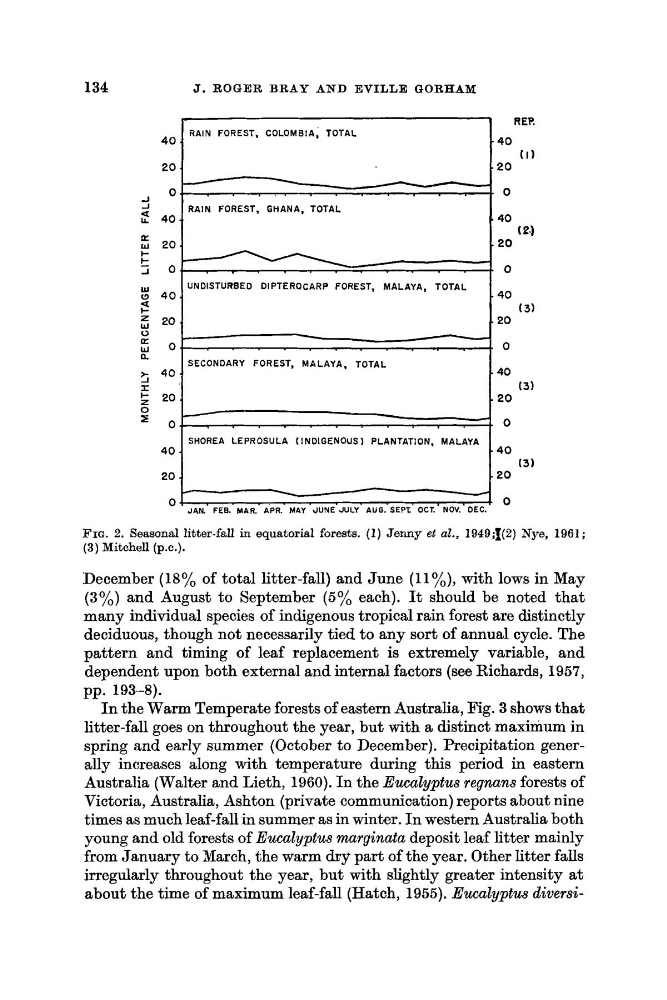
FIG. 2. Seasonal litter-fall in equatorial forests. (1) Jenny et al., 1949;1(2) Nye, 1961;
(3) Mitchell (P.c.).
December (18% of total litter-fall) and June (llx), with lows in May
(3%) and August to September (5% each). It should be noted that
many individual species of indigenous tropical rain forest are distinctly
deciduous, though not necessarily tied to any sort of annual cycle. The
pattern and timing of leaf replacement is extremely variable, and
dependent upon both external and internal factors (see Richards, 1957,
I n the Warm Temperate forests of eastern Australia, Fig. 3 shows that
litter-fall goes on throughout the year, but with a distinct maximum in
spring and early summer (October to December). Precipitation generally increases along with temperature during this period in eastern
Australia (Walter and Lieth, 1960). In the Eucalyptus regnans forests of
Victoria, Australia, Ashton (private communication) reports about nine
times as much leaf-fall in summer as in winter. In western Australia both
young and old forests of Eucalyptus marginata deposit leaf litter mainly
from January to March, the warm dry part of the year. Other litter falls
irregularly throughout the year, but with slightly greater intensity at
about the time of maximum leaf-fall (Hatch, 1955). Eucalyptus diversipp. 193-8).
J. ROGER B R A Y AND EVILLE G O R H A M
40
20
0
2 40
w 20
k
J
O
4 0
20
w
o
n.
3 40
-I
-I
! x
I2
0
n
I
0
5 20
= o
40
20
0
RAIN FOREST, COLOMBIA, TOTAL
.
.
.
RAIN FOREST, GHANA, TOTAL
. .
UNDISTURBED DIPTEROCARP FOREST, MALAYA, TOTAL
.
.
.
.
.
.
.
.
.
.
.
SECONDARY FOREST, MALAYA, TOTAL
. . . . . . . . . . .
SHOREA LEPROSULA [INDIGENOUS 1 PLANTATION, MALAYA
1
/
JAN. FEB. MAR. APR. MAY JUNE JULY AUG. SEPT. OCT.' NOV. OEC
REP.
( I )
40
20
0
40
2 0
0
40
20
0
40
20
0
4 0
20
0
( 2.)
(3)
(3)
(31
FIG. 2. Seasonal litter-fall in equatorial forests. (1) Jenny et al., 1949;1(2) Nye, 1961;
(3) Mitchell (P.c.).
December (18% of total litter-fall) and June (llx), with lows in May
(3%) and August to September (5% each). It should be noted that
many individual species of indigenous tropical rain forest are distinctly
deciduous, though not necessarily tied to any sort of annual cycle. The
pattern and timing of leaf replacement is extremely variable, and
dependent upon both external and internal factors (see Richards, 1957,
I n the Warm Temperate forests of eastern Australia, Fig. 3 shows that
litter-fall goes on throughout the year, but with a distinct maximum in
spring and early summer (October to December). Precipitation generally increases along with temperature during this period in eastern
Australia (Walter and Lieth, 1960). In the Eucalyptus regnans forests of
Victoria, Australia, Ashton (private communication) reports about nine
times as much leaf-fall in summer as in winter. In western Australia both
young and old forests of Eucalyptus marginata deposit leaf litter mainly
from January to March, the warm dry part of the year. Other litter falls
irregularly throughout the year, but with slightly greater intensity at
about the time of maximum leaf-fall (Hatch, 1955). Eucalyptus diversipp. 193-8).