

LITTER PRODUCTION IN FORESTS OF THE WORLD
119
showed stem litter ranging from 14 to 50% of total yearly litter over
four years. Non-leaf litter data in Table IV range from 2.8% in an
angiosperm stand of Bonnevie and Gjems (1957) to 55% in an Angiosperm forest of Stoate (1958). These variations emphasize that stem
litter sampling requires larger areas and longer time spans than leaf
litter sampling if accurate comparisons of the two are to be made. *
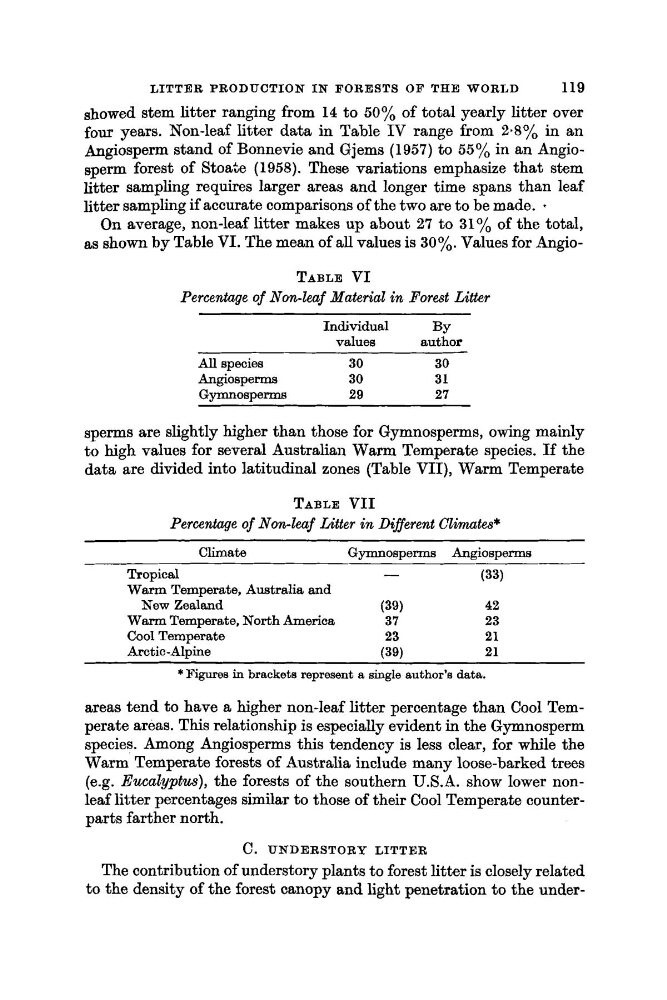
On average, non-leaf litter makes up about 27 to 31% of the total,
as shown by Table VI. The mean of all values is 30%. Values for AngioTABLE VI
Percentage of Non-leaf Material in Forest Litter
Individual
BY
values
author
A l l species
30
30
Angiosperms
30
31
Gymnosperms
29
27
sperms are slightly higher than those for Gymnosperms, owing mainly
to high values for several Australian Warm Temperate species. If the
data are divided into latitudinal zones (Table VII), Warm Temperate
TABLE VII
Percentage of Non-leaf Litter in Different Climates*
Climate
Gymnosperms Angiosperms
(33)
Tropical
-
New Zealand
(39)
42
Warm Temperate. North America
37
23
Cool Temperate
23
21
Arctic-Alpine
(39)
21
Warm Temperate, Australia and
~~
*Figures i n brackets represent a single author’s data.
areas tend to have a higher non-leaf litter percentage than Cool Temperate areas. This relationship is especially evident in the Gymnosperm
species. Among Angiosperms this tendency is less clear, for while the
Warm Temperate forests of Australia include many loose-barked trees
(e.g. Eucalyptus), the forests of the southern U.S.A. show lower nonleaf litter percentages similar to those of their Cool Temperate counterparts farther north.
c. UNDERSTORY LITTER
The contribution of understory plants to forest litter is closely related
to the density of the forest canopy and light penetration to the under-
119
showed stem litter ranging from 14 to 50% of total yearly litter over
four years. Non-leaf litter data in Table IV range from 2.8% in an
angiosperm stand of Bonnevie and Gjems (1957) to 55% in an Angiosperm forest of Stoate (1958). These variations emphasize that stem
litter sampling requires larger areas and longer time spans than leaf
litter sampling if accurate comparisons of the two are to be made. *
On average, non-leaf litter makes up about 27 to 31% of the total,
as shown by Table VI. The mean of all values is 30%. Values for AngioTABLE VI
Percentage of Non-leaf Material in Forest Litter
Individual
BY
values
author
A l l species
30
30
Angiosperms
30
31
Gymnosperms
29
27
sperms are slightly higher than those for Gymnosperms, owing mainly
to high values for several Australian Warm Temperate species. If the
data are divided into latitudinal zones (Table VII), Warm Temperate
TABLE VII
Percentage of Non-leaf Litter in Different Climates*
Climate
Gymnosperms Angiosperms
(33)
Tropical
-
New Zealand
(39)
42
Warm Temperate. North America
37
23
Cool Temperate
23
21
Arctic-Alpine
(39)
21
Warm Temperate, Australia and
~~
*Figures i n brackets represent a single author’s data.
areas tend to have a higher non-leaf litter percentage than Cool Temperate areas. This relationship is especially evident in the Gymnosperm
species. Among Angiosperms this tendency is less clear, for while the
Warm Temperate forests of Australia include many loose-barked trees
(e.g. Eucalyptus), the forests of the southern U.S.A. show lower nonleaf litter percentages similar to those of their Cool Temperate counterparts farther north.
c. UNDERSTORY LITTER
The contribution of understory plants to forest litter is closely related
to the density of the forest canopy and light penetration to the under-