

QUANTITATIVE ECOLOGY A N D WOODLAND ECOSYSTEM
137
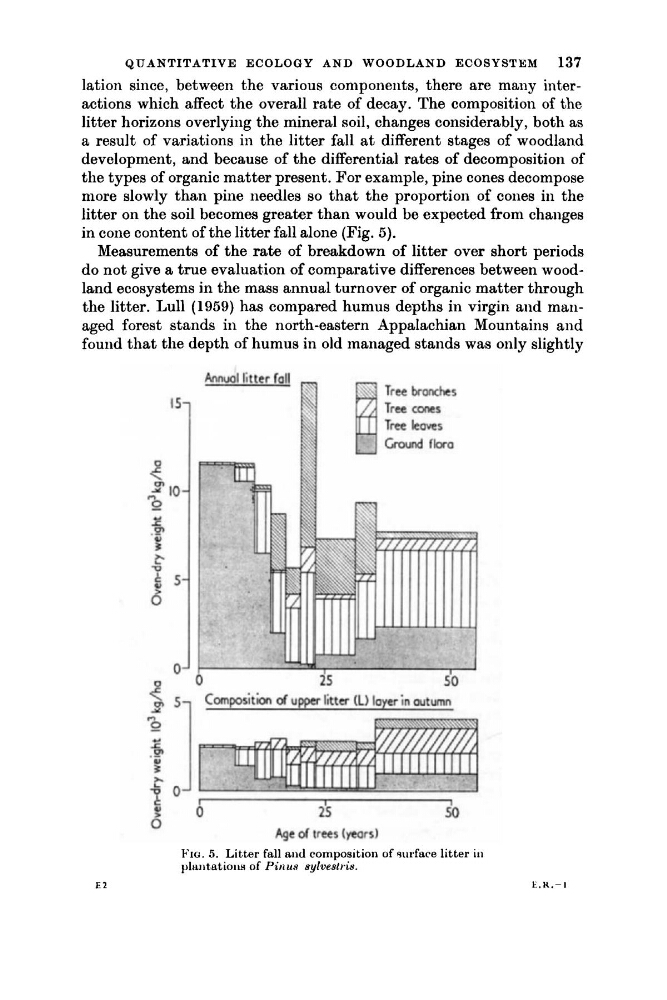
lation since, between the various components, there are many interactions which affect the overall rate of decay. The composition of the
litter horizons overlying the mineral soil, changes considerably, both as
a result of variations in the litter fall a t different stages of woodland
development, and because of the differential rates of decomposition of
the types of organic matter present. For example, pine cones decompose
more slowly than pine needles so that the proportion of cones in the
litter on the soil becomes greater than would be expected from changes
in cone content of the litter fall alone (Fig. 5).
Measurements of the rate of breakdown of litter over short periods
do not give a true evaluat,ion of comparative differences between woodland ecosystems in the mass annual turnover of organic matter through
the litter. Lull (1959) has compared humus depths in virgin and managed forest stands in the north-eastern Appalachian Mountains and
found that the depth of humus in old managed stands was only slightly
Annual litter fall
151
0
0
Tree branches
Tree cones
Tree leaves
Ground flora
0
25
SO
f
Composition of upper litter (L) layer in autumn
2 5 1
i "
I
I
w
o
2s
50
Age of trees (years)
6
FIG. 5. Litter fall and composition of surface litter ill
pllt~itatioiiv of Piiius aylveslriu.
€ 2
E . K . 7 1
137
lation since, between the various components, there are many interactions which affect the overall rate of decay. The composition of the
litter horizons overlying the mineral soil, changes considerably, both as
a result of variations in the litter fall a t different stages of woodland
development, and because of the differential rates of decomposition of
the types of organic matter present. For example, pine cones decompose
more slowly than pine needles so that the proportion of cones in the
litter on the soil becomes greater than would be expected from changes
in cone content of the litter fall alone (Fig. 5).
Measurements of the rate of breakdown of litter over short periods
do not give a true evaluat,ion of comparative differences between woodland ecosystems in the mass annual turnover of organic matter through
the litter. Lull (1959) has compared humus depths in virgin and managed forest stands in the north-eastern Appalachian Mountains and
found that the depth of humus in old managed stands was only slightly
Annual litter fall
151
0
0
Tree branches
Tree cones
Tree leaves
Ground flora
0
25
SO
f
Composition of upper litter (L) layer in autumn
2 5 1
i "
I
I
w
o
2s
50
Age of trees (years)
6
FIG. 5. Litter fall and composition of surface litter ill
pllt~itatioiiv of Piiius aylveslriu.
€ 2
E . K . 7 1