

13F
J . D. OVINGTON
5000
I
a
Y
c.l
0
2 Is)
3 250._
x
W
c
I
P
Age of trees (years)
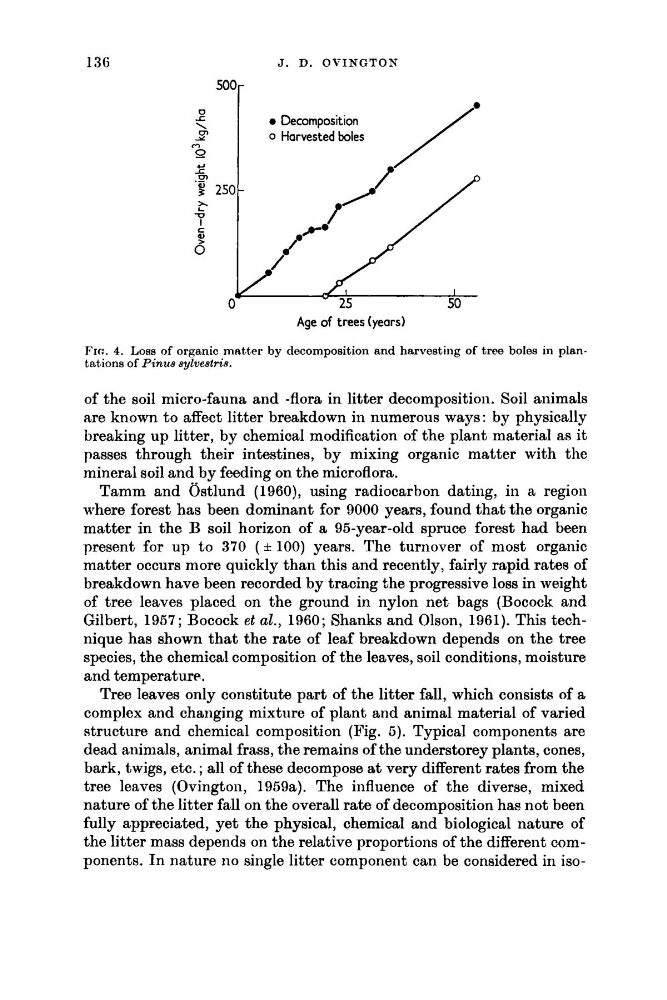
Fro. 4. Loss of orga,nic matter by clecomposition and harvesting of tree boles in plantat,ions of Pinus sylvestris.
of the soil micro-fauna and -flora in litter decomposition. Soil animals
are known t o affect litter breakdown in numerous ways: by physically
breaking up litter, by chemical modification of the plant material as it
passes through their intestines, by mixing organic matter with the
mineral soil and by feeding on the microflora.
Tamm and Ostlund (1960), using radiocarbon dating, in a region
where forest has been dominant for 9000 years, found that the organic
matter in the B soil horizon of a 95-year-old spruce forest had been
present for up t o 370 (f 100) years. The turnover of most organic
matter occurs more quickly than this and recently, fairly rapid rates of
breakdown have been recorded by tracing the progressive loss in weight
of tree leaves placed on the ground in nylon net bags (Bocock and
Gilbert, 1957; Bocock et al., 1960; Shanks and Olson, 1961). This technique has shown that the rate of leaf breakdown depends on the tree
species, the chemical composition of the leaves, soil conditions, moisture
and temperature.
Tree leaves only constitute part of the litter fall, which consists of a
complex and changing mixture of plant and animal material of varied
structure and chemical composition (Fig. 6). Typical components are
dead animals, animal frass, the remains of the understorey plants, cones,
bark, twigs, etc. ; all of these decompose a t very different rates from the
tree leaves (Ovington, 1959a). The influence of the diverse, mixed
nature of the litter fall on the overall rate of decomposition has not been
fully appreciated, yet the physical, chemical and biological nature of
the litter mass depends on the relative proportions of the different components. In nature n o single litter component can be considered in iso-
J . D. OVINGTON
5000
I
a
Y
c.l
0
2 Is)
3 250._
x
W
c
I
P
Age of trees (years)
Fro. 4. Loss of orga,nic matter by clecomposition and harvesting of tree boles in plantat,ions of Pinus sylvestris.
of the soil micro-fauna and -flora in litter decomposition. Soil animals
are known t o affect litter breakdown in numerous ways: by physically
breaking up litter, by chemical modification of the plant material as it
passes through their intestines, by mixing organic matter with the
mineral soil and by feeding on the microflora.
Tamm and Ostlund (1960), using radiocarbon dating, in a region
where forest has been dominant for 9000 years, found that the organic
matter in the B soil horizon of a 95-year-old spruce forest had been
present for up t o 370 (f 100) years. The turnover of most organic
matter occurs more quickly than this and recently, fairly rapid rates of
breakdown have been recorded by tracing the progressive loss in weight
of tree leaves placed on the ground in nylon net bags (Bocock and
Gilbert, 1957; Bocock et al., 1960; Shanks and Olson, 1961). This technique has shown that the rate of leaf breakdown depends on the tree
species, the chemical composition of the leaves, soil conditions, moisture
and temperature.
Tree leaves only constitute part of the litter fall, which consists of a
complex and changing mixture of plant and animal material of varied
structure and chemical composition (Fig. 6). Typical components are
dead animals, animal frass, the remains of the understorey plants, cones,
bark, twigs, etc. ; all of these decompose a t very different rates from the
tree leaves (Ovington, 1959a). The influence of the diverse, mixed
nature of the litter fall on the overall rate of decomposition has not been
fully appreciated, yet the physical, chemical and biological nature of
the litter mass depends on the relative proportions of the different components. In nature n o single litter component can be considered in iso-