

QUANTITATIVE ECOLOGY A N D WOODLAND ECOSYSTEM
133
Apart from instances when members of the fauna cause serious
damage t o the plant cover, progressive long term changes in the biomass of the animal organic matter am poorly documented but there
seems little doubt that they do occur. Lack (1933, 1939) for example,
has recorded the progressive changes in the avifauna following afforestation in England, and it appears likely that these changes in species of
bird present result in a change of avian biomass.
c. ORQANIC MATTER PRODUCTION
1. Net Primary Production
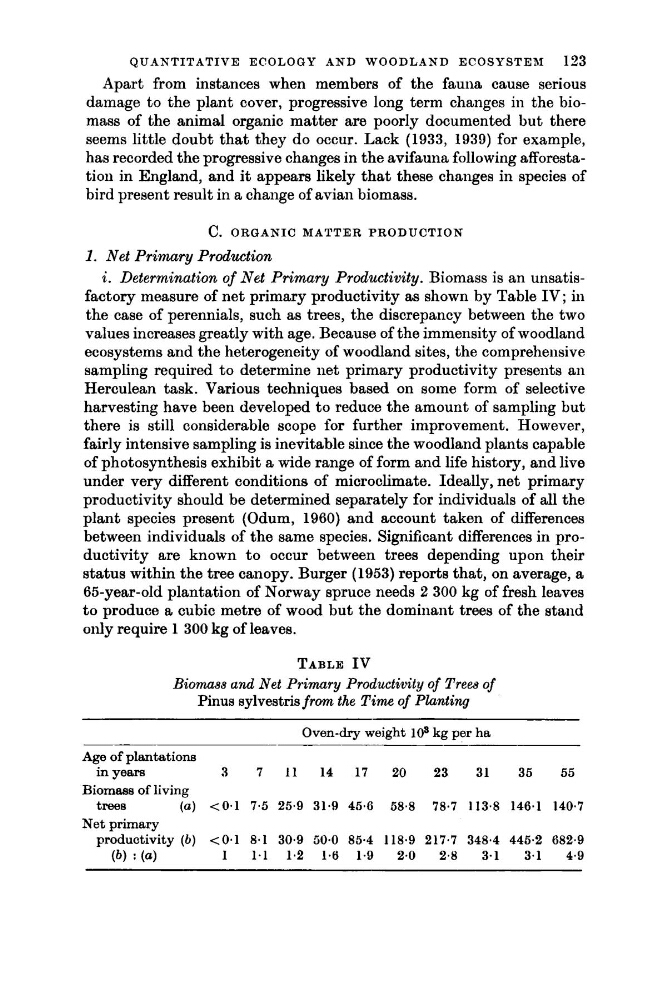
i . Determination of Net Primary Productivity. Biomass is an unsatisfactory measure of net primary productivity as shown by Table IV; in
the case of perennials, such as trees, the discrepancy between the two
values increases greatly with age. Because of the immensity of woodland
ecosystems and the heterogeneity of woodland sites, the comprehensive
sampling required t o determine net primary productivity presents an
Herculean task. Various techniques based on some form of selective
harvesting have been developed t o reduce the amount of sampling but
there is still considerable scope for further improvement. However,
fairly intensive sampling is inevitable since the woodland plants capable
of photosynthesis exhibit a wide range of form and life history, and live
under very different conditions of microclimate. Ideally, net primary
productivity should be determined separately for individuals of all the
plant species present (Odum, 1960) and account taken of differences
between individuals of the same species. Significant differences in productivity are known to occur between trees depending upon their
status within the tree canopy. Burger (1953) reports that, on average, a
65-year-old plantation of Norway spruce needs 2 300 kg of fresh leaves
t o produce a cubic metre of wood but the dominant trees of the stand
only require 1 300 kg of leaves.
TABLE IV
Biomass and Net Primary Productivity of Trees of
Pinus sylvestris frmn th Time of Planting
Oven-dry weight los kg per ha
Age of plantations
Biomass of living
Net primary
in years
3
7
1 1
14
17
20
23
31
35
55
trees
( a ) <0.1 7.5 25.9 31.9 45.6 58.8 78.7 113.8 146.1 140.7
productivity ( b ) <0.1 8.1 30.9 50.0 85.4 118.9 217.7 348.4 445.2 682.9
(b) : (a)
1
1.1 1.2 1.6 1.9
2.0
2.8
3.1
3.1
4.9
133
Apart from instances when members of the fauna cause serious
damage t o the plant cover, progressive long term changes in the biomass of the animal organic matter am poorly documented but there
seems little doubt that they do occur. Lack (1933, 1939) for example,
has recorded the progressive changes in the avifauna following afforestation in England, and it appears likely that these changes in species of
bird present result in a change of avian biomass.
c. ORQANIC MATTER PRODUCTION
1. Net Primary Production
i . Determination of Net Primary Productivity. Biomass is an unsatisfactory measure of net primary productivity as shown by Table IV; in
the case of perennials, such as trees, the discrepancy between the two
values increases greatly with age. Because of the immensity of woodland
ecosystems and the heterogeneity of woodland sites, the comprehensive
sampling required t o determine net primary productivity presents an
Herculean task. Various techniques based on some form of selective
harvesting have been developed t o reduce the amount of sampling but
there is still considerable scope for further improvement. However,
fairly intensive sampling is inevitable since the woodland plants capable
of photosynthesis exhibit a wide range of form and life history, and live
under very different conditions of microclimate. Ideally, net primary
productivity should be determined separately for individuals of all the
plant species present (Odum, 1960) and account taken of differences
between individuals of the same species. Significant differences in productivity are known to occur between trees depending upon their
status within the tree canopy. Burger (1953) reports that, on average, a
65-year-old plantation of Norway spruce needs 2 300 kg of fresh leaves
t o produce a cubic metre of wood but the dominant trees of the stand
only require 1 300 kg of leaves.
TABLE IV
Biomass and Net Primary Productivity of Trees of
Pinus sylvestris frmn th Time of Planting
Oven-dry weight los kg per ha
Age of plantations
Biomass of living
Net primary
in years
3
7
1 1
14
17
20
23
31
35
55
trees
( a ) <0.1 7.5 25.9 31.9 45.6 58.8 78.7 113.8 146.1 140.7
productivity ( b ) <0.1 8.1 30.9 50.0 85.4 118.9 217.7 348.4 445.2 682.9
(b) : (a)
1
1.1 1.2 1.6 1.9
2.0
2.8
3.1
3.1
4.9