

122
J. D. OVINOTON
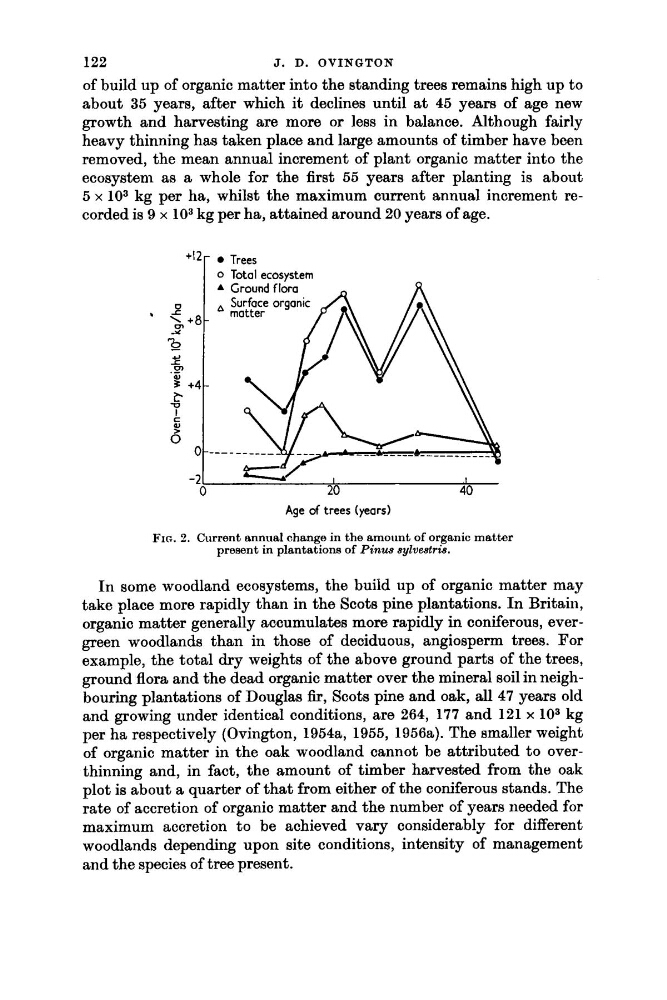
of build up of organic matter into the standing trees remains high up t o
about 35 years, after which it declines until at 45 years of age new
growth and harvesting are more or less in balance. Although fairly
heavy thinning has taken place and large amounts of timber have been
removed, the mean annual increment of plant organic matter into the
ecosystem as a whole for the first 55 years after planting is about
5 x 10³ kg per ha, whilst the maximum current annual increment recorded is 9 x lo3 kg per ha, attained around 20 years of age.
0
20
40
Age of trees (years)
FIG. 9 . Current annual change in the amount of organic matter
present in plantations of Pinus aylveatria.
In some woodland ecosystems, the build up of organic matter may
take place more rapidly than in the Scots pine plantations. In Britain,
organic matter generally accumulates more rapidly in coniferous, evergreen woodlands than in those of deciduous, angiosperm trees. For
example, the total dry weights of the above ground parts of the trees,
ground flora and the dead organic matter over the mineral soil in neighbouring plantations of Douglas fir, Scots pine and oak, all 47 years old
and growing under identical conditions, are 264, 177 and 121 x 103 kg
per ha respectively (Ovington, 1954a, 1955, 1956a). The smaller weight
of organic matter in the oak woodland cannot be attributed t o overthinning and, in fact, the amount of timber harvested from the oak
plot is about a quarter of that from either of the coniferous stands. The
rate of accretion of organic matter and the number of years needed for
maximum accretion t o be achieved vary considerably for different
woodlands depending upon site conditions, intensity of management
and the species of tree present.
J. D. OVINOTON
of build up of organic matter into the standing trees remains high up t o
about 35 years, after which it declines until at 45 years of age new
growth and harvesting are more or less in balance. Although fairly
heavy thinning has taken place and large amounts of timber have been
removed, the mean annual increment of plant organic matter into the
ecosystem as a whole for the first 55 years after planting is about
5 x 10³ kg per ha, whilst the maximum current annual increment recorded is 9 x lo3 kg per ha, attained around 20 years of age.
0
20
40
Age of trees (years)
FIG. 9 . Current annual change in the amount of organic matter
present in plantations of Pinus aylveatria.
In some woodland ecosystems, the build up of organic matter may
take place more rapidly than in the Scots pine plantations. In Britain,
organic matter generally accumulates more rapidly in coniferous, evergreen woodlands than in those of deciduous, angiosperm trees. For
example, the total dry weights of the above ground parts of the trees,
ground flora and the dead organic matter over the mineral soil in neighbouring plantations of Douglas fir, Scots pine and oak, all 47 years old
and growing under identical conditions, are 264, 177 and 121 x 103 kg
per ha respectively (Ovington, 1954a, 1955, 1956a). The smaller weight
of organic matter in the oak woodland cannot be attributed t o overthinning and, in fact, the amount of timber harvested from the oak
plot is about a quarter of that from either of the coniferous stands. The
rate of accretion of organic matter and the number of years needed for
maximum accretion t o be achieved vary considerably for different
woodlands depending upon site conditions, intensity of management
and the species of tree present.