

1. PENTOSE PHOSPHATE CYCLE
77
stituted for ribulose-l,5-diphosphate (506). This latter substitution assumes, then, that two other enzymes are active in the extracts of the
tissue, namely, phosphoribose isomerase and phosphoribulokinase. In
comparing the two citrus fruits, in all cases the enzymatic activity is
higher in the trifoliate orange tissues than in the corresponding rough
lemon tissues (506).
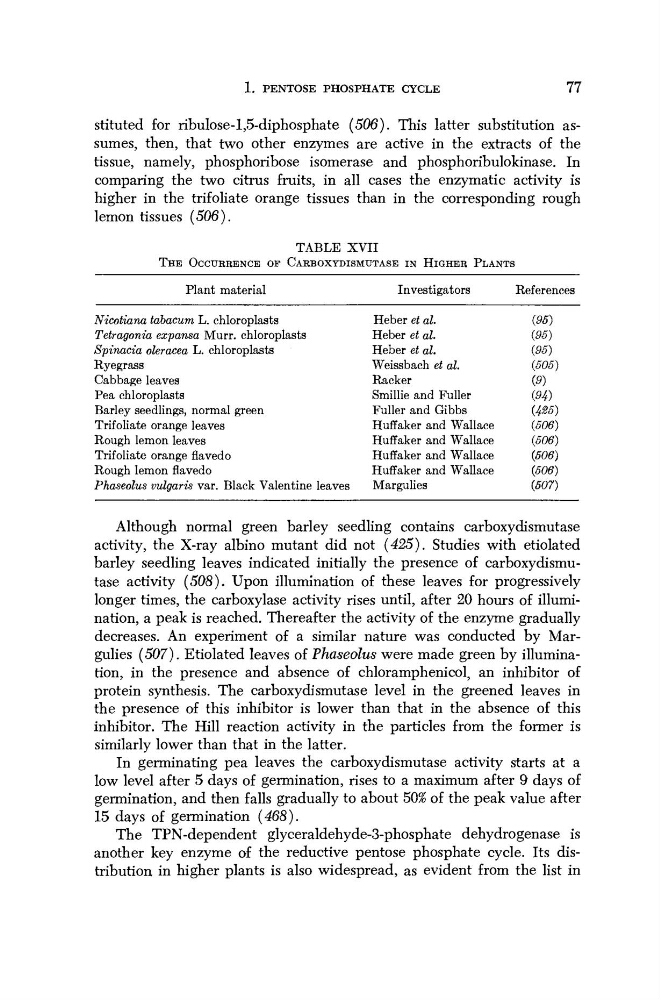
TABLE XVII
THE OCCURRENCE OF CARBOXYDISMUTASE IN HIGHER PLANTS
Plant material
Investigators
References
Nicotiana tabacum L. chloroplasts
Heber et al.
(95)
Tetragonia expansa Murr, chloroplasts
Heber et al.
(95)
Spinacia oleracea L. chloroplasts
Heber et al.
(95)
Ryegrass
Weissbach et al.
(505)
Cabbage leaves
Racker
(9)
Pea chloroplasts
Smillie and Fuller
(94)
Barley seedlings, normal green
Fuller and Gibbs
(425)
Trifoliate orange leaves
Huffaker and Wallace
(506)
Rough lemon leaves
Huffaker and Wallace
(506)
Trifoliate orange flavedo
Huffaker and Wallace
(506)
Rough lemon flavedo
Huffaker and Wallace
(506)
Phaseolus vulgaris var. Black Valentine leaves
Margulies
(507)
Although normal green barley seedling contains carboxydismutase
activity, the X-ray albino mutant did not (425). Studies with etiolated
barley seedling leaves indicated initially the presence of carboxydismutase activity (508). Upon illumination of these leaves for progressively
longer times, the carboxylase activity rises until, after 20 hours of illumination, a peak is reached. Thereafter the activity of the enzyme gradually
decreases. An experiment of a similar nature was conducted by Margulies (507). Etiolated leaves of Phaseolus were made green by illumination, in the presence and absence of chloramphenicol, an inhibitor of
protein synthesis. The carboxydismutase level in the greened leaves in
the presence of this inhibitor is lower than that in the absence of this
inhibitor. The Hill reaction activity in the particles from the former is
similarly lower than that in the latter.
In germinating pea leaves the carboxydismutase activity starts at a
low level after 5 days of germination, rises to a maximum after 9 days of
germination, and then falls gradually to about 50% of the peak value after
15 days of germination (468).
The TPN-dependent glyceraldehyde-3-phosphate dehydrogenase is
another key enzyme of the reductive pentose phosphate cycle. Its distribution in higher plants is also widespread, as evident from the list in
77
stituted for ribulose-l,5-diphosphate (506). This latter substitution assumes, then, that two other enzymes are active in the extracts of the
tissue, namely, phosphoribose isomerase and phosphoribulokinase. In
comparing the two citrus fruits, in all cases the enzymatic activity is
higher in the trifoliate orange tissues than in the corresponding rough
lemon tissues (506).
TABLE XVII
THE OCCURRENCE OF CARBOXYDISMUTASE IN HIGHER PLANTS
Plant material
Investigators
References
Nicotiana tabacum L. chloroplasts
Heber et al.
(95)
Tetragonia expansa Murr, chloroplasts
Heber et al.
(95)
Spinacia oleracea L. chloroplasts
Heber et al.
(95)
Ryegrass
Weissbach et al.
(505)
Cabbage leaves
Racker
(9)
Pea chloroplasts
Smillie and Fuller
(94)
Barley seedlings, normal green
Fuller and Gibbs
(425)
Trifoliate orange leaves
Huffaker and Wallace
(506)
Rough lemon leaves
Huffaker and Wallace
(506)
Trifoliate orange flavedo
Huffaker and Wallace
(506)
Rough lemon flavedo
Huffaker and Wallace
(506)
Phaseolus vulgaris var. Black Valentine leaves
Margulies
(507)
Although normal green barley seedling contains carboxydismutase
activity, the X-ray albino mutant did not (425). Studies with etiolated
barley seedling leaves indicated initially the presence of carboxydismutase activity (508). Upon illumination of these leaves for progressively
longer times, the carboxylase activity rises until, after 20 hours of illumination, a peak is reached. Thereafter the activity of the enzyme gradually
decreases. An experiment of a similar nature was conducted by Margulies (507). Etiolated leaves of Phaseolus were made green by illumination, in the presence and absence of chloramphenicol, an inhibitor of
protein synthesis. The carboxydismutase level in the greened leaves in
the presence of this inhibitor is lower than that in the absence of this
inhibitor. The Hill reaction activity in the particles from the former is
similarly lower than that in the latter.
In germinating pea leaves the carboxydismutase activity starts at a
low level after 5 days of germination, rises to a maximum after 9 days of
germination, and then falls gradually to about 50% of the peak value after
15 days of germination (468).
The TPN-dependent glyceraldehyde-3-phosphate dehydrogenase is
another key enzyme of the reductive pentose phosphate cycle. Its distribution in higher plants is also widespread, as evident from the list in