

5. ANTIBIOSIS AND ANTIBIOTICS
283
D-Orn—— L-Val—Leu
L-ΡΓΟ—D-Phe—D-Leu
Gramicidin Jl
(XLVIa)
D-Orn—^L-Val——L-Orn >
L-Pro-— D-Phe—- D-Leu
D-Phe
Gramicidin J2
(XLVIb)
L - Leu—- Phe ——L - Pro ——L - Val
t
I
L-Orn
L-Orn
I
i
L - Val -»— L - Pro-*- D - Phe - ·— L - Leu
L - Leu—D - Phe —-L - Pro —L - Phe
t
I
L-Orn
D-Phe
L-vL^L-TyrL -
G !
u -L -
A ^
a r a
-
tamine
gine
Gramicidin S
(XLVII)
Asp —Ala—-Asp —Glu —Leu——Asp
Tyrocidin A
(in Tyrocidin B, L-Try replaces L-Phe)
(XLVm)
Ser
Pro —Asp— Glu— Tyr— Asp — Tyr^^
Mycobacillin
(XLLX)
D-Asparagine
L-Asp—L-Ly s —L-Ileu—D -Glu— L- Leu— C— HC
CH, (L- lieu)
L-HIS
o-Orn
N
* c /
S
j
{
^CHNHg— CH— CH 2
— CH 3
D-Phe—L-Ileu
Bacitracin A
(L)
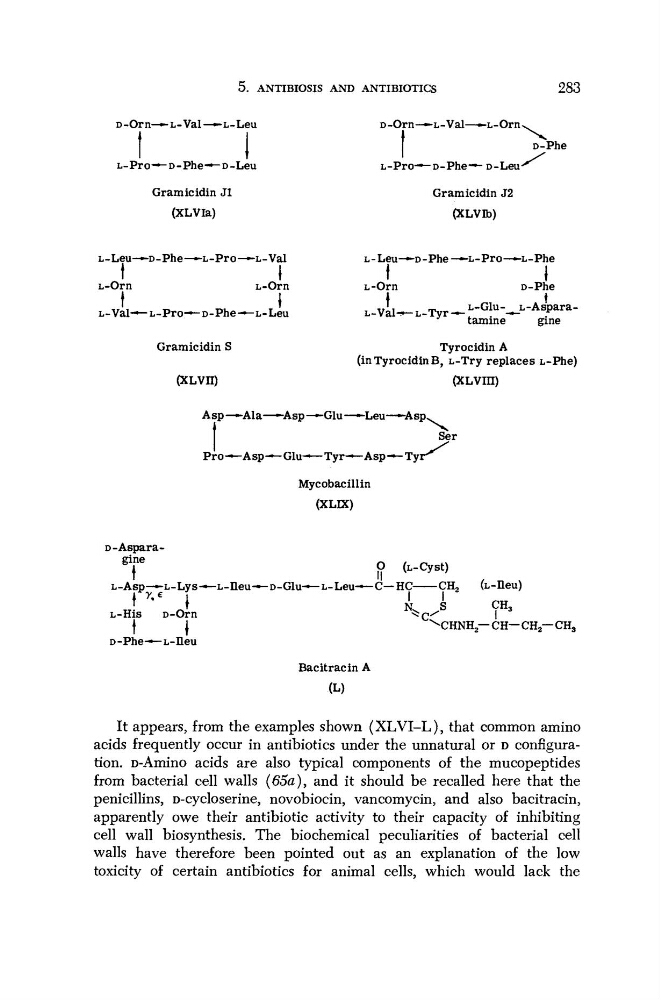
It appears, from the examples shown (XLVI-L), that common amino
acids frequently occur in antibiotics under the unnatural or D configuration. D-Amino acids are also typical components of the mucopeptides
from bacterial cell walls (65a), and it should be recalled here that the
penicillins, D-cycloserine, novobiocin, vancomycin, and also bacitracin,
apparently owe their antibiotic activity to their capacity of inhibiting
cell wall biosynthesis. The biochemical peculiarities of bacterial cell
walls have therefore been pointed out as an explanation of the low
toxicity of certain antibiotics for animal cells, which would lack the
283
D-Orn—— L-Val—Leu
L-ΡΓΟ—D-Phe—D-Leu
Gramicidin Jl
(XLVIa)
D-Orn—^L-Val——L-Orn >
L-Pro-— D-Phe—- D-Leu
D-Phe
Gramicidin J2
(XLVIb)
L - Leu—- Phe ——L - Pro ——L - Val
t
I
L-Orn
L-Orn
I
i
L - Val -»— L - Pro-*- D - Phe - ·— L - Leu
L - Leu—D - Phe —-L - Pro —L - Phe
t
I
L-Orn
D-Phe
L-vL^L-TyrL -
G !
u -L -
A ^
a r a
-
tamine
gine
Gramicidin S
(XLVII)
Asp —Ala—-Asp —Glu —Leu——Asp
Tyrocidin A
(in Tyrocidin B, L-Try replaces L-Phe)
(XLVm)
Ser
Pro —Asp— Glu— Tyr— Asp — Tyr^^
Mycobacillin
(XLLX)
D-Asparagine
L-Asp—L-Ly s —L-Ileu—D -Glu— L- Leu— C— HC
CH, (L- lieu)
L-HIS
o-Orn
N
* c /
S
j
{
^CHNHg— CH— CH 2
— CH 3
D-Phe—L-Ileu
Bacitracin A
(L)
It appears, from the examples shown (XLVI-L), that common amino
acids frequently occur in antibiotics under the unnatural or D configuration. D-Amino acids are also typical components of the mucopeptides
from bacterial cell walls (65a), and it should be recalled here that the
penicillins, D-cycloserine, novobiocin, vancomycin, and also bacitracin,
apparently owe their antibiotic activity to their capacity of inhibiting
cell wall biosynthesis. The biochemical peculiarities of bacterial cell
walls have therefore been pointed out as an explanation of the low
toxicity of certain antibiotics for animal cells, which would lack the