

274
MAURICE WELSCH
Ο
R—C—ΝΗ—CH—HC
CC
I
I I CH 3
0=C
Ν
CH—COOH
Penicillins
(see Table I for significance of R)
(XXXVIIc)
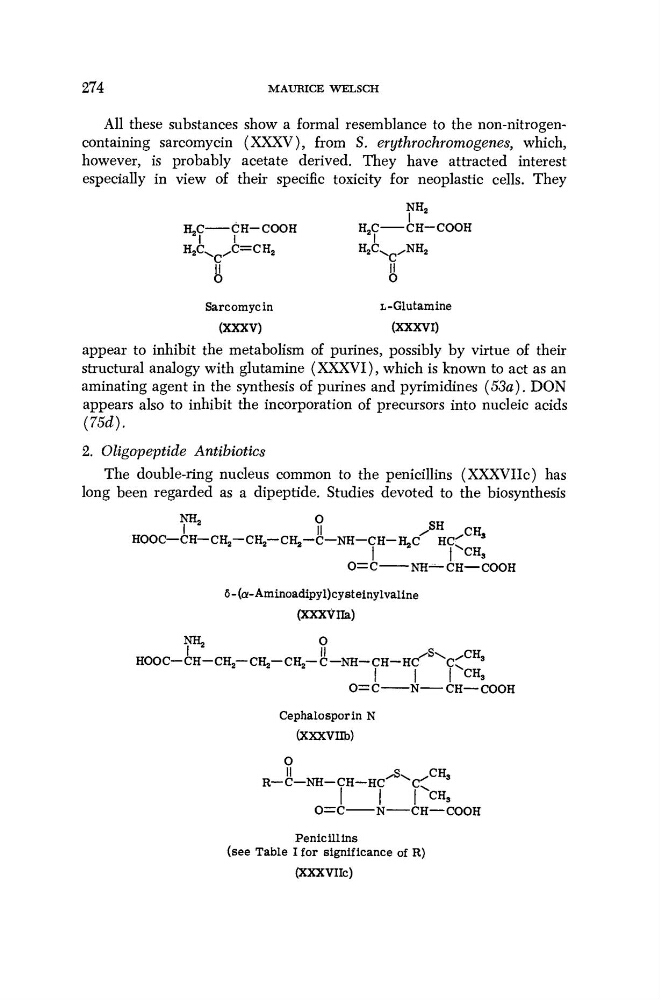
All these substances show a formal resemblance to the non-nitrogencontaining sarcomycin (XXXV), from S. erythrochromogenes, which,
however, is probably acetate derived. They have attracted interest
especially in view of their specific toxicity for neoplastic cells. They
NH 2
H 2 C
CH- COOH
H 2 C
CH- COOH
H 2 C^ C /C=CH 2
H 2 C^ c /NH 2
U
Ä
ο
ο
Sarcomycin
L-Glutamine
(XXXV)
(XXXVI)
appear to inhibit the metabolism of purines, possibly by virtue of their
structural analogy with glutamine (XXXVI), which is known to act as an
aminating agent in the synthesis of purines and pyrimidines (53a). DON
appears also to inhibit the incorporation of precursors into nucleic acids
(75d).
2. Oligopeptide
Antibiotics
The double-ring nucleus common to the penicillins (XXXVIIc) has
long been regarded as a dipeptide. Studies devoted to the biosynthesis
Ψ**
9
SfT
I
II
^
CH
HOOC—CH-CH 2 -CH 2 -CH 2 -C-NH-CH-H 2 C
HC^
3
I
PCH 3
0=C
NH-^- CH—COOH
δ - (a- Aminoadipyljcysteinylvaline
(XXXVIIa)
NH 2
Ο
HOOC—CH-CH 2 —CH 2 —CH 2 —C—NH—CH—HC^
S v
"cC
CH s
I
I
| C H 3
0= C
Ν
CH— COOH
Cephalosporin Ν
(XXXVIIb)
MAURICE WELSCH
Ο
R—C—ΝΗ—CH—HC
CC
I
I I CH 3
0=C
Ν
CH—COOH
Penicillins
(see Table I for significance of R)
(XXXVIIc)
All these substances show a formal resemblance to the non-nitrogencontaining sarcomycin (XXXV), from S. erythrochromogenes, which,
however, is probably acetate derived. They have attracted interest
especially in view of their specific toxicity for neoplastic cells. They
NH 2
H 2 C
CH- COOH
H 2 C
CH- COOH
H 2 C^ C /C=CH 2
H 2 C^ c /NH 2
U
Ä
ο
ο
Sarcomycin
L-Glutamine
(XXXV)
(XXXVI)
appear to inhibit the metabolism of purines, possibly by virtue of their
structural analogy with glutamine (XXXVI), which is known to act as an
aminating agent in the synthesis of purines and pyrimidines (53a). DON
appears also to inhibit the incorporation of precursors into nucleic acids
(75d).
2. Oligopeptide
Antibiotics
The double-ring nucleus common to the penicillins (XXXVIIc) has
long been regarded as a dipeptide. Studies devoted to the biosynthesis
Ψ**
9
SfT
I
II
^
CH
HOOC—CH-CH 2 -CH 2 -CH 2 -C-NH-CH-H 2 C
HC^
3
I
PCH 3
0=C
NH-^- CH—COOH
δ - (a- Aminoadipyljcysteinylvaline
(XXXVIIa)
NH 2
Ο
HOOC—CH-CH 2 —CH 2 —CH 2 —C—NH—CH—HC^
S v
"cC
CH s
I
I
| C H 3
0= C
Ν
CH— COOH
Cephalosporin Ν
(XXXVIIb)