

5. ANTIBIOSIS AND ANTIBIOTICS
273
NH 2
H 2 C
CH
HO
COOH
NH 2
H 2 C
CH—COOH
NH;
I
H 2 C
CH
serine
+
Ο
C=0
HO—Ν—Η
Η
Η
hydroxylamine
Ο- Car b amy 1 - D- serine
(XXXI)
D-Cycloserine
(XXXII)
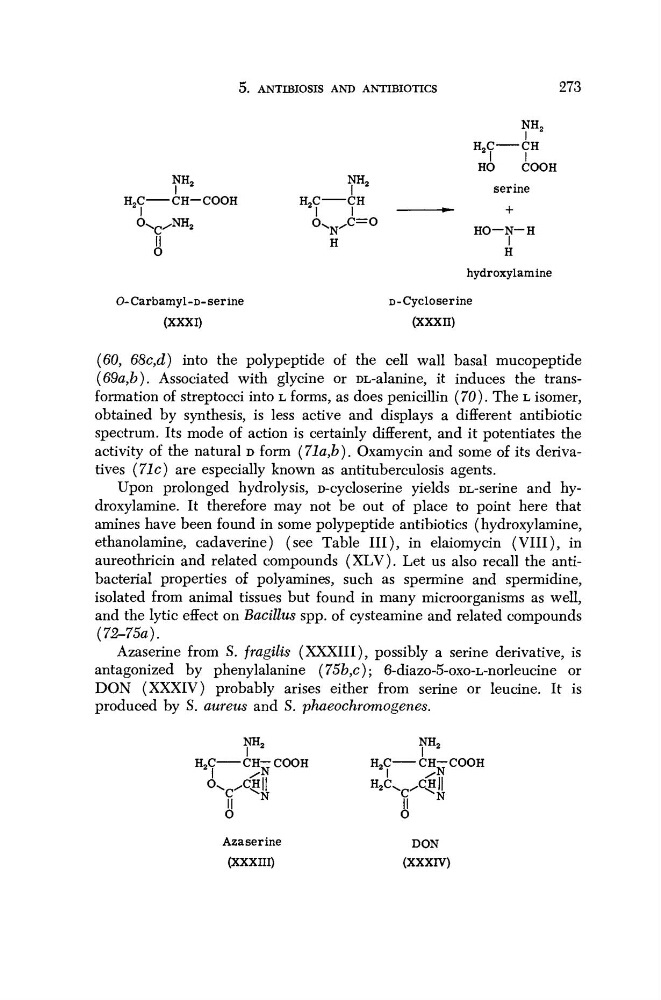
(60, 68c,d) into the polypeptide of the cell wall basal mucopeptide
(69a,b). Associated with glycine or DL-alanine, it induces the transformation of streptocci into L forms, as does penicillin (70). The L isomer,
obtained by synthesis, is less active and displays a different antibiotic
spectrum. Its mode of action is certainly different, and it potentiates the
activity of the natural D form (71a,b). Oxamycin and some of its derivatives (71c) are especially known as antituberculosis agents.
Upon prolonged hydrolysis, D-cycloserine yields DL-serine and hydroxylamine. It therefore may not be out of place to point here that
amines have been found in some polypeptide antibiotics (hydroxylamine,
ethanolamine, cadaverine) (see Table III), in elaiomycin (VIII), in
aureothricin and related compounds (XLV). Let us also recall the antibacterial properties of poly amines, such as spermine and spermidine,
isolated from animal tissues but found in many microorganisms as well,
and the lytic effect on Bacillus spp. of cysteamine and related compounds
(72-75a).
Azaserine from S. fragilis (XXXIII), possibly a serine derivative, is
antagonized by phenylalanine (75b,c);
6-diazo-5-oxo-L-norleucine or
DON (XXXIV) probably arises either from serine or leucine. It is
produced by S. aureus and S. phaeochromo genes.
NH 2
I
H 2 C
CHT-COOH
C
II
ο
Azaserine
(XXXIII)
DON
(XXXIV)
273
NH 2
H 2 C
CH
HO
COOH
NH 2
H 2 C
CH—COOH
NH;
I
H 2 C
CH
serine
+
Ο
C=0
HO—Ν—Η
Η
Η
hydroxylamine
Ο- Car b amy 1 - D- serine
(XXXI)
D-Cycloserine
(XXXII)
(60, 68c,d) into the polypeptide of the cell wall basal mucopeptide
(69a,b). Associated with glycine or DL-alanine, it induces the transformation of streptocci into L forms, as does penicillin (70). The L isomer,
obtained by synthesis, is less active and displays a different antibiotic
spectrum. Its mode of action is certainly different, and it potentiates the
activity of the natural D form (71a,b). Oxamycin and some of its derivatives (71c) are especially known as antituberculosis agents.
Upon prolonged hydrolysis, D-cycloserine yields DL-serine and hydroxylamine. It therefore may not be out of place to point here that
amines have been found in some polypeptide antibiotics (hydroxylamine,
ethanolamine, cadaverine) (see Table III), in elaiomycin (VIII), in
aureothricin and related compounds (XLV). Let us also recall the antibacterial properties of poly amines, such as spermine and spermidine,
isolated from animal tissues but found in many microorganisms as well,
and the lytic effect on Bacillus spp. of cysteamine and related compounds
(72-75a).
Azaserine from S. fragilis (XXXIII), possibly a serine derivative, is
antagonized by phenylalanine (75b,c);
6-diazo-5-oxo-L-norleucine or
DON (XXXIV) probably arises either from serine or leucine. It is
produced by S. aureus and S. phaeochromo genes.
NH 2
I
H 2 C
CHT-COOH
C
II
ο
Azaserine
(XXXIII)
DON
(XXXIV)