

174
ERNEST SCHOFFENIELS
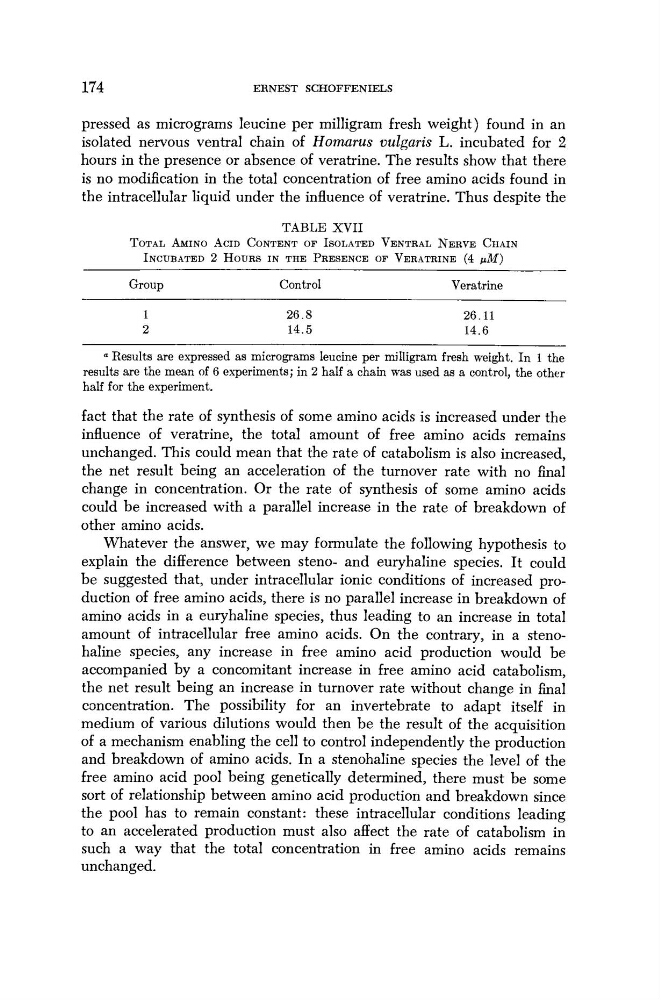
pressed as micrograms leucine per milligram fresh weight) found in an
isolated nervous ventral chain of Homarus vulgaris L. incubated for 2
hours in the presence or absence of veratrine. The results show that there
is no modification in the total concentration of free amino acids found in
the intracellular liquid under the influence of veratrine. Thus despite the
TABLE XVII
TOTAL AMINO ACID CONTENT OF ISOLATED VENTRAL NERVE CHAIN
INCUBATED 2 HOURS IN THE PRESENCE OF VERATRINE (4 μΜ)
Group
Control
Veratrine
1
26.8
26.11
2
14.5
14.6
° Results are expressed as micrograms leucine per milligram fresh weight. In 1 the
results are the mean of 6 experiments; in 2 half a chain was used as a control, the other
half for the experiment.
fact that the rate of synthesis of some amino acids is increased under the
influence of veratrine, the total amount of free amino acids remains
unchanged. This could mean that the rate of catabolism is also increased,
the net result being an acceleration of the turnover rate with no final
change in concentration. Or the rate of synthesis of some amino acids
could be increased with a parallel increase in the rate of breakdown of
other amino acids.
Whatever the answer, we may formulate the following hypothesis to
explain the difference between steno- and euryhaline species. It could
be suggested that, under intracellular ionic conditions of increased production of free amino acids, there is no parallel increase in breakdown of
amino acids in a euryhaline species, thus leading to an increase in total
amount of intracellular free amino acids. On the contrary, in a stenohaline species, any increase in free amino acid production would be
accompanied by a concomitant increase in free amino acid catabolism,
the net result being an increase in turnover rate without change in final
concentration. The possibility for an invertebrate to adapt itself in
medium of various dilutions would then be the result of the acquisition
of a mechanism enabling the cell to control independently the production
and breakdown of amino acids. In a stenohaline species the level of the
free amino acid pool being genetically determined, there must be some
sort of relationship between amino acid production and breakdown since
the pool has to remain constant: these intracellular conditions leading
to an accelerated production must also affect the rate of catabolism in
such a way that the total concentration in free amino acids remains
unchanged.
ERNEST SCHOFFENIELS
pressed as micrograms leucine per milligram fresh weight) found in an
isolated nervous ventral chain of Homarus vulgaris L. incubated for 2
hours in the presence or absence of veratrine. The results show that there
is no modification in the total concentration of free amino acids found in
the intracellular liquid under the influence of veratrine. Thus despite the
TABLE XVII
TOTAL AMINO ACID CONTENT OF ISOLATED VENTRAL NERVE CHAIN
INCUBATED 2 HOURS IN THE PRESENCE OF VERATRINE (4 μΜ)
Group
Control
Veratrine
1
26.8
26.11
2
14.5
14.6
° Results are expressed as micrograms leucine per milligram fresh weight. In 1 the
results are the mean of 6 experiments; in 2 half a chain was used as a control, the other
half for the experiment.
fact that the rate of synthesis of some amino acids is increased under the
influence of veratrine, the total amount of free amino acids remains
unchanged. This could mean that the rate of catabolism is also increased,
the net result being an acceleration of the turnover rate with no final
change in concentration. Or the rate of synthesis of some amino acids
could be increased with a parallel increase in the rate of breakdown of
other amino acids.
Whatever the answer, we may formulate the following hypothesis to
explain the difference between steno- and euryhaline species. It could
be suggested that, under intracellular ionic conditions of increased production of free amino acids, there is no parallel increase in breakdown of
amino acids in a euryhaline species, thus leading to an increase in total
amount of intracellular free amino acids. On the contrary, in a stenohaline species, any increase in free amino acid production would be
accompanied by a concomitant increase in free amino acid catabolism,
the net result being an increase in turnover rate without change in final
concentration. The possibility for an invertebrate to adapt itself in
medium of various dilutions would then be the result of the acquisition
of a mechanism enabling the cell to control independently the production
and breakdown of amino acids. In a stenohaline species the level of the
free amino acid pool being genetically determined, there must be some
sort of relationship between amino acid production and breakdown since
the pool has to remain constant: these intracellular conditions leading
to an accelerated production must also affect the rate of catabolism in
such a way that the total concentration in free amino acids remains
unchanged.