

3. CELLULAR ASPECTS OF ACTIVE TRANSPORT
167
solution, the active transport of Na is inhibited; in the presence of
glucose or of an actively transported amino acid, it is stimulated. There
is thus a reciprocal relation in the active transport of inorganic and
organic ions or molecules.
Many hypothesis may be formulated to explain this reciprocity. Let
us first consider the effect of amino acids on the potential difference and
the short circuit current of the intestinal epithelium. The fact that only
those amino acids which are actively transported are able to modify the
bioelectric potential could suggest that the activation of the transport
60 h
Μ NaCI 130125 115
80
300
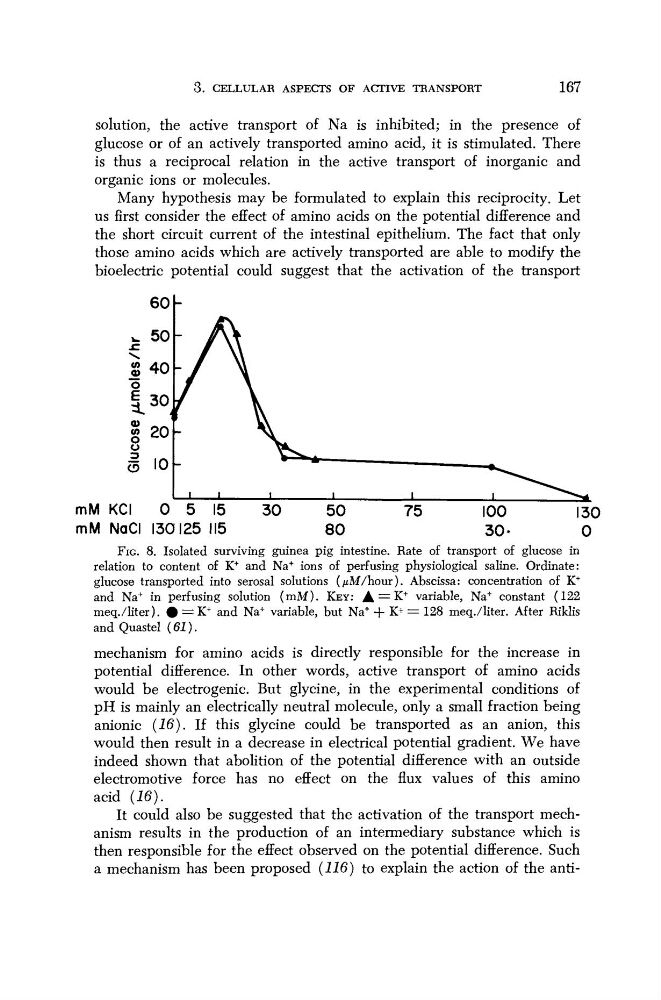
FIG. 8. Isolated surviving guinea pig intestine. Rate of transport of glucose in
relation to content of K
+ and Na
+ ions of perfusing physiological saline. Ordinate:
glucose transported into serosal solutions (μΜ/hour). Abscissa: concentration of K
+
and Na
+ in perfusing solution (mM). KEY: A — K
+ variable, Na
+ constant (122
meq./liter). · = K
+ and Na
+ variable, but Na
+ + K+ = 128 meq./liter. After Riklis
and Quastel (61).
mechanism for amino acids is directly responsible for the increase in
potential difference. In other words, active transport of amino acids
would be electrogenic. But glycine, in the experimental conditions of
pH is mainly an electrically neutral molecule, only a small fraction being
anionic (16). If this glycine could be transported as an anion, this
would then result in a decrease in electrical potential gradient. We have
indeed shown that abolition of the potential difference with an outside
electromotive force has no effect on the flux values of this amino
acid (16).
It could also be suggested that the activation of the transport mechanism results in the production of an intermediary substance which is
then responsible for the effect observed on the potential difference. Such
a mechanism has been proposed (116) to explain the action of the anti-
167
solution, the active transport of Na is inhibited; in the presence of
glucose or of an actively transported amino acid, it is stimulated. There
is thus a reciprocal relation in the active transport of inorganic and
organic ions or molecules.
Many hypothesis may be formulated to explain this reciprocity. Let
us first consider the effect of amino acids on the potential difference and
the short circuit current of the intestinal epithelium. The fact that only
those amino acids which are actively transported are able to modify the
bioelectric potential could suggest that the activation of the transport
60 h
Μ NaCI 130125 115
80
300
FIG. 8. Isolated surviving guinea pig intestine. Rate of transport of glucose in
relation to content of K
+ and Na
+ ions of perfusing physiological saline. Ordinate:
glucose transported into serosal solutions (μΜ/hour). Abscissa: concentration of K
+
and Na
+ in perfusing solution (mM). KEY: A — K
+ variable, Na
+ constant (122
meq./liter). · = K
+ and Na
+ variable, but Na
+ + K+ = 128 meq./liter. After Riklis
and Quastel (61).
mechanism for amino acids is directly responsible for the increase in
potential difference. In other words, active transport of amino acids
would be electrogenic. But glycine, in the experimental conditions of
pH is mainly an electrically neutral molecule, only a small fraction being
anionic (16). If this glycine could be transported as an anion, this
would then result in a decrease in electrical potential gradient. We have
indeed shown that abolition of the potential difference with an outside
electromotive force has no effect on the flux values of this amino
acid (16).
It could also be suggested that the activation of the transport mechanism results in the production of an intermediary substance which is
then responsible for the effect observed on the potential difference. Such
a mechanism has been proposed (116) to explain the action of the anti-