

166
ERNEST SCHOFFENIELS
transported, whereas it remains unchanged with the others (Fig. 6).
However, in the case of L-glutamic acid, although the potential is
never affected, the short-circuit current always increases.
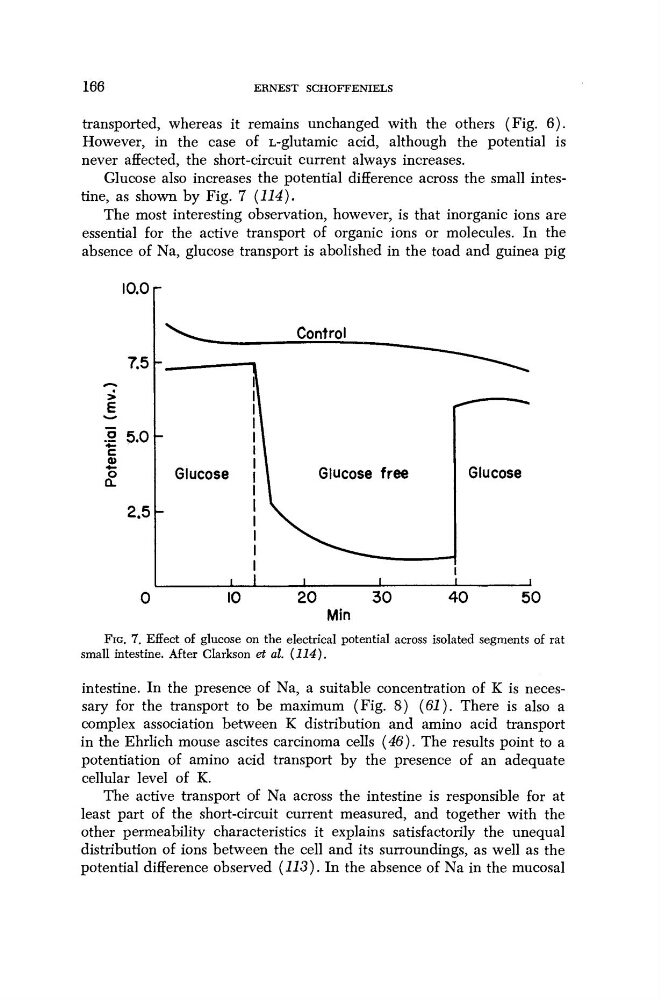
Glucose also increases the potential difference across the small intestine, as shown by Fig. 7 (114).
The most interesting observation, however, is that inorganic ions are
essential for the active transport of organic ions or molecules. In the
absence of Na, glucose transport is abolished in the toad and guinea pig
10.0 γ
7.5 h
>
Ε
.2 5.0 h
Q)
2.5
Λ—
Control
Glucose
ι 1
Glucose free
Glucose
!
ι 1
10
20
30
40
50
Min
FIG. 7. Effect of glucose on the electrical potential across isolated segments of rat
small intestine. After Clarkson et al. (114).
intestine. In the presence of Na, a suitable concentration of Κ is necessary for the transport to be maximum (Fig. 8) (61). There is also a
complex association between Κ distribution and amino acid transport
in the Ehrlich mouse ascites carcinoma cells (46). The results point to a
potentiation of amino acid transport by the presence of an adequate
cellular level of K.
The active transport of Na across the intestine is responsible for at
least part of the short-circuit current measured, and together with the
other permeability characteristics it explains satisfactorily the unequal
distribution of ions between the cell and its surroundings, as well as the
potential difference observed (113). In the absence of Na in the mucosal
ERNEST SCHOFFENIELS
transported, whereas it remains unchanged with the others (Fig. 6).
However, in the case of L-glutamic acid, although the potential is
never affected, the short-circuit current always increases.
Glucose also increases the potential difference across the small intestine, as shown by Fig. 7 (114).
The most interesting observation, however, is that inorganic ions are
essential for the active transport of organic ions or molecules. In the
absence of Na, glucose transport is abolished in the toad and guinea pig
10.0 γ
7.5 h
>
Ε
.2 5.0 h
Q)
2.5
Λ—
Control
Glucose
ι 1
Glucose free
Glucose
!
ι 1
10
20
30
40
50
Min
FIG. 7. Effect of glucose on the electrical potential across isolated segments of rat
small intestine. After Clarkson et al. (114).
intestine. In the presence of Na, a suitable concentration of Κ is necessary for the transport to be maximum (Fig. 8) (61). There is also a
complex association between Κ distribution and amino acid transport
in the Ehrlich mouse ascites carcinoma cells (46). The results point to a
potentiation of amino acid transport by the presence of an adequate
cellular level of K.
The active transport of Na across the intestine is responsible for at
least part of the short-circuit current measured, and together with the
other permeability characteristics it explains satisfactorily the unequal
distribution of ions between the cell and its surroundings, as well as the
potential difference observed (113). In the absence of Na in the mucosal