

3. CELLULAR ASPECTS OF ACTIVE TRANSPORT
163
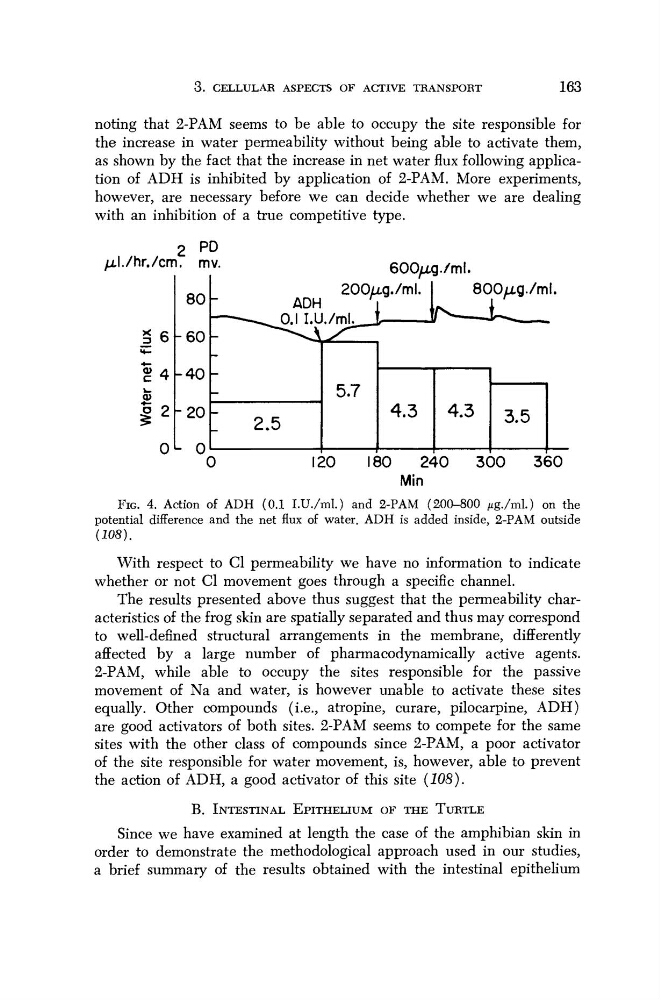
noting that 2-PAM seems to be able to occupy the site responsible for
the increase in water permeability without being able to activate them,
as shown by the fact that the increase in net water flux following application of ADH is inhibited by application of 2-PAM. More experiments,
however, are necessary before we can decide whether we are dealing
with an inhibition of a true competitive type.
2
PD
μ,Ι./hr./cm. mv.
80
X
JD
6 -60
πω
c 4 -40
ν1
2 -20
0 -
0
600/xg./ml.
200μ.ς./ιυΙ.
ADH
r
0.1 I.U./ml.
A. "
800^.g./ml.
2.5
5.7
4.3
120
4.3
3.5
180
240
Min
300
360
FIG. 4. Action of ADH (0.1 I.U./ml.) and 2-PAM (200-800 /tg./ml.) on the
potential difference and the net flux of water. ADH is added inside, 2-PAM outside
(108).
With respect to CI permeability we have no information to indicate
whether or not CI movement goes through a specific channel.
The results presented above thus suggest that the permeability characteristics of the frog skin are spatially separated and thus may correspond
to well-defined structural arrangements in the membrane, differently
affected by a large number of pharmacodynamically active agents.
2-PAM, while able to occupy the sites responsible for the passive
movement of Na and water, is however unable to activate these sites
equally. Other compounds (i.e., atropine, curare, pilocarpine, ADH)
are good activators of both sites. 2-PAM seems to compete for the same
sites with the other class of compounds since 2-PAM, a poor activator
of the site responsible for water movement, is, however, able to prevent
the action of ADH, a good activator of this site (108).
B. INTESTINAL EPITHELIUM OF THE TURTLE
Since we have examined at length the case of the amphibian skin in
order to demonstrate the methodological approach used in our studies,
a brief summary of the results obtained with the intestinal epithelium
163
noting that 2-PAM seems to be able to occupy the site responsible for
the increase in water permeability without being able to activate them,
as shown by the fact that the increase in net water flux following application of ADH is inhibited by application of 2-PAM. More experiments,
however, are necessary before we can decide whether we are dealing
with an inhibition of a true competitive type.
2
PD
μ,Ι./hr./cm. mv.
80
X
JD
6 -60
πω
c 4 -40
ν1
2 -20
0 -
0
600/xg./ml.
200μ.ς./ιυΙ.
ADH
r
0.1 I.U./ml.
A. "
800^.g./ml.
2.5
5.7
4.3
120
4.3
3.5
180
240
Min
300
360
FIG. 4. Action of ADH (0.1 I.U./ml.) and 2-PAM (200-800 /tg./ml.) on the
potential difference and the net flux of water. ADH is added inside, 2-PAM outside
(108).
With respect to CI permeability we have no information to indicate
whether or not CI movement goes through a specific channel.
The results presented above thus suggest that the permeability characteristics of the frog skin are spatially separated and thus may correspond
to well-defined structural arrangements in the membrane, differently
affected by a large number of pharmacodynamically active agents.
2-PAM, while able to occupy the sites responsible for the passive
movement of Na and water, is however unable to activate these sites
equally. Other compounds (i.e., atropine, curare, pilocarpine, ADH)
are good activators of both sites. 2-PAM seems to compete for the same
sites with the other class of compounds since 2-PAM, a poor activator
of the site responsible for water movement, is, however, able to prevent
the action of ADH, a good activator of this site (108).
B. INTESTINAL EPITHELIUM OF THE TURTLE
Since we have examined at length the case of the amphibian skin in
order to demonstrate the methodological approach used in our studies,
a brief summary of the results obtained with the intestinal epithelium