

162
ERNEST SCHOFFENIELS
consistently enhanced. This again is a confirmation of previous results
concerning the capricious way in which R. temporaria responds to curare
and other neurotropic compounds. Although alternative explanations are
possible, these results may suggest that the increase in water and Na
permeabilities are two independent processes: thus, water and Na move
through different channels in the frog skin. This explanation seems to
be very likely if one considers the following.
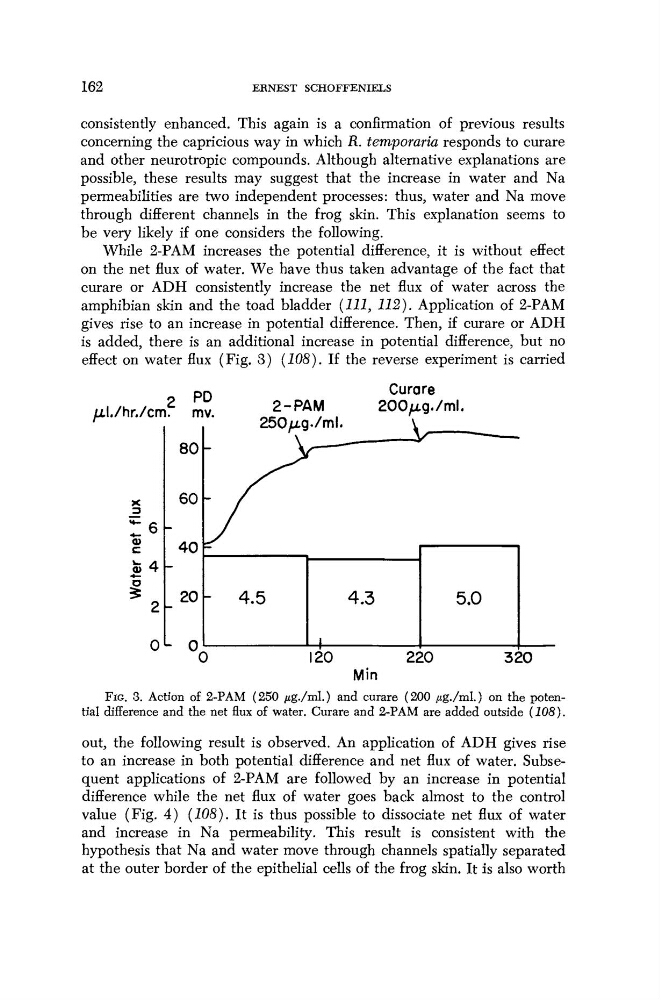
While 2-PAM increases the potential difference, it is without effect
on the net flux of water. We have thus taken advantage of the fact that
curare or ADH consistently increase the net flux of water across the
amphibian skin and the toad bladder (III, 112). Application of 2-PAM
gives rise to an increase in potential difference. Then, if curare or ADH
is added, there is an additional increase in potential difference, but no
effect on water flux (Fig. 3) (108). If the reverse experiment is carried
2
PD
μί/hr./cm.
mv.
80 h
3
0)
c
Ό
60
40
20
2-PAM
250yxg./ml
Curare
200/xg./ml.
0
120
220
320
Min
FIG. 3. Action of 2-PAM (250 /tg./ml.) and curare (200 /ig./ml.) on the potential difference and the net flux of water. Curare and 2-PAM are added outside (108).
out, the following result is observed. An application of ADH gives rise
to an increase in both potential difference and net flux of water. Subsequent applications of 2-PAM are followed by an increase in potential
difference while the net flux of water goes back almost to the control
value (Fig. 4) (108). It is thus possible to dissociate net flux of water
and increase in Na permeability. This result is consistent with the
hypothesis that Na and water move through channels spatially separated
at the outer border of the epithelial cells of the frog skin. It is also worth
ERNEST SCHOFFENIELS
consistently enhanced. This again is a confirmation of previous results
concerning the capricious way in which R. temporaria responds to curare
and other neurotropic compounds. Although alternative explanations are
possible, these results may suggest that the increase in water and Na
permeabilities are two independent processes: thus, water and Na move
through different channels in the frog skin. This explanation seems to
be very likely if one considers the following.
While 2-PAM increases the potential difference, it is without effect
on the net flux of water. We have thus taken advantage of the fact that
curare or ADH consistently increase the net flux of water across the
amphibian skin and the toad bladder (III, 112). Application of 2-PAM
gives rise to an increase in potential difference. Then, if curare or ADH
is added, there is an additional increase in potential difference, but no
effect on water flux (Fig. 3) (108). If the reverse experiment is carried
2
PD
μί/hr./cm.
mv.
80 h
3
0)
c
Ό
60
40
20
2-PAM
250yxg./ml
Curare
200/xg./ml.
0
120
220
320
Min
FIG. 3. Action of 2-PAM (250 /tg./ml.) and curare (200 /ig./ml.) on the potential difference and the net flux of water. Curare and 2-PAM are added outside (108).
out, the following result is observed. An application of ADH gives rise
to an increase in both potential difference and net flux of water. Subsequent applications of 2-PAM are followed by an increase in potential
difference while the net flux of water goes back almost to the control
value (Fig. 4) (108). It is thus possible to dissociate net flux of water
and increase in Na permeability. This result is consistent with the
hypothesis that Na and water move through channels spatially separated
at the outer border of the epithelial cells of the frog skin. It is also worth