

3. CELLULAR ASPECTS OF ACTIVE TRANSPORT
159
rise to a diffusion potential which makes the cell positive in relation to
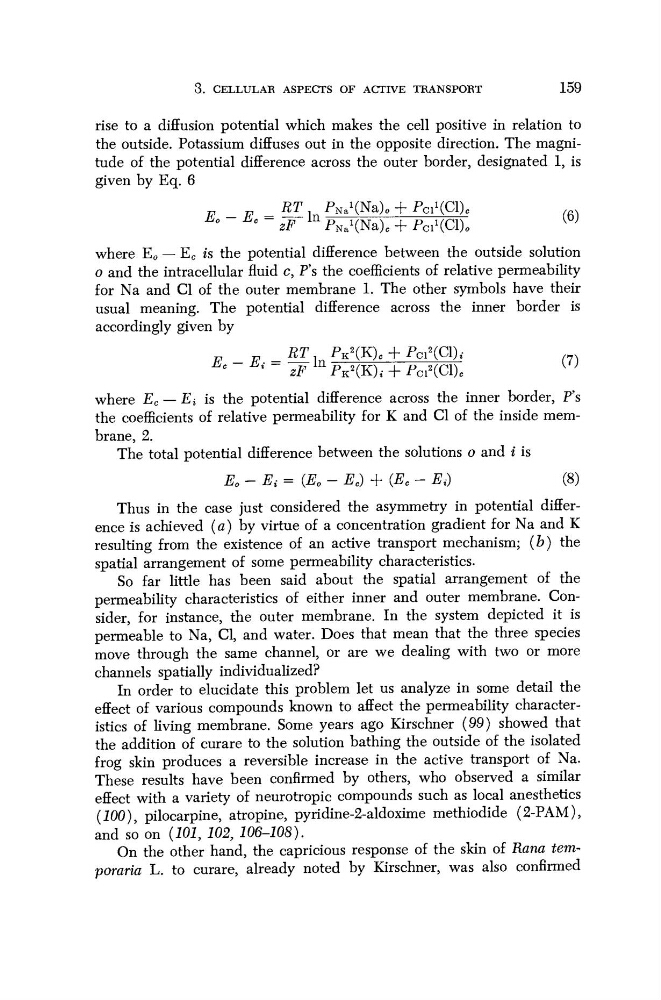
the outside. Potassium diffuses out in the opposite direction. The magnitude of the potential difference across the outer border, designated 1, is
given by Eq. 6
where E 0 — E c is the potential difference between the outside solution
ο and the intracellular fluid c, P's the coefficients of relative permeability
for Na and CI of the outer membrane 1. The other symbols have their
usual meaning. The potential difference across the inner border is
accordingly given by
F - F =
*V(K) C + Pci
2 (ClXu c
z
F
in P K 2 ( K) . + p C L 2(d) c
^
where E c — Ei is the potential difference across the inner border, P's
the coefficients of relative permeability for Κ and CI of the inside membrane, 2.
The total potential difference between the solutions ο and i is
Eo - Ei = (E 0 - E e ) + (E e - E x )
(8)
Thus in the case just considered the asymmetry in potential difference is achieved (α) by virtue of a concentration gradient for Na and Κ
resulting from the existence of an active transport mechanism; (6) the
spatial arrangement of some permeability characteristics.
So far little has been said about the spatial arrangement of the
permeability characteristics of either inner and outer membrane. Consider, for instance, the outer membrane. In the system depicted it is
permeable to Na, CI, and water. Does that mean that the three species
move through the same channel, or are we dealing with two or more
channels spatially individualized?
In order to elucidate this problem let us analyze in some detail the
effect of various compounds known to affect the permeability characteristics of living membrane. Some years ago Kirschner (99) showed that
the addition of curare to the solution bathing the outside of the isolated
frog skin produces a reversible increase in the active transport of Na.
These results have been confirmed by others, who observed a similar
effect with a variety of neurotropic compounds such as local anesthetics
(100), pilocarpine, atropine, pyridine-2-aldoxime methiodide (2-PAM),
and so on (101, 102, 106-108).
On the other hand, the capricious response of the skin of Rana temporaria L. to curare, already noted by Kirschner, was also confirmed
159
rise to a diffusion potential which makes the cell positive in relation to
the outside. Potassium diffuses out in the opposite direction. The magnitude of the potential difference across the outer border, designated 1, is
given by Eq. 6
where E 0 — E c is the potential difference between the outside solution
ο and the intracellular fluid c, P's the coefficients of relative permeability
for Na and CI of the outer membrane 1. The other symbols have their
usual meaning. The potential difference across the inner border is
accordingly given by
F - F =
*V(K) C + Pci
2 (ClXu c
z
F
in P K 2 ( K) . + p C L 2(d) c
^
where E c — Ei is the potential difference across the inner border, P's
the coefficients of relative permeability for Κ and CI of the inside membrane, 2.
The total potential difference between the solutions ο and i is
Eo - Ei = (E 0 - E e ) + (E e - E x )
(8)
Thus in the case just considered the asymmetry in potential difference is achieved (α) by virtue of a concentration gradient for Na and Κ
resulting from the existence of an active transport mechanism; (6) the
spatial arrangement of some permeability characteristics.
So far little has been said about the spatial arrangement of the
permeability characteristics of either inner and outer membrane. Consider, for instance, the outer membrane. In the system depicted it is
permeable to Na, CI, and water. Does that mean that the three species
move through the same channel, or are we dealing with two or more
channels spatially individualized?
In order to elucidate this problem let us analyze in some detail the
effect of various compounds known to affect the permeability characteristics of living membrane. Some years ago Kirschner (99) showed that
the addition of curare to the solution bathing the outside of the isolated
frog skin produces a reversible increase in the active transport of Na.
These results have been confirmed by others, who observed a similar
effect with a variety of neurotropic compounds such as local anesthetics
(100), pilocarpine, atropine, pyridine-2-aldoxime methiodide (2-PAM),
and so on (101, 102, 106-108).
On the other hand, the capricious response of the skin of Rana temporaria L. to curare, already noted by Kirschner, was also confirmed