

94
P. W. KENT
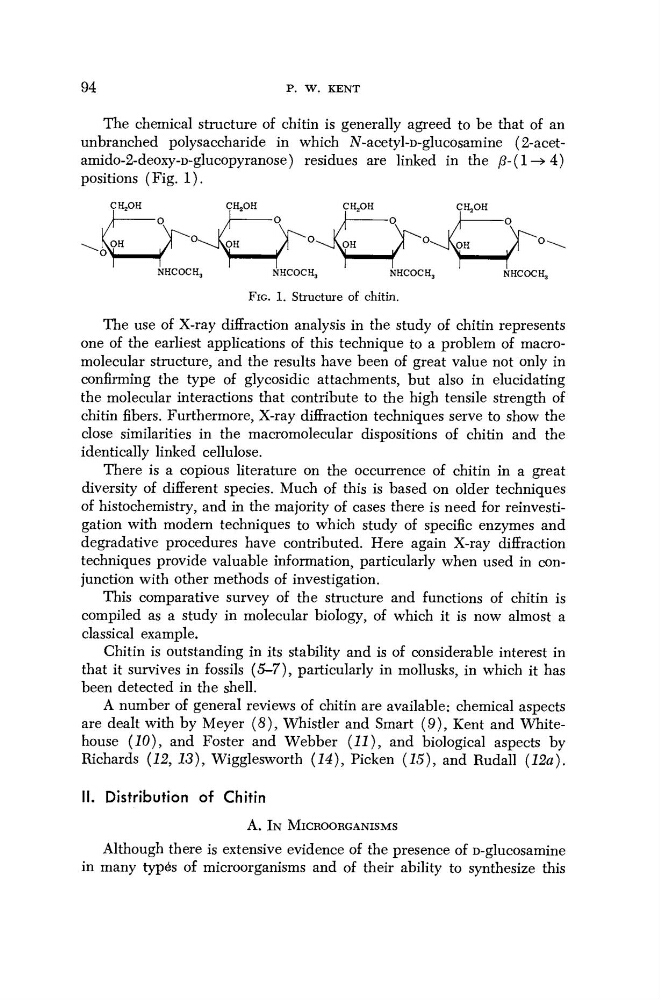
The chemical structure of chitin is generally agreed to be that of an
unbranched polysaccharide in which N-acetyl-D-glucosamine (2-acetamido-2-deoxy-D-glucopyranose) residues are linked in the /?-(l—>4)
positions (Fig. 1).
NHC0CH3
NHCOCH3
NHC0CH3
NHCOCH3
FIG. 1. Structure of chitin.
The use of X-ray diffraction analysis in the study of chitin represents
one of the earliest applications of this technique to a problem of macromolecular structure, and the results have been of great value not only in
confirming the type of glycosidic attachments, but also in elucidating
the molecular interactions that contribute to the high tensile strength of
chitin fibers. Furthermore, X-ray diffraction techniques serve to show the
close similarities in the macromolecular dispositions of chitin and the
identically linked cellulose.
There is a copious literature on the occurrence of chitin in a great
diversity of different species. Much of this is based on older techniques
of histochemistry, and in the majority of cases there is need for reinvestigation with modern techniques to which study of specific enzymes and
degradative procedures have contributed. Here again X-ray diffraction
techniques provide valuable information, particularly when used in conjunction with other methods of investigation.
This comparative survey of the structure and functions of chitin is
compiled as a study in molecular biology, of which it is now almost a
classical example.
Chitin is outstanding in its stability and is of considerable interest in
that it survives in fossils (5-7), particularly in mollusks, in which it has
been detected in the shell.
A number of general reviews of chitin are available: chemical aspects
are dealt with by Meyer (8), Whistler and Smart (9), Kent and Whitehouse (10), and Foster and Webber (11), and biological aspects by
Richards (12, 13), Wigglesworth (14), Picken (15), and Rudall (12a).
II. Distribution of Chitin
A. IN MICROORGANISMS
Although there is extensive evidence of the presence of D-glucosamine
in many typ^s of microorganisms and of their ability to synthesize this
P. W. KENT
The chemical structure of chitin is generally agreed to be that of an
unbranched polysaccharide in which N-acetyl-D-glucosamine (2-acetamido-2-deoxy-D-glucopyranose) residues are linked in the /?-(l—>4)
positions (Fig. 1).
NHC0CH3
NHCOCH3
NHC0CH3
NHCOCH3
FIG. 1. Structure of chitin.
The use of X-ray diffraction analysis in the study of chitin represents
one of the earliest applications of this technique to a problem of macromolecular structure, and the results have been of great value not only in
confirming the type of glycosidic attachments, but also in elucidating
the molecular interactions that contribute to the high tensile strength of
chitin fibers. Furthermore, X-ray diffraction techniques serve to show the
close similarities in the macromolecular dispositions of chitin and the
identically linked cellulose.
There is a copious literature on the occurrence of chitin in a great
diversity of different species. Much of this is based on older techniques
of histochemistry, and in the majority of cases there is need for reinvestigation with modern techniques to which study of specific enzymes and
degradative procedures have contributed. Here again X-ray diffraction
techniques provide valuable information, particularly when used in conjunction with other methods of investigation.
This comparative survey of the structure and functions of chitin is
compiled as a study in molecular biology, of which it is now almost a
classical example.
Chitin is outstanding in its stability and is of considerable interest in
that it survives in fossils (5-7), particularly in mollusks, in which it has
been detected in the shell.
A number of general reviews of chitin are available: chemical aspects
are dealt with by Meyer (8), Whistler and Smart (9), Kent and Whitehouse (10), and Foster and Webber (11), and biological aspects by
Richards (12, 13), Wigglesworth (14), Picken (15), and Rudall (12a).
II. Distribution of Chitin
A. IN MICROORGANISMS
Although there is extensive evidence of the presence of D-glucosamine
in many typ^s of microorganisms and of their ability to synthesize this