

80
F. B. SHORLAND
E. FATTY ACIDS OF NONADIPOSE TISSUE LIPIDS
Included in this category are the liver lipids of mammals which, unlike those of fish, are not important fat depots. Their fatty acid composition has been discussed in Section V,B,1, where it was shown that
the liver glycerides, and especially the liver phospholipids, are richer in
highly unsaturated C 20 and C 22 acids than are the depot fats. The organ
lipids, in general, appear to contain more highly unsaturated C 20 and
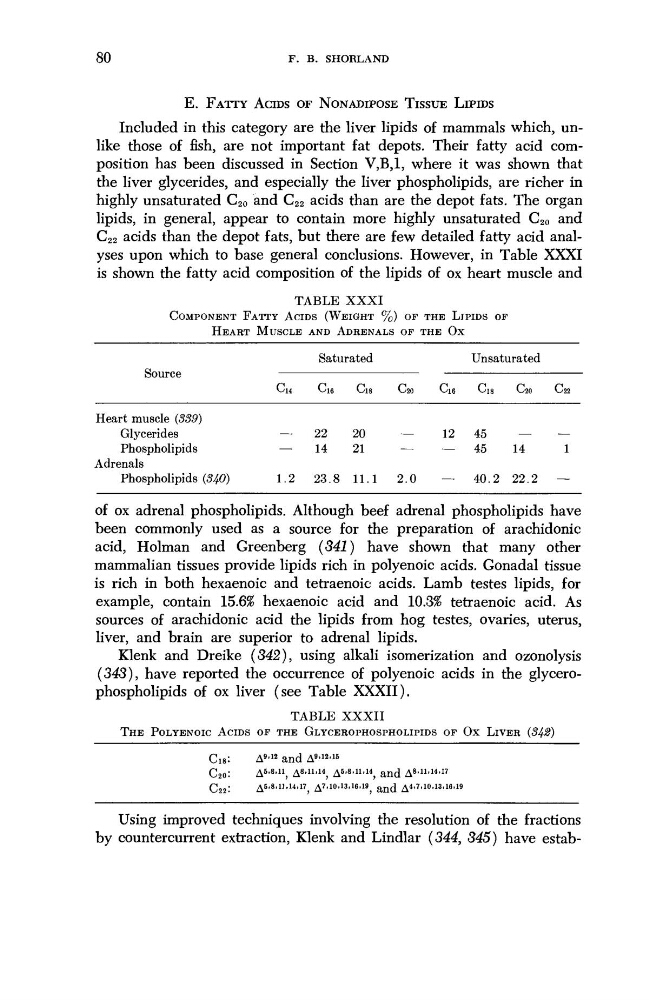
C 22 acids than the depot fats, but there are few detailed fatty acid analyses upon which to base general conclusions. However, in Table XXXI
is shown the fatty acid composition of the lipids of ox heart muscle and
TABLE XXXI
COMPONENT FATTY ACIDS (WEIGHT %) OF THE LIPIDS OF
HEART MUSCLE AND ADRENALS OF THE OX
Saturated
Unsaturated
Source
C14
Cl6
Cl8
C20
Ci6
Ci8
C20
C22
Heart muscle (339)
Glycerides
—
22
20
—
12
45
—
—
Phospholipids
—
14
21
—
—
45
14
1
Adrenals
Phospholipids (340)
1.2
23.8 11.1
2.0
—
40.2 22.2
—
of ox adrenal phospholipids. Although beef adrenal phospholipids have
been commonly used as a source for the preparation of arachidonic
acid, Holman and Greenberg (341) have shown that many other
mammalian tissues provide lipids rich in polyenoic acids. Gonadal tissue
is rich in both hexaenoic and tetraenoic acids. Lamb testes lipids, for
example, contain 15.6% hexaenoic acid and 10.3% tetraenoic acid. As
sources of arachidonic acid the lipids from hog testes, ovaries, uterus,
liver, and brain are superior to adrenal lipids.
Klenk and Dreike (342), using alkali isomerization and ozonolysis
(343), have reported the occurrence of polyenoic acids in the glycerophospholipids of ox liver (see Table XXXII).
TABLE XXXII
THE POLYENOIC ACIDS OF THE GLYCEROPHOSPHOLIPIDS OF OX LIVER (342)
Δ
9 '
12 and Δ
9
'
12
-
15
^5.8,11 ^8,11.14 ^5,8,11,14 and Δ
8 ·
1 1 , 1 4 , 1
7
^5,8.11,14,17 ^7,10,13,16,19
a n (
J ^4,7,10,13,16,19
Using improved techniques involving the resolution of the fractions
by countercurrent extraction, Klenk and Lindlar (344, 345) have estab<^18
C20
C99.
F. B. SHORLAND
E. FATTY ACIDS OF NONADIPOSE TISSUE LIPIDS
Included in this category are the liver lipids of mammals which, unlike those of fish, are not important fat depots. Their fatty acid composition has been discussed in Section V,B,1, where it was shown that
the liver glycerides, and especially the liver phospholipids, are richer in
highly unsaturated C 20 and C 22 acids than are the depot fats. The organ
lipids, in general, appear to contain more highly unsaturated C 20 and
C 22 acids than the depot fats, but there are few detailed fatty acid analyses upon which to base general conclusions. However, in Table XXXI
is shown the fatty acid composition of the lipids of ox heart muscle and
TABLE XXXI
COMPONENT FATTY ACIDS (WEIGHT %) OF THE LIPIDS OF
HEART MUSCLE AND ADRENALS OF THE OX
Saturated
Unsaturated
Source
C14
Cl6
Cl8
C20
Ci6
Ci8
C20
C22
Heart muscle (339)
Glycerides
—
22
20
—
12
45
—
—
Phospholipids
—
14
21
—
—
45
14
1
Adrenals
Phospholipids (340)
1.2
23.8 11.1
2.0
—
40.2 22.2
—
of ox adrenal phospholipids. Although beef adrenal phospholipids have
been commonly used as a source for the preparation of arachidonic
acid, Holman and Greenberg (341) have shown that many other
mammalian tissues provide lipids rich in polyenoic acids. Gonadal tissue
is rich in both hexaenoic and tetraenoic acids. Lamb testes lipids, for
example, contain 15.6% hexaenoic acid and 10.3% tetraenoic acid. As
sources of arachidonic acid the lipids from hog testes, ovaries, uterus,
liver, and brain are superior to adrenal lipids.
Klenk and Dreike (342), using alkali isomerization and ozonolysis
(343), have reported the occurrence of polyenoic acids in the glycerophospholipids of ox liver (see Table XXXII).
TABLE XXXII
THE POLYENOIC ACIDS OF THE GLYCEROPHOSPHOLIPIDS OF OX LIVER (342)
Δ
9 '
12 and Δ
9
'
12
-
15
^5.8,11 ^8,11.14 ^5,8,11,14 and Δ
8 ·
1 1 , 1 4 , 1
7
^5,8.11,14,17 ^7,10,13,16,19
a n (
J ^4,7,10,13,16,19
Using improved techniques involving the resolution of the fractions
by countercurrent extraction, Klenk and Lindlar (344, 345) have estab<^18
C20
C99.