

1. FATTY ACID OCCURRENCE AND DISTRIBUTION
79
in the rabbit sebum only 3.7% is present. The human hair fatty acids
consist of nearly half their total as n-unsaturated acids with octadecenoic as the main constituent, together with hexadecenoic acid. In
the guinea pig with its lower content of unsaturated acids octadecenoic
followed by nonadecenoic, not present in the other sebum lipids, are
the two prominent constituents. In the rat, octadecenoic is also the
main n-unsaturated constituent, followed by n-hexadecenoic acid, the
n-odd-numbered unsaturated acids being absent.
In wool grease the branched-chain acids make up the greater part
of the total and cover a wide range of carbon numbers, more than 2% of
each acid being found over the range C 14 to C 27 . In the sebum fats,
other than wool grease, branched-chain acids are present in much
smaller amounts. The rat sebum, however, is notable for its high content of Ci 8 branched-chain acids and for the occurrence of polybranched
C 20 acids. The rabbit sebum has important quantities of polybranched
C 17 and Ci 8 acids, and the most important branched-chain acid in the
guinea pig sebum is Ci 9 . The human sebum is comparable to that of
the mouse with its low content of branched-chain acids, but the two
kinds of sebum are differentiated by the differences in composition of
the branched-chain constituents.
Other fatty secretions of considerable interest are those of the preen
glands of birds. The coccygeal or preen glands are found in birds as a
special organ in place of the sebaceous glands distributed over the
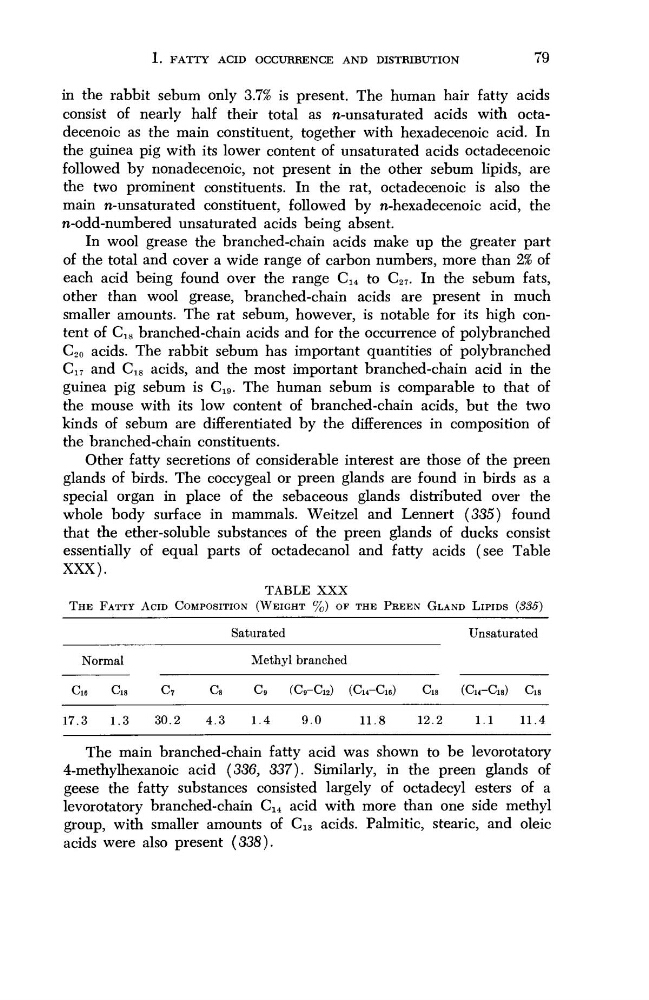
whole body surface in mammals. Weitzel and Lennert (335) found
that the ether-soluble substances of the preen glands of ducks consist
essentially of equal parts of octadecanol and fatty acids (see Table
XXX).
TABLE XXX
THE FATTY ACID COMPOSITION (WEIGHT %) OF THE PREEN GLAND LIPIDS (335)
Normal
Ci6
Ci8
17.3
1.3
c 7
30.2
c 8
4.3
Saturated
Methyl branched
C9
(C9-C12)
(C14—Cie)
1.4
9.0
11.8
Ci8
12.2
Unsaturated
(C14-C18)
Cie
1.1
11.4
The main branched-chain fatty acid was shown to be levorotatory
4-methylhexanoic acid (336, 337). Similarly, in the preen glands of
geese the fatty substances consisted largely of octadecyl esters of a
levorotatory branched-chain C 14 acid with more than one side methyl
group, with smaller amounts of Ci 3 acids. Palmitic, stearic, and oleic
acids were also present (338).
79
in the rabbit sebum only 3.7% is present. The human hair fatty acids
consist of nearly half their total as n-unsaturated acids with octadecenoic as the main constituent, together with hexadecenoic acid. In
the guinea pig with its lower content of unsaturated acids octadecenoic
followed by nonadecenoic, not present in the other sebum lipids, are
the two prominent constituents. In the rat, octadecenoic is also the
main n-unsaturated constituent, followed by n-hexadecenoic acid, the
n-odd-numbered unsaturated acids being absent.
In wool grease the branched-chain acids make up the greater part
of the total and cover a wide range of carbon numbers, more than 2% of
each acid being found over the range C 14 to C 27 . In the sebum fats,
other than wool grease, branched-chain acids are present in much
smaller amounts. The rat sebum, however, is notable for its high content of Ci 8 branched-chain acids and for the occurrence of polybranched
C 20 acids. The rabbit sebum has important quantities of polybranched
C 17 and Ci 8 acids, and the most important branched-chain acid in the
guinea pig sebum is Ci 9 . The human sebum is comparable to that of
the mouse with its low content of branched-chain acids, but the two
kinds of sebum are differentiated by the differences in composition of
the branched-chain constituents.
Other fatty secretions of considerable interest are those of the preen
glands of birds. The coccygeal or preen glands are found in birds as a
special organ in place of the sebaceous glands distributed over the
whole body surface in mammals. Weitzel and Lennert (335) found
that the ether-soluble substances of the preen glands of ducks consist
essentially of equal parts of octadecanol and fatty acids (see Table
XXX).
TABLE XXX
THE FATTY ACID COMPOSITION (WEIGHT %) OF THE PREEN GLAND LIPIDS (335)
Normal
Ci6
Ci8
17.3
1.3
c 7
30.2
c 8
4.3
Saturated
Methyl branched
C9
(C9-C12)
(C14—Cie)
1.4
9.0
11.8
Ci8
12.2
Unsaturated
(C14-C18)
Cie
1.1
11.4
The main branched-chain fatty acid was shown to be levorotatory
4-methylhexanoic acid (336, 337). Similarly, in the preen glands of
geese the fatty substances consisted largely of octadecyl esters of a
levorotatory branched-chain C 14 acid with more than one side methyl
group, with smaller amounts of Ci 3 acids. Palmitic, stearic, and oleic
acids were also present (338).