

698
R. H. THOMSON
such as 2-phenylglycerose. Read and Vining (309) thought that dimerization of two commonly available C 6 -C 3 straight-chain intermediates was more probable, and have shown, in preliminary tracer studies,
that highly active volucrisporin is produced when Volucrispom aurantiaca is grown in a nutrient medium containing C
14 -labeled shikimic
acid or L-phenylalanine. On the other hand neither labeled glycine,
tyrosine, 3,4-dihydroxyphenylalanine, nor acetate, cinnamate and caffeate, were incorporated into the mold metabolite. This implied that the
m-hydroxyl groups were introduced separately, and not derived from a
dihydroxylated intermediate. Read and Vining therefore proposed the
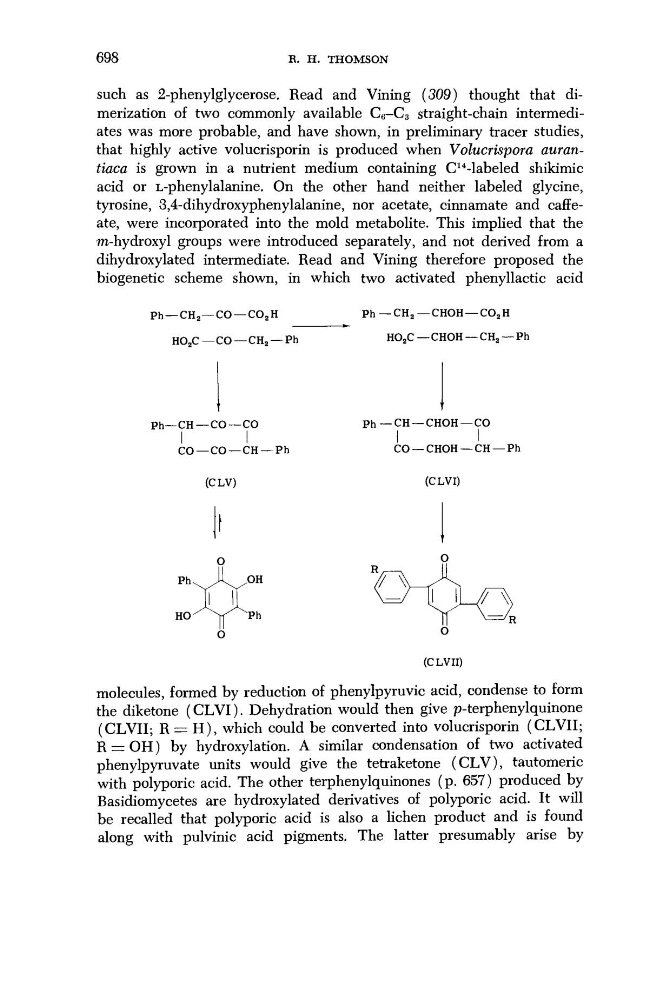
biogenetic scheme shown, in which two activated phenyllactic acid
Ph—CH 2 —CO —C0 2 H
HO,C—CO—CH 2 —Ph
Ph — CH 2 — CHOH —C0 2 H
HO,C— CHOH — CH 2 —Ph
Ph— CH—CO — CO
I
I
CO—CO—CH—Ph
(CLV)
Ph—CH—CHOH —CO
I
I
CO — CHOH — CH — Ph
(CLVI)
OH
(CLVII)
molecules, formed by reduction of phenylpyruvic acid, condense to form
the diketone (CLVI). Dehydration would then give p-terphenylquinone
(CLVII; R = H), which could be converted into volucrisporin (CLVII;
R = OH) by hydroxylation. A similar condensation of two activated
phenylpyruvate units would give the tetraketone (CLV), tautomeric
with polyporic acid. The other terphenylquinones (p. 657) produced by
Basidiomycetes are hydroxylated derivatives of polyporic acid. It will
be recalled that polyporic acid is also a lichen product and is found
along with pulvinic acid pigments. The latter presumably arise by