

12. QUINONES: STRUCTURE AND DISTRIBUTION
697
Glucose
ΟΟ,,Η
I
c=o
I
CH 2
-*- HO —C —H
I
H —C—OH
I
H—C—OH
ΗΟ^,ΟΟ,,Η
OH
OH
CH 2 —ΟΡθ3Η 2 5-Dehydroquinic acid
ΟΟ,Η
CO^
CO^
Ο^ T
OH
HO
T
OH Η,ρ,,ΡΟ
Τ
OH
OH
OH
OH
5-Dehydroshikimic acid
Shikimic acid
Shikimic acid
5-phosphate
H0 2 C
CHaCOCOjjH
CH 2 COC0 2 H
. Phenylpyruvic acid
p -Hydroxyphenyllactic acid -
Phenylalanine
Tyrosine
Prephenic acid
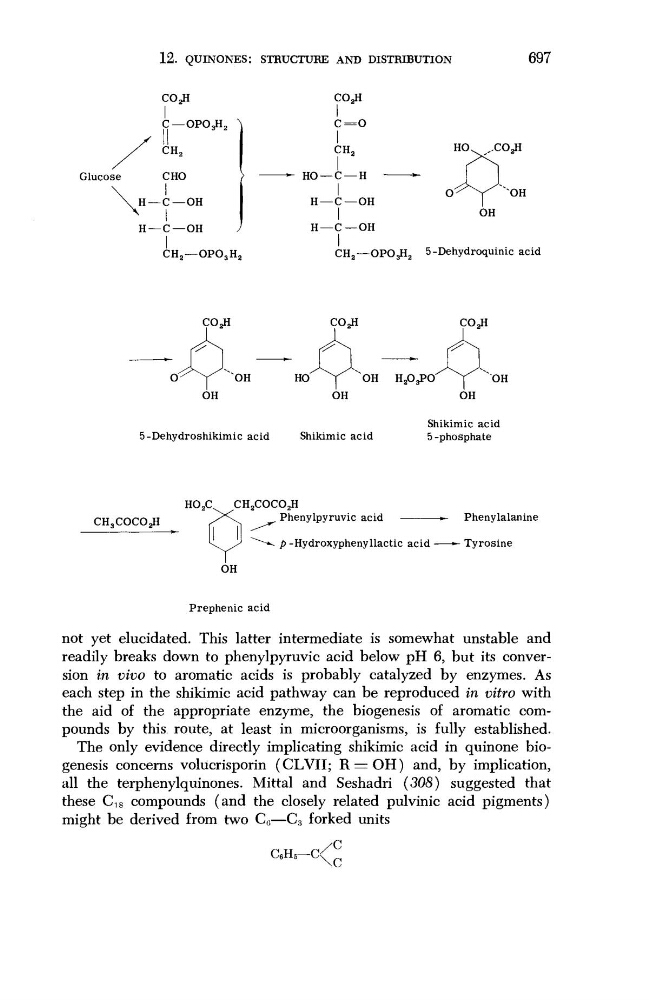
not yet elucidated. This latter intermediate is somewhat unstable and
readily breaks down to phenylpyruvic acid below pH 6, but its conversion in vivo to aromatic acids is probably catalyzed by enzymes. As
each step in the shikimic acid pathway can be reproduced in vitro with
the aid of the appropriate enzyme, the biogenesis of aromatic compounds by this route, at least in microorganisms, is fully established.
The only evidence directly implicating shikimic acid in quinone biogenesis concerns volucrisporin (CLVII; R = OH) and, by implication,
all the terphenylquinones. Mittal and Seshadri (308) suggested that
these C 18 compounds (and the closely related pulvinic acid pigments)
might be derived from two C G —C 3 forked units
C 6 H 5 —O
\c