

670
R. H. THOMSON
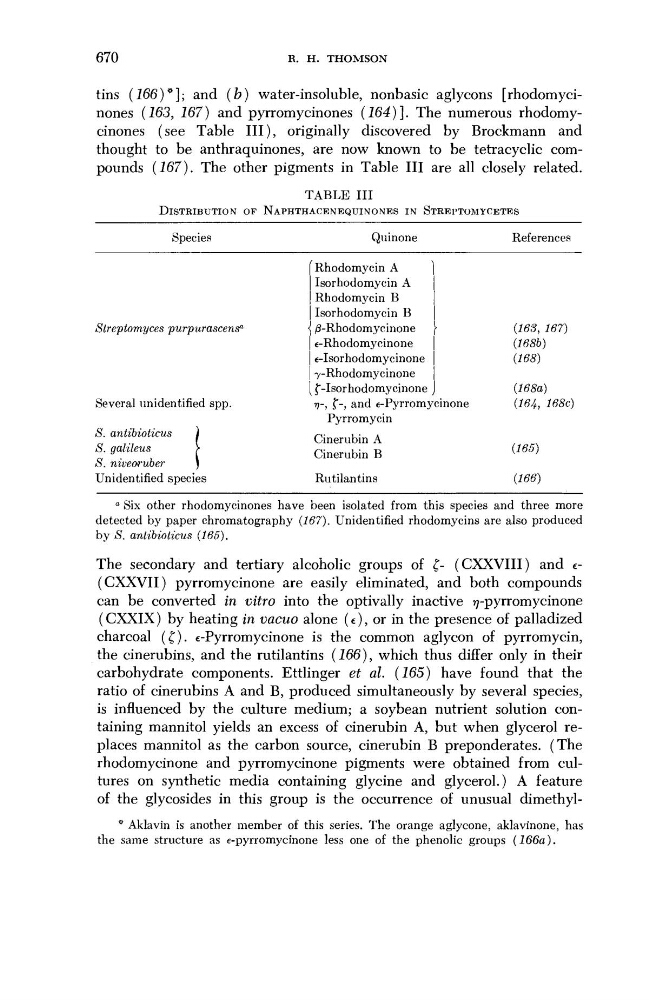
tins (166)*]; and (b) water-insoluble, nonbasic aglycons [rhodomycinones (163, 167) and pyrromycinones (164)]. The numerous rhodomycinones (see Table III), originally discovered by Brockmann and
thought to be anthraquinones, are now known to be tetracyclic compounds (167). The other pigments in Table III are all closely related.
TABLE III
DISTRIBUTION OF NAPHTHACENEQUINONES IN STREPTOMYCETES
Species
Streptomyces purpurascens
a
<
Several unidentified spp.
S. antibioticus
)
S. galileus
>
S. niveoruber
)
Unidentified species
Quinone
Rhodomycin A
Isorhodomycin A
Rhodomycin B
Isorhodomycin B
ß-Rhodomycinone
e-Rhodomycinone
e-Isorhodomycinone
γ-Rhodomycinone
^ f-Isorhodomycinone j
η-, ζ-, and e-Pyrromy
Pyrromycin
Cinerubin A
Cinerubin B
Rutilantins
References
(163, 167)
(168b)
(168)
(168a)
cinone
(164, 168c)
(165)
(166)
a Six other rhodomycinones have been isolated from this species and three more
detected by paper chromatography (167). Unidentified rhodomycins are also produced
by S. antibioticus (165).
The secondary and tertiary alcoholic groups of ζ- (CXXVIII) and e(CXXVII) pyrromycinone are easily eliminated, and both compounds
can be converted in vitro into the optivally inactive ^-pyrromycinone
(CXXIX) by heating in vacuo alone (e), or in the presence of palladized
charcoal (ζ). e-Pyrromycinone is the common aglycon of pyrromycin,
the cinerubins, and the rutilantins (166), which thus differ only in their
carbohydrate components. Ettlinger et al. (165) have found that the
ratio of cinerubins A and B, produced simultaneously by several species,
is influenced by the culture medium; a soybean nutrient solution containing mannitol yields an excess of cinerubin A, but when glycerol replaces mannitol as the carbon source, cinerubin B preponderates. (The
rhodomycinone and pyrromycinone pigments were obtained from cultures on synthetic media containing glycine and glycerol.) A feature
of the glycosides in this group is the occurrence of unusual dimethyl* Aklavin is another member of this series. The orange aglycone, aklavinone, has
the same structure as e-pyrromycinone less one of the phenolic groups (166a).