

634
R. H. THOMSON
primary or secondary amines, are of great importance in the formation
of certain complex polyquinonoid structures and may be significant in
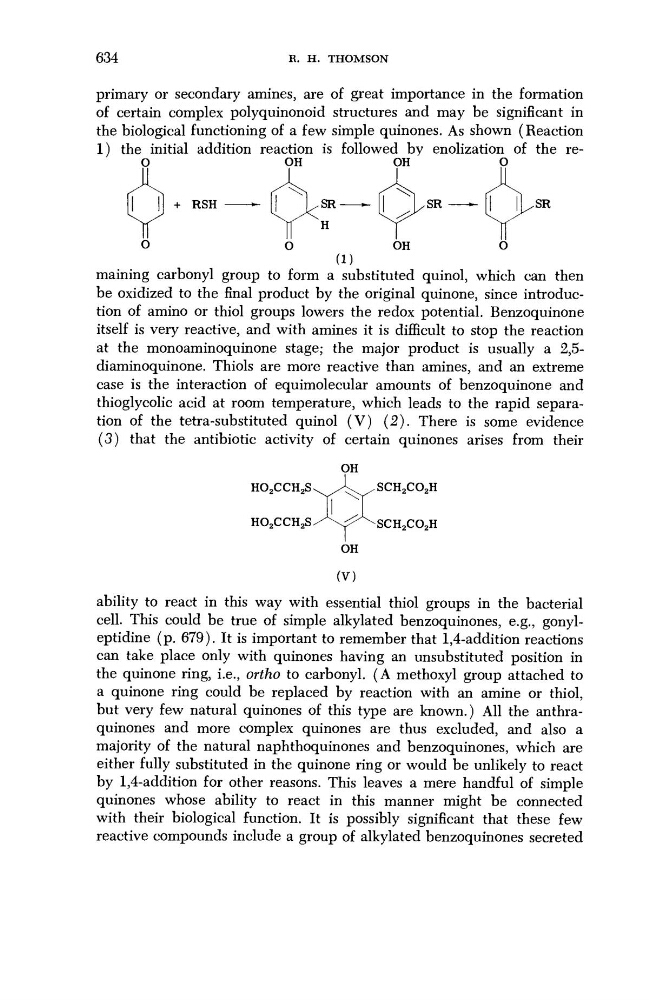
the biological functioning of a few simple quinones. As shown (Reaction
1) the initial addition reaction is followed by enolization of the reO
OH
OH
p
RSH
O
O
OH
O
(1)
maining carbonyl group to form a substituted quinol, which can then
be oxidized to the final product by the original quinone, since introduction of amino or thiol groups lowers the redox potential. Benzoquinone
itself is very reactive, and with amines it is difficult to stop the reaction
at the monoaminoquinone stage; the major product is usually a 2,5diaminoquinone. Thiols are more reactive than amines, and an extreme
case is the interaction of equimolecular amounts of benzoquinone and
thioglycolic acid at room temperature, which leads to the rapid separation of the tetra-substituted quinol (V) (2). There is some evidence
(3) that the antibiotic activity of certain quinones arises from their
OH
H0 2 CCH 2 S\ J\ /SCH 2 C0 2 H
H0 2 CCH 2 S/
/ \^\SCH 2 C0 2 H
(V)
ability to react in this way with essential thiol groups in the bacterial
cell. This could be true of simple alleviated benzoquinones, e.g., gonyleptidine (p. 679). It is important to remember that 1,4-addition reactions
can take place only with quinones having an unsubstituted position in
the quinone ring, i.e., ortho to carbonyl. (A methoxyl group attached to
a quinone ring could be replaced by reaction with an amine or thiol,
but very few natural quinones of this type are known.) All the anthraquinones and more complex quinones are thus excluded, and also a
majority of the natural naphthoquinones and benzoquinones, which are
either fully substituted in the quinone ring or would be unlikely to react
by 1,4-addition for other reasons. This leaves a mere handful of simple
quinones whose ability to react in this manner might be connected
with their biological function. It is possibly significant that these few
reactive compounds include a group of alkylated benzoquinones secreted