

12. QUINONES: STRUCTURE AND DISTRIBUTION
633
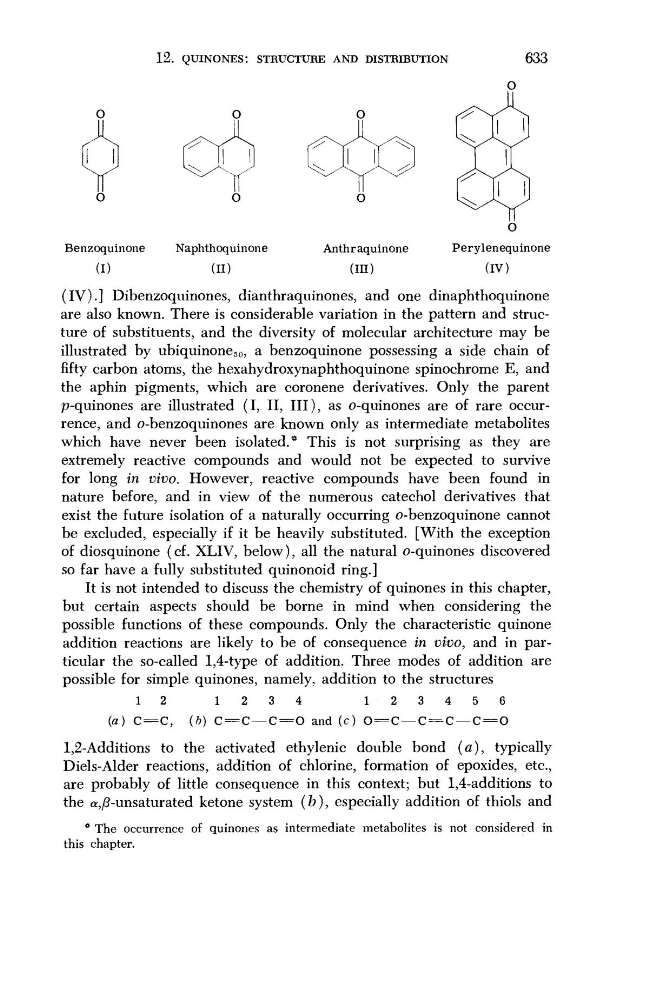
Benzoquinone
Naphthoquinone
Anthraquinone
Perylenequinone
(I)
(ID
(III)
(IV)
(IV).] Dibenzoquinones, dianthraquinones, and one dinaphthoquinone
are also known. There is considerable variation in the pattern and structure of substituents, and the diversity of molecular architecture may be
illustrated by ubiquinone 50 , a benzoquinone possessing a side chain of
fifty carbon atoms, the hexahydroxynaphthoquinone spinochrome E, and
the aphin pigments, which are coronene derivatives. Only the parent
p-quinones are illustrated (I, II, III), as o-quinones are of rare occurrence, and o-benzoquinones are known only as intermediate metabolites
which have never been isolated.* This is not surprising as they are
extremely reactive compounds and would not be expected to survive
for long in vivo. However, reactive compounds have been found in
nature before, and in view of the numerous catechol derivatives that
exist the future isolation of a naturally occurring o-benzoquinone cannot
be excluded, especially if it be heavily substituted. [With the exception
of diosquinone (cf. XLIV, below), all the natural o-quinones discovered
so far have a fully substituted quinonoid ring.]
It is not intended to discuss the chemistry of quinones in this chapter,
but certain aspects should be borne in mind when considering the
possible functions of these compounds. Only the characteristic quinone
addition reactions are likely to be of consequence in vivo, and in particular the so-called 1,4-type of addition. Three modes of addition are
possible for simple quinones, namely, addition to the structures
12
1234
123456
(a) C=C,
(b) C = C —C=0 and (c) 0=C —C = C—C=0
1,2-Additions to the activated ethylenic double bond (a), typically
Diels-Alder reactions, addition of chlorine, formation of epoxides, etc.,
are probably of little consequence in this context; but 1,4-additions to
the α,β-unsaturated ketone system (b), especially addition of thiols and
* The occurrence of quinones as intermediate metabolites is not considered in
this chapter.