

1. FATTY ACID OCCURRENCE AND DISTRIBUTION
49
are found in the seed fats of many members of the Flacourtiaceae, but
not elsewhere (3). The only other known occurrence of cyclic acids in
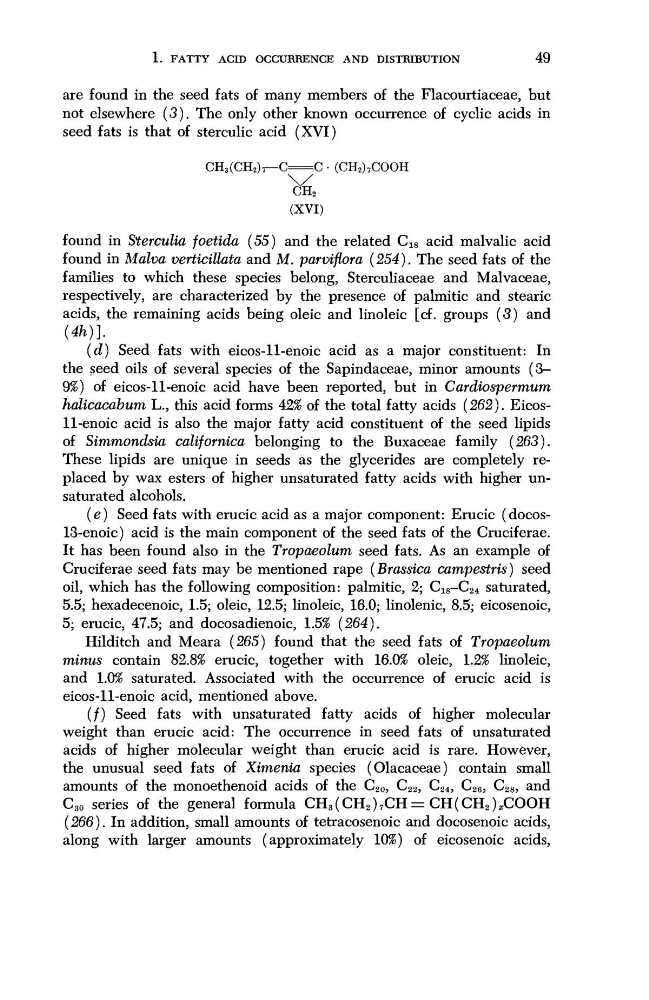
seed fats is that of sterculic acid (XVI)
CH 3 (CH 2 ) 7 —C=C · (CH 2 ) 7 COOH
\κ
CH 2
(XVI)
found in Sterculia foetida (55) and the related Ci 8 acid malvalic acid
found in Malva verticillata and M. parviflora (254). The seed fats of the
families to which these species belong, Sterculiaceae and Malvaceae,
respectively, are characterized by the presence of palmitic and stearic
acids, the remaining acids being oleic and linoleic [cf. groups (3) and
(4h)].
(d) Seed fats with eicos-11-enoic acid as a major constituent: In
the seed oils of several species of the Sapindaceae, minor amounts (39%) of eicos-11-enoic acid have been reported, but in Cardiospermum
halicacabum L., this acid forms 42% of the total fatty acids (262). Eicos11-enoic acid is also the major fatty acid constituent of the seed lipids
of Simmondsia californica belonging to the Buxaceae family (263).
These lipids are unique in seeds as the glycerides are completely replaced by wax esters of higher unsaturated fatty acids with higher unsaturated alcohols.
(e) Seed fats with erucic acid as a major component: Erucic (docos13-enoic) acid is the main component of the seed fats of the Cruciferae.
It has been found also in the Tropaeolum seed fats. As an example of
Cruciferae seed fats may be mentioned rape (Brassica campestris) seed
oil, which has the following composition: palmitic, 2; Ci 8 -C 24 saturated,
5.5; hexadecenoic, 1.5; oleic, 12.5; linoleic, 16.0; linolenic, 8.5; eicosenoic,
5; erucic, 47.5; and docosadienoic, 1.5% (264).
Hilditch and Meara (265) found that the seed fats of Tropaeolum
minus contain 82.8% erucic, together with 16.0% oleic, 1.2% linoleic,
and 1.0% saturated. Associated with the occurrence of erucic acid is
eicos-11-enoic acid, mentioned above.
(/) Seed fats with unsaturated fatty acids of higher molecular
weight than erucic acid: The occurrence in seed fats of unsaturated
acids of higher molecular weight than erucic acid is rare. However,
the unusual seed fats of Ximenia species (Olacaceae) contain small
amounts of the monoethenoid acids of the C 20 , C 22 , C 24 , C 26 , C 28 , and
C 30 series of the general formula CH 3 (CH 2 ) 7 CH = CH(CH 2 ) a? COOH
(266). In addition, small amounts of tetracosenoic and docosenoic acids,
along with larger amounts (approximately 10%) of eicosenoic acids,
49
are found in the seed fats of many members of the Flacourtiaceae, but
not elsewhere (3). The only other known occurrence of cyclic acids in
seed fats is that of sterculic acid (XVI)
CH 3 (CH 2 ) 7 —C=C · (CH 2 ) 7 COOH
\κ
CH 2
(XVI)
found in Sterculia foetida (55) and the related Ci 8 acid malvalic acid
found in Malva verticillata and M. parviflora (254). The seed fats of the
families to which these species belong, Sterculiaceae and Malvaceae,
respectively, are characterized by the presence of palmitic and stearic
acids, the remaining acids being oleic and linoleic [cf. groups (3) and
(4h)].
(d) Seed fats with eicos-11-enoic acid as a major constituent: In
the seed oils of several species of the Sapindaceae, minor amounts (39%) of eicos-11-enoic acid have been reported, but in Cardiospermum
halicacabum L., this acid forms 42% of the total fatty acids (262). Eicos11-enoic acid is also the major fatty acid constituent of the seed lipids
of Simmondsia californica belonging to the Buxaceae family (263).
These lipids are unique in seeds as the glycerides are completely replaced by wax esters of higher unsaturated fatty acids with higher unsaturated alcohols.
(e) Seed fats with erucic acid as a major component: Erucic (docos13-enoic) acid is the main component of the seed fats of the Cruciferae.
It has been found also in the Tropaeolum seed fats. As an example of
Cruciferae seed fats may be mentioned rape (Brassica campestris) seed
oil, which has the following composition: palmitic, 2; Ci 8 -C 24 saturated,
5.5; hexadecenoic, 1.5; oleic, 12.5; linoleic, 16.0; linolenic, 8.5; eicosenoic,
5; erucic, 47.5; and docosadienoic, 1.5% (264).
Hilditch and Meara (265) found that the seed fats of Tropaeolum
minus contain 82.8% erucic, together with 16.0% oleic, 1.2% linoleic,
and 1.0% saturated. Associated with the occurrence of erucic acid is
eicos-11-enoic acid, mentioned above.
(/) Seed fats with unsaturated fatty acids of higher molecular
weight than erucic acid: The occurrence in seed fats of unsaturated
acids of higher molecular weight than erucic acid is rare. However,
the unusual seed fats of Ximenia species (Olacaceae) contain small
amounts of the monoethenoid acids of the C 20 , C 22 , C 24 , C 26 , C 28 , and
C 30 series of the general formula CH 3 (CH 2 ) 7 CH = CH(CH 2 ) a? COOH
(266). In addition, small amounts of tetracosenoic and docosenoic acids,
along with larger amounts (approximately 10%) of eicosenoic acids,