

40
F. B. SHORLAND
Of the other groups of bacteria which have received detailed attention may be mentioned the lactobacilli. Those examined by Hofmann
and co-workers include L. arabinosis, L. casei, and L. delbrueckii. Their
lipids contain, in addition to the series of n-saturated (mainly palmitic)
acids, octadec-cis-11-enoic, and lactobacillic acids (XIV).
|-CH 2 -|
CH 3 (CH 2 ) 5 —CH
CH(CH 2 ) 9 COOH
(XIV)
The last two acids are also main constituents of Phytomonas tumefaciens. On the other hand, the Streptococcus species has ds-vaccenic
but no lactobacillic acid (206).
The bacterial lipids have been studied in a somewhat fragmentary
manner, but the lipids have been shown to vary greatly in the different
species. The complex lipids present in tubercle bacilli contain unique
types of branched-chain fatty acids whereas the lactobacilli are unusual in elaborating lactobacillic and cfc-vaccenic acids. Apart from
cis-vaccenic acid the fatty acids of Streptococcus species show no unusual features (207). The absence of sterols distinguishes bacteria from
other forms of life (198).
The pattern of fatty acid occurrence in bacterial lipids thus shows a
uniqueness, and at the same time a diversity between different groups
of bacteria.
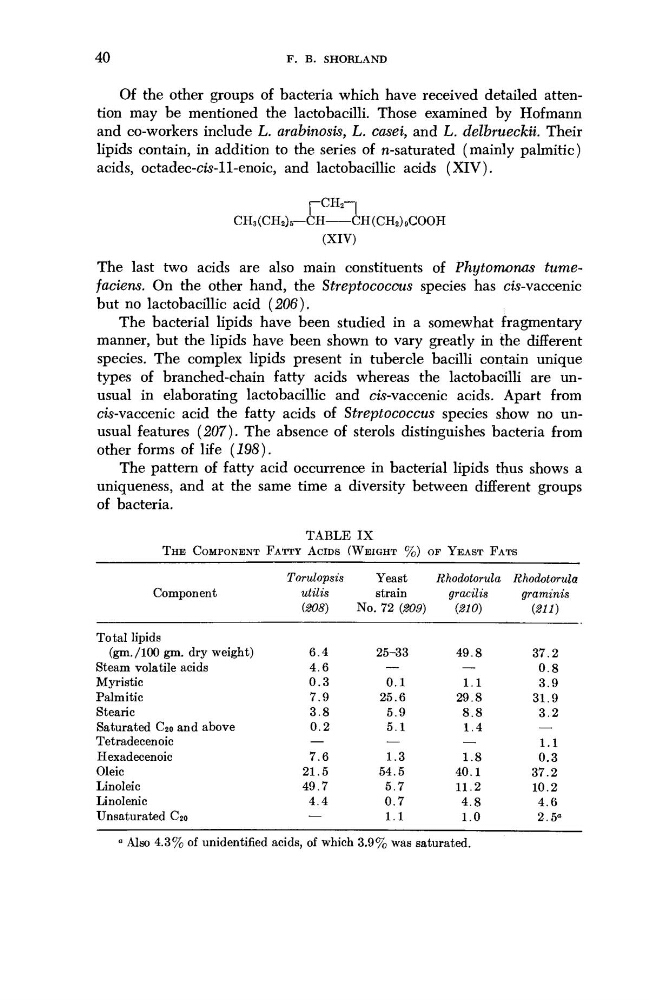
TABLE IX
THE COMPONENT FATTY ACIDS (WEIGHT %) OF YEAST FATS
Torulopsis
Yeast
Rhodotorula
Rhodotorula
Component
utilis
strain
gracilis
graminis
(208)
No. 72 (209)
(210)
(211)
Total lipids
(gm. /100 gm. dry weight)
Steam volatile acids
Myristic
Palmitic
Stearic
Saturated C 2 o and above
Tetradecenoic
Hexadecenoic
Oleic
Linoleic
Linolenic
Unsaturated C20
6.4
25-33
4.6
—
0.3
0.1
7.9
25.6
3.8
5.9
0.2
5.1
7.6
1.3
21.5
54.5
49.7
5.7
4.4
0.7
—
1.1
49.8
—
1.1
29.8
8.8
1.4
—
1.8
40.1
11.2
4.8
1.0
37.2
0.8
3.9
31.9
3.2
—
1.1
0.3
37.2
10.2
4.6
2.5*
0 Also 4.3% of unidentified acids, of which 3.9% was saturated.
F. B. SHORLAND
Of the other groups of bacteria which have received detailed attention may be mentioned the lactobacilli. Those examined by Hofmann
and co-workers include L. arabinosis, L. casei, and L. delbrueckii. Their
lipids contain, in addition to the series of n-saturated (mainly palmitic)
acids, octadec-cis-11-enoic, and lactobacillic acids (XIV).
|-CH 2 -|
CH 3 (CH 2 ) 5 —CH
CH(CH 2 ) 9 COOH
(XIV)
The last two acids are also main constituents of Phytomonas tumefaciens. On the other hand, the Streptococcus species has ds-vaccenic
but no lactobacillic acid (206).
The bacterial lipids have been studied in a somewhat fragmentary
manner, but the lipids have been shown to vary greatly in the different
species. The complex lipids present in tubercle bacilli contain unique
types of branched-chain fatty acids whereas the lactobacilli are unusual in elaborating lactobacillic and cfc-vaccenic acids. Apart from
cis-vaccenic acid the fatty acids of Streptococcus species show no unusual features (207). The absence of sterols distinguishes bacteria from
other forms of life (198).
The pattern of fatty acid occurrence in bacterial lipids thus shows a
uniqueness, and at the same time a diversity between different groups
of bacteria.
TABLE IX
THE COMPONENT FATTY ACIDS (WEIGHT %) OF YEAST FATS
Torulopsis
Yeast
Rhodotorula
Rhodotorula
Component
utilis
strain
gracilis
graminis
(208)
No. 72 (209)
(210)
(211)
Total lipids
(gm. /100 gm. dry weight)
Steam volatile acids
Myristic
Palmitic
Stearic
Saturated C 2 o and above
Tetradecenoic
Hexadecenoic
Oleic
Linoleic
Linolenic
Unsaturated C20
6.4
25-33
4.6
—
0.3
0.1
7.9
25.6
3.8
5.9
0.2
5.1
7.6
1.3
21.5
54.5
49.7
5.7
4.4
0.7
—
1.1
49.8
—
1.1
29.8
8.8
1.4
—
1.8
40.1
11.2
4.8
1.0
37.2
0.8
3.9
31.9
3.2
—
1.1
0.3
37.2
10.2
4.6
2.5*
0 Also 4.3% of unidentified acids, of which 3.9% was saturated.